
TL;DR:
- Weekly KPI reporting provides real-time visibility into performance trends, enabling early detection and swift action.
- Implementing a consistent process fosters accountability, improves team focus, and cultivates a results-oriented culture.
Picture this: your team is three weeks away from a quarterly deadline, and you're only now discovering that a key performance metric has been trending in the wrong direction for the past month. The data was there, but nobody looked at it. That scenario plays out in organizations of every size, and it's entirely preventable. Weekly KPI reporting creates the visibility and accountability structure that catches problems early, keeps teams aligned, and turns raw data into real action. This article walks you through exactly how to build that process, from the ground up.
Table of Contents
- Understanding KPIs and the importance of weekly reporting
- Gathering requirements and preparing for weekly KPI reporting
- Step-by-step process for weekly KPI reporting
- Troubleshooting and avoiding common pitfalls
- What results to expect from weekly KPI reporting
- A fresh perspective: Why most teams underestimate weekly KPI reviews
- Streamline your KPI reporting with Outsprinter
- Frequently asked questions
Key Takeaways
| Point | Details |
|---|---|
| Weekly reviews drive results | Weekly KPI reporting enables faster detection of trends and quicker course corrections. |
| Preparation is essential | Successful KPI reporting starts with clear data sources, well-defined roles, and effective tools. |
| Consistency builds accountability | Regular cycles and transparent sharing are key to holding teams accountable and encouraging improvement. |
| Avoid common pitfalls | Recognize and address mistakes, such as vague KPIs or inconsistent reviews, to sustain process benefits. |
| Impact is measurable | Teams experience improved focus, morale, and performance when weekly KPI reporting is used well. |
Understanding KPIs and the importance of weekly reporting
A KPI, or key performance indicator, is a measurable value that shows how effectively your team is achieving a defined objective. For mid-level managers, relevant KPIs might include sales revenue per rep, ticket resolution time, project completion rates, customer satisfaction scores, or budget utilization percentages. These are not vanity metrics. They are the specific numbers that, when tracked closely, tell you whether your team is on track or drifting.
Monthly or quarterly reviews feel manageable on the surface, but they create a dangerous blind spot. By the time a problem shows up in a monthly summary, it has usually had weeks to compound. Tracking KPIs weekly helps teams respond faster to performance trends, giving you enough runway to course-correct before small issues become bigger structural problems. This is the core argument for a weekly cadence, and it's backed by how teams actually function in real work environments.
Understanding the weekly performance psychology behind regular reporting matters too. When people know their numbers will be reviewed every week, their behavior shifts. Accountability becomes part of the rhythm, not a once-a-quarter event. The feedback loop gets tighter, improvement becomes more continuous, and focus sharpens.
"Weekly tracking gives teams a real chance to course-correct before small issues become major failures."
The top benefits of weekly KPI reporting include:
- Real-time visibility into performance trends as they develop, not after the fact
- Better accountability because team members know results are reviewed consistently
- Improved team focus by keeping everyone aligned on what actually matters week to week
- Faster escalation of issues that need leadership attention before they become costly
Following weekly KPI tracking best practices from the start ensures you get the most from this reporting cadence rather than creating noise without action.
Gathering requirements and preparing for weekly KPI reporting
With the importance clear, let's look at what you need for an effective reporting process and how to structure your groundwork.
Before you run your first weekly report, you need to get a few things in order. Skipping this step is why so many reporting processes start strong and then fall apart by week four. Solid preparation is not optional. It's what separates a reporting habit that drives performance from one that just adds work.
Here is what you need to gather before you start:
- Data sources: Identify exactly where your KPI data lives. Is it a CRM, a project management tool, a customer support platform, or a spreadsheet?
- Access and permissions: Make sure the right people can view and enter data into your reporting system.
- Defined KPIs: Narrow down to three to seven KPIs per team or function. Too many metrics dilute focus.
- Designated roles: Assign who collects data, who reviews it, who facilitates the meeting, and who follows up on action items.
- Reporting tools: Decide whether you'll use manual spreadsheets or a dedicated KPI management platform.
Speaking of tools, this comparison matters more than most teams realize:
| Feature | Manual spreadsheets | KPI management system |
|---|---|---|
| Setup speed | Fast initially | Takes one to three days upfront |
| Data accuracy | Prone to human error | Automated and consistent |
| Visibility | Limited to file access | Role-based, real-time access |
| Trend analysis | Manual charting required | Built-in visualizations |
| Scalability | Breaks down at scale | Handles multiple teams easily |
| Accountability tracking | Difficult to enforce | Built into workflows |
The trade-off is clear. Spreadsheets work for very small, simple setups, but they fail as your team grows or your reporting needs become more nuanced.

Setting clear KPI thresholds with color coding such as green for on target, yellow for approaching risk, and red for off track helps teams quickly spot areas needing attention without having to interpret raw numbers every time. This green/yellow/red system removes ambiguity from your weekly reviews. Everyone looks at the same dashboard and immediately knows where to focus.
For step-by-step KPI tracking that sticks, also consider how you'll handle building accountability with KPIs so the process reinforces ownership rather than surveillance.
Pro Tip: Always make KPI dashboards visible to all team members, not just managers. When everyone can see the same numbers, transparency builds naturally and peer accountability often reinforces the process better than top-down pressure ever could.
Step-by-step process for weekly KPI reporting
Now that your requirements are in place, let's map out each step in a successful weekly KPI reporting routine.
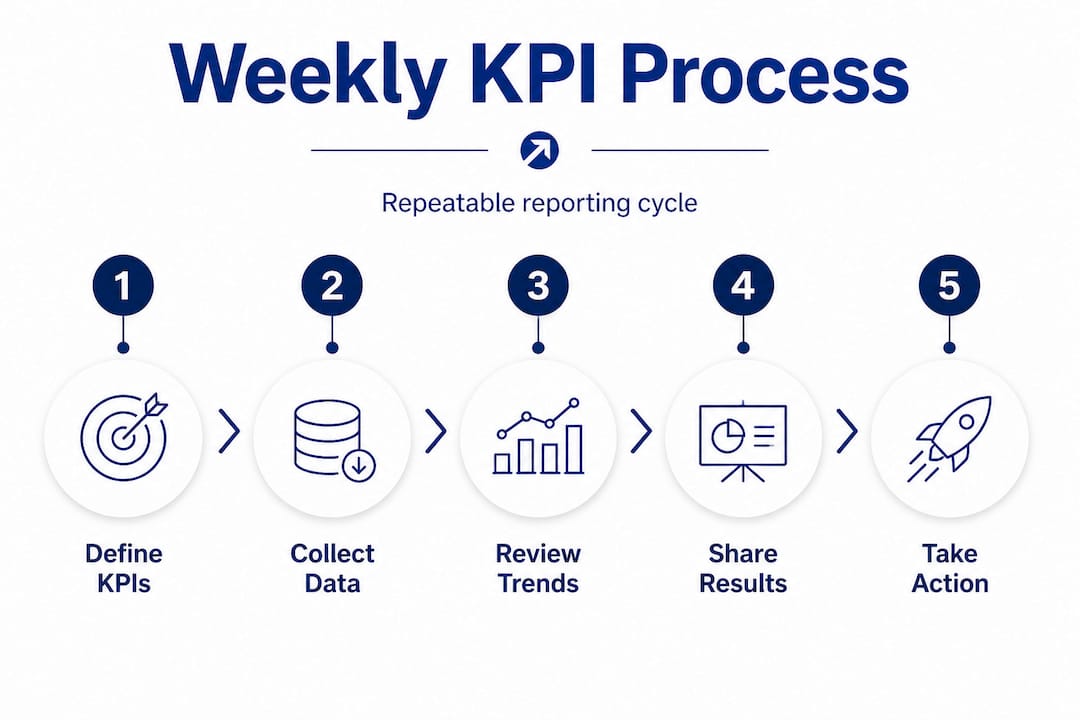
A good reporting process doesn't just happen. It follows a consistent structure that becomes second nature over time. Here's a sequence that works across most team types:
- Collect data on Monday or Tuesday morning, pulling figures from all relevant sources for the previous week.
- Enter or sync data into your reporting dashboard or KPI tracking tool, ensuring consistency in how numbers are recorded.
- Apply the green/yellow/red thresholds so status is visible at a glance before the review meeting.
- Distribute the report to all stakeholders by mid-week, giving people time to review before the meeting.
- Hold the weekly review meeting with the full team or relevant leads, focusing discussion on yellows and reds rather than reviewing every green line.
- Document action items from the meeting, assigning each one to a specific person with a clear deadline.
- Follow up on prior action items at the start of the next week's session to close the loop.
Turning goals into weekly action with KPIs maximizes results by aligning daily work with strategic objectives, which is exactly what this step-by-step process is designed to do. Without that alignment, weekly reports become bureaucratic exercises rather than performance drivers.
Here's what a practical weekly report structure looks like in practice:
| Report section | Example KPI | Target | Actual | Status |
|---|---|---|---|---|
| Sales activity | Calls made per rep | 50 | 47 | Yellow |
| Customer support | Tickets resolved | 200 | 218 | Green |
| Project delivery | Tasks completed on time | 90% | 78% | Red |
| Budget tracking | Spend vs. plan | 100% | 103% | Yellow |
| Team engagement | Tasks logged in system | 95% | 91% | Yellow |
This table structure is simple, but it drives focused conversation. Managers can see instantly where the discussion needs to go and where things are running smoothly.
The hidden costs of skipping KPIs become painfully apparent when a red line in a table like this goes unreviewed for three or four weeks. That's when a recoverable issue becomes a missed deadline or a lost client.
Pro Tip: Schedule your weekly review meeting at the exact same time every week, such as Wednesday at 10 a.m. Consistency reduces friction, prevents last-minute conflicts, and trains the team to treat the review as non-negotiable rather than optional.
Troubleshooting and avoiding common pitfalls
Once you have a process, staying consistent and avoiding mistakes is just as critical.
Even well-designed processes break down. Knowing the most common failure points in advance gives you a way to fix them before they derail your reporting habit entirely.
The most frequent mistakes teams make include:
- Inconsistent tracking: Data gets entered late, incompletely, or not at all. This makes trend analysis unreliable and meetings frustrating.
- Vague KPIs: Metrics like "improve customer satisfaction" without a specific number or method of measurement are impossible to track meaningfully.
- No follow-up on action items: Teams identify problems during the review but nobody owns the fix, so the same issue appears again next week.
- Too many KPIs: Tracking fifteen metrics per person overwhelms everyone and dilutes the signal from the truly important numbers.
- Skipping the meeting when things are going well: This is subtle but damaging. Consistency matters more than convenience.
Teams risk losing accountability and missing early warning signs if KPIs aren't reviewed regularly. That regularity is the whole mechanism by which weekly reporting works. Break the cadence and you break the process.
To fix these issues in practice, start with ownership. Every KPI on your list should have one named person responsible for it, not a department or a team generally. One person. Next, automate data collection wherever you can. If your system can pull numbers directly from your CRM or project tool, you eliminate a major point of human error and late submissions. Finally, address exceptions immediately when they come up, rather than deferring them until the following week.
Reviewing how high-performing leadership teams use KPIs reveals a consistent pattern: they don't just track the numbers, they build a culture where the process itself is respected and protected, even when everything is running smoothly.
Pro Tip: Send a brief weekly recap email to all team members within 24 hours of the review meeting. Summarize what was discussed, what action items were assigned, and who owns each one. This single habit dramatically improves follow-through and reinforces accountability across the team.
What results to expect from weekly KPI reporting
With pitfalls addressed, you're positioned to unlock the real benefits of systematic weekly KPI reporting.
The results are not immediate, but they become undeniable within six to eight weeks of consistent practice. Weekly KPI tracking increases accountability and accelerates corrective action, which means your team spends less time reacting to crises and more time executing with confidence.
Here's what you can realistically expect once the process matures:
- Faster decision-making: Because data is current and visible, managers stop waiting for reports and start acting on trends as they develop.
- Improved team focus: Weekly metrics keep everyone oriented toward the outcomes that matter most, reducing distraction from low-priority work.
- Stronger culture of results: When progress is measured and shared consistently, performance becomes part of the team's identity rather than an external demand.
- Earlier problem detection: Issues that would have taken a month to surface in a quarterly review are visible within days.
- Greater psychological safety: Counterintuitively, regular review reduces anxiety. Team members know exactly where they stand and aren't waiting for a surprise evaluation.
Building accountability without micromanaging is the real outcome that managers who adopt weekly KPI reporting often report as most valuable. The process creates structure that replaces the need for constant checking-in, which frees managers to focus on coaching and strategy.
The compounding effect over time is also worth noting. Teams that have tracked KPIs weekly for six months develop an intuitive understanding of their own performance patterns. They can anticipate dips before they happen, recognize which interventions work, and build informed confidence in their own forecasting.
A fresh perspective: Why most teams underestimate weekly KPI reviews
Most teams default to monthly or quarterly reviews for a simple reason: they feel less disruptive. Pulling people into a meeting every week sounds like a lot. Leaders worry about the time commitment, the overhead of preparing reports, and whether the frequency will feel like surveillance rather than support.
These are legitimate concerns, but they are based on a misunderstanding of what weekly reviews are actually for. Monthly reviews are retrospective by design. You look at what happened, draw conclusions, and plan adjustments for next month. That lag is built into the structure. Weekly reviews operate on a completely different principle. They are not about judgment. They are about awareness. And awareness in real time changes behavior in ways that retrospective analysis simply cannot.
"Monthly reviews often catch problems too late to fix. Weekly reporting empowers teams to adapt while it still matters."
The weekly numbers psychology supports this strongly. Regular measurement creates a feedback loop that motivates performance improvements organically. When people see their numbers weekly, they develop an active relationship with those metrics rather than a passive one. The number stops being something that happens to them and becomes something they influence. That shift in mindset is where real cultural change begins.
The teams that get the most from weekly KPI reporting are not the ones with the most sophisticated dashboards. They are the ones where the conversation around the data is genuinely useful, where people feel safe discussing yellows and reds honestly, and where action items are taken seriously. The technology enables all of this, but the culture sustains it.
Streamline your KPI reporting with Outsprinter
If you're ready to simplify and scale your KPI reporting, here's how Outsprinter can help.
Building a reliable weekly KPI reporting process takes real infrastructure, and that's exactly what Outsprinter is designed to provide. With real-time KPI tracking at the center of the platform, your team can define, visualize, and monitor every metric that matters without juggling spreadsheets or chasing down data.
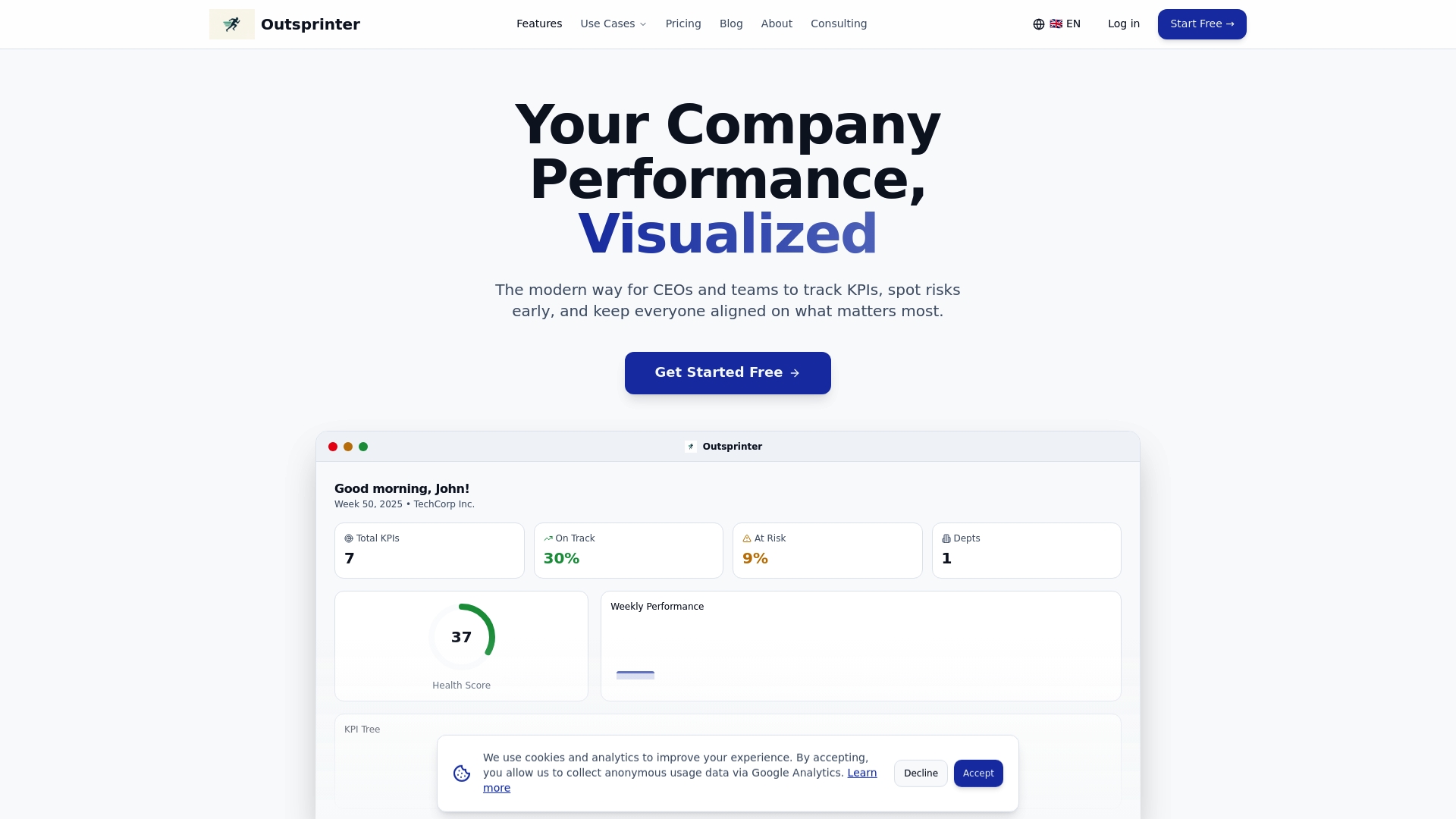
Outsprinter's project management tools keep your work organized with health metrics and workload analysis, so KPI reporting becomes part of a connected performance system rather than a standalone task. You can also use advanced task management to link specific tasks directly to KPI outcomes, creating full visibility from individual work items to team-level results. The AI Assistant helps you analyze trends, plan better KPIs, and get actionable insights on your data, all from a single dashboard. Whether you're just starting out or optimizing an existing process, Outsprinter gives your team the structure to make weekly reporting stick.
Frequently asked questions
What types of KPIs work best for weekly reporting?
Operational KPIs such as sales calls made, tasks completed, or tickets resolved are ideal for weekly tracking because they reflect ongoing activity and visible progress from week to week.
How long does it take to set up a weekly KPI reporting process?
Most teams can set up a functional weekly KPI reporting process within one week, provided that KPIs are defined, data sources are identified, and the right tools are already in place.
Should KPI reports be shared with the entire team each week?
Yes. Reporting KPIs to everyone increases transparency and accountability, making it a best practice rather than an optional step.
What if a KPI is missed in any given week?
Use a missed KPI as a prompt for intra-week corrective action and treat it as the focus of a structured discussion in the next review. Weekly KPI tracking accelerates corrective action precisely because issues are addressed before they compound.