
Most business leaders assume that tracking more metrics means better visibility. It doesn't. Too many KPIs dilute focus instead of sharpening it, leaving teams overwhelmed and executives no closer to real answers. Effective KPI management isn't about volume. It's about choosing the right indicators, acting on them consistently, and knowing when to change course. This article breaks down what KPI management actually means, which frameworks work best, how to select KPIs that move the needle, and how to avoid the traps that quietly undermine even well-intentioned performance programs.
Table of Contents
- What is KPI management?
- Essential frameworks for KPI management
- The art of selecting the right KPIs
- Implementing and auditing KPI management processes
- Common pitfalls and expert strategies for KPI success
- How software can streamline KPI management
- Frequently asked questions
Key Takeaways
| Point | Details |
|---|---|
| KPI definition matters | KPIs are focused metrics that drive business impact, not just any tracked number. |
| Frameworks improve focus | Using a proven KPI framework helps teams zero in on what truly matters. |
| Few KPIs are best | Tracking 3–10 KPIs at a time keeps teams aligned and avoids overload. |
| Balance and update | Pair leading and lagging KPIs, review often, and adapt as your business evolves. |
| Tech streamlines management | KPI management platforms automate busywork so leaders can focus on results. |
What is KPI management?
KPI management is the end-to-end process of defining, tracking, analyzing, and acting on Key Performance Indicators (KPIs). A KPI is a measurable value that shows how effectively an organization is achieving a specific business objective. But not every number qualifies as a KPI, and that distinction matters enormously.
Here's a quick breakdown of terms that often get confused:
| Term | Definition | Time horizon | Focus |
|---|---|---|---|
| Metric | Any quantifiable measurement | Ongoing | Operational data |
| KPI | A metric tied directly to a strategic goal | Ongoing | Business outcomes |
| OKR | Objective plus measurable key results | Time-bound (quarterly) | Strategic ambition |
KPIs are operational and ongoing, while OKRs are strategic and time-bound. Mixing them up leads to misaligned priorities and wasted effort.
Common mistakes in KPI management include:
- Tracking activity metrics (calls made, emails sent) instead of outcome metrics (revenue generated, deals closed)
- Assigning KPIs without connecting them to a specific business goal
- Letting KPIs go stale as the business evolves
- Treating every department metric as a KPI
When done right, KPI management gives leaders a clear signal about what's working, what isn't, and where to focus resources. Organizations that want to boost organizational KPI results need to start by getting this foundation right.
Essential frameworks for KPI management
Once you understand what KPI management is, the next challenge is structure. Without a framework, KPI selection becomes guesswork. With one, it becomes a repeatable, defensible process.

SMART, Balanced Scorecard, KPI Trees, Pyramid Framework, and 4DX are among the most widely used structures for KPI management. Each has a different strength depending on your organization's size, maturity, and strategic priorities.
| Framework | Best for | Strength | Limitation |
|---|---|---|---|
| SMART | Individual or team KPIs | Simple, clear criteria | Doesn't show relationships between KPIs |
| Balanced Scorecard | Enterprise-wide alignment | Covers financial and non-financial goals | Can become complex to maintain |
| KPI Tree | Cascading goals across departments | Shows cause-and-effect links | Requires strong data infrastructure |
| Pyramid Framework | Hierarchical organizations | Aligns strategy to operations | Less flexible for flat structures |
| 4DX | Execution-focused teams | Drives behavioral change | Narrow focus, not suited for all KPI types |
Here's how to choose the right one for your organization:
- Start with your goal. Are you trying to align strategy across the business, or drive execution within a single team?
- Assess your data maturity. KPI Trees require reliable data pipelines. SMART works even with basic spreadsheets.
- Consider your team size. The Balanced Scorecard suits larger organizations with multiple departments. 4DX works well for focused execution teams.
- Test before committing. Run a pilot with one department before rolling out a framework company-wide.
- Revisit annually. As the business grows, your framework needs may shift.
Pro Tip: Don't mix frameworks across departments without a clear integration plan. Inconsistent structures create reporting confusion and make it harder to compare performance across teams. Consistent weekly KPI tracking becomes much easier when everyone uses the same structure.
The art of selecting the right KPIs
Frameworks give you structure. But selecting the actual KPIs is where most organizations stumble. The temptation is to track everything measurable. The discipline is to track only what matters.
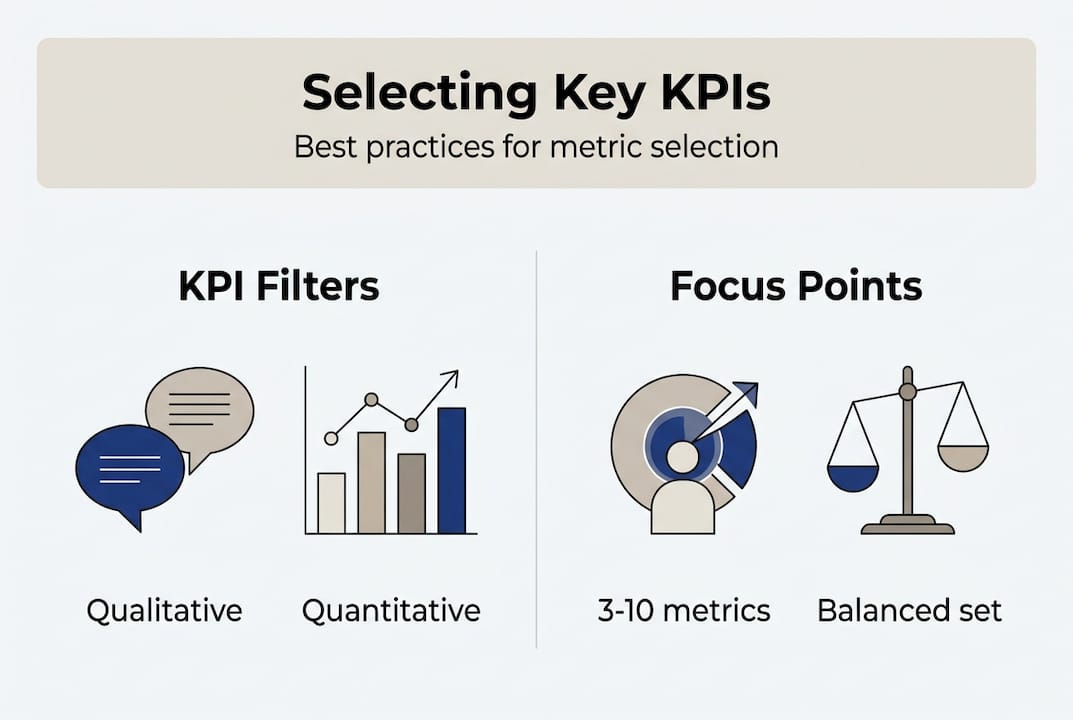
Limiting KPIs to 3 to 10, using a balanced set of qualitative and quantitative indicators, and differentiating between leading and lagging KPIs are essential best practices for any serious performance program.
Leading KPIs are predictive. They tell you where performance is heading before results are locked in. Lagging KPIs confirm what already happened. You need both. Pairing leading and lagging KPIs improves prediction and enables faster corrective action.
Here's what to watch out for when selecting KPIs:
- Overfitting: Choosing KPIs that perfectly explain past performance but fail to predict future results
- Gaming: Selecting metrics that are easy to manipulate, which distorts the picture over time
- Short-term bias: Focusing only on quarterly numbers while ignoring long-term health indicators
- Ignoring context: A KPI that works for one market or team may be irrelevant for another
- Outdated indicators: Keeping KPIs that no longer reflect current business priorities
"The best KPIs are not the ones that are easiest to measure. They are the ones most directly connected to the outcomes your business actually cares about."
If you're unsure how many to track, explore guidance on the ideal number of KPIs for your organization's stage. And if your team is already drowning in dashboards, avoiding KPI overload is a practical place to start trimming.
Qualitative observations matter too. Customer sentiment, employee engagement, and brand perception don't always fit neatly into a number, but ignoring them creates blind spots. The strongest KPI sets blend hard data with structured qualitative inputs.
Implementing and auditing KPI management processes
Choosing the right KPIs is only half the work. Putting them into practice, and keeping them relevant, is where most programs either succeed or quietly fall apart.
Here's a step-by-step process for rolling out a KPI management system that holds up over time:
- Define each KPI clearly. Document the formula, data source, owner, and target for every KPI before tracking begins.
- Communicate the purpose. Teams perform better when they understand why a KPI matters, not just what it measures.
- Set up your tracking infrastructure. Decide how data will be collected, who enters it, and how often it updates.
- Establish review cadences. Weekly operational reviews, monthly trend analysis, and quarterly strategic reviews serve different purposes.
- Build in capacity checks. Confirm that teams have the resources to actually influence the KPIs they own.
- Iterate based on results. If a KPI isn't driving behavior change or decisions, replace it.
Regular audits and reviews, capacity alignment, and updating KPIs for evolving conditions keep metrics relevant and prevent the system from becoming a bureaucratic exercise.
Pro Tip: Borrow the concept of "early stopping" from AI model training. If a KPI stops improving decisions or starts producing noise, stop tracking it. Holding onto irrelevant KPIs wastes attention and distorts your overall performance picture.
Organizations at different maturity levels need different approaches. Early-stage companies should start with 3 to 5 KPIs and build from there. Mid-sized organizations benefit from structured frameworks and setting KPI thresholds to trigger alerts. More mature enterprises need governance models that prevent KPI sprawl. Understanding how leadership and KPI use differs at each level helps calibrate the right approach.
Common pitfalls and expert strategies for KPI success
Even well-designed KPI programs run into trouble. The problems are usually predictable, which means they're also preventable.
Gaming metrics, KPI overfitting, and outdated KPIs can undermine performance if not actively managed. Goodhart's Law captures this perfectly: when a measure becomes a target, it ceases to be a good measure. Teams optimize for the number instead of the outcome the number was meant to represent.
Here are the most common pitfalls and how to address them:
- Metric gaming: Rotate KPIs periodically and pair them with qualitative checks to reduce manipulation incentives
- Focus dilution: Enforce a hard limit on the number of KPIs per team or department
- Ignoring intangibles: Add structured qualitative reviews alongside quantitative KPI tracking
- Stale KPIs: Schedule mandatory reviews every quarter to assess whether each KPI still reflects current priorities
- Misaligned ownership: Every KPI needs a named owner who has the authority and resources to influence it
"The organizations that get KPI management right treat their metrics like a living system, not a static report. They audit, adjust, and retire KPIs with the same rigor they use to create them."
Knowing when to pivot your KPI set is a skill in itself. If a KPI has been green for six consecutive months without driving any new decisions, it may have served its purpose. Retire it and redirect attention to what's emerging. For a deeper look at why performance programs fail and how to fix them, explore building KPIs that drive results.
How software can streamline KPI management
Managing KPIs manually through spreadsheets and email threads is slow, error-prone, and nearly impossible to scale. As your organization grows, the complexity of tracking, updating, and communicating KPI data multiplies fast.
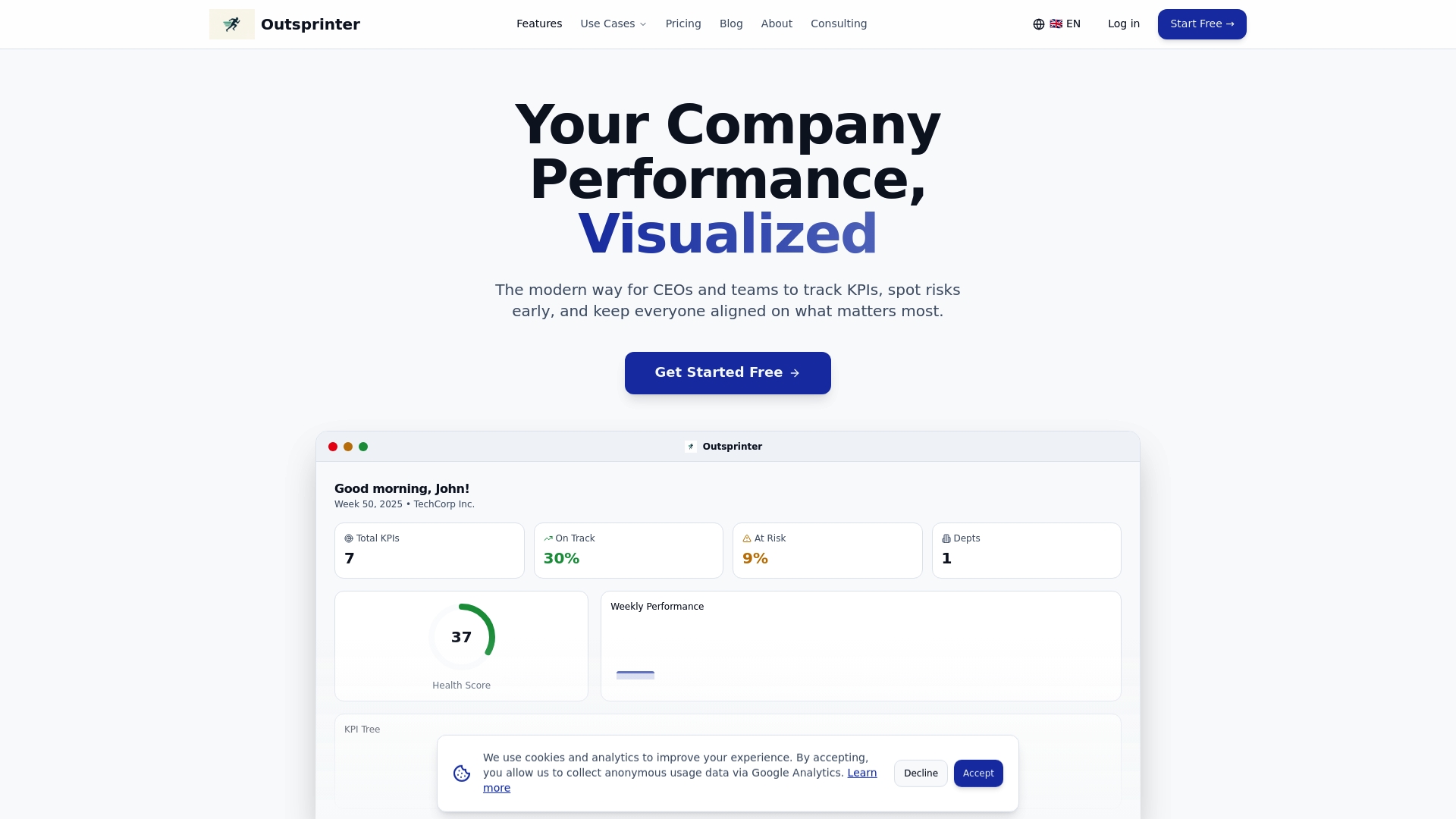
Cloud-based KPI management software automates data collection, real-time visualization, and threshold alerts, so your team spends less time compiling reports and more time acting on insights. Platforms that combine KPI and project tracking in one place eliminate the disconnect between strategic goals and day-to-day execution. With Outsprinter, you can define KPIs, assign ownership, set targets, and monitor progress across every department from a single dashboard. The AI Assistant helps you analyze performance trends and surface actionable recommendations without needing a data analyst on call. If you're ready to move from manual tracking to a system that scales, explore what's possible.
Frequently asked questions
How is a KPI different from an OKR?
KPIs are operational and ongoing, while OKRs are strategic and time-bound, pairing a qualitative objective with measurable key results to achieve it within a set period.
How many KPIs should a company track at once?
Experts recommend focusing on 3 to 10 KPIs at a time to maintain clarity, avoid overload, and ensure each metric drives meaningful decisions.
What's the difference between leading and lagging KPIs?
Leading KPIs predict future performance by measuring inputs and early signals, while lagging KPIs report past results. Pairing both types gives you a complete picture of where you are and where you're heading.
How often should KPIs be reviewed or updated?
Regular audits and reviews are essential. Most organizations benefit from weekly operational checks, monthly trend reviews, and quarterly strategic audits to keep KPIs aligned with current business priorities.
Can KPI management software really make a difference?
Yes. Software automates data collection, reduces human error, and makes KPI tracking scalable, freeing leaders to focus on analysis and action rather than manual reporting.