
Most organizations struggle with performance tracking because they measure too much or too little. When companies focus on 5 to 7 well-chosen KPIs, they see a 25% improvement in goal achievement compared to those drowning in metrics. This guide shows you how to implement performance tracking that delivers clarity, accountability, and measurable results for your team.
Table of Contents
- Understanding performance tracking: definition and purpose
- The role of KPIs in performance tracking
- Common misconceptions about performance tracking
Key takeaways
| Point | Details |
|---|---|
| Focus on fewer KPIs | Tracking 5 to 7 relevant KPIs prevents overload and improves clarity. |
| Use real-time dashboards | Immediate data access accelerates decision-making and trend detection. |
| Integrate with project workflows | Linking KPIs to sprint planning and retrospectives boosts accountability. |
| Leverage automation and AI | Technology reduces manual errors and provides predictive insights. |
| Involve all management levels | Top-down only tracking limits impact and team engagement. |
Understanding performance tracking: definition and purpose
Performance tracking is the systematic process of measuring, monitoring, and analyzing key business activities against strategic objectives. It transforms abstract goals into concrete, measurable actions that teams can execute daily. By establishing clear metrics and regular review cycles, performance tracking creates visibility into what's working and what needs adjustment.
The core purpose is to align daily work with strategic goals and drive continuous improvement and accountability. When done correctly, it bridges the gap between executive vision and operational execution. Teams gain clarity on priorities, leaders spot problems early, and organizations adapt faster to market changes.

Performance tracking also fosters transparency across departments. Everyone sees how their work contributes to company objectives, which strengthens motivation and collaboration. This visibility becomes especially valuable during periods of rapid growth or organizational change.
Effective tracking systems balance quantitative data with qualitative insights. Numbers tell you what's happening, but context explains why. Combined, they enable informed decisions that improve operational efficiency and accelerate goal attainment. For deeper strategies on maximizing organizational outcomes, explore our organizational performance guide.
Key benefits include:
- Real-time insight into business health and progress
- Early warning signals for potential issues or bottlenecks
- Data-driven foundation for strategic decisions
- Clear accountability across teams and individuals
- Framework for continuous learning and improvement
Pro Tip: Start tracking weekly instead of monthly. Weekly cycles provide faster feedback loops, helping teams course-correct before small issues become major problems.
The role of KPIs in performance tracking
KPIs (Key Performance Indicators) are specific, quantifiable metrics that measure progress toward critical business objectives. They serve as the foundation of any effective performance tracking system. Without well-defined KPIs, organizations lack the focus needed to evaluate success or identify improvement opportunities.
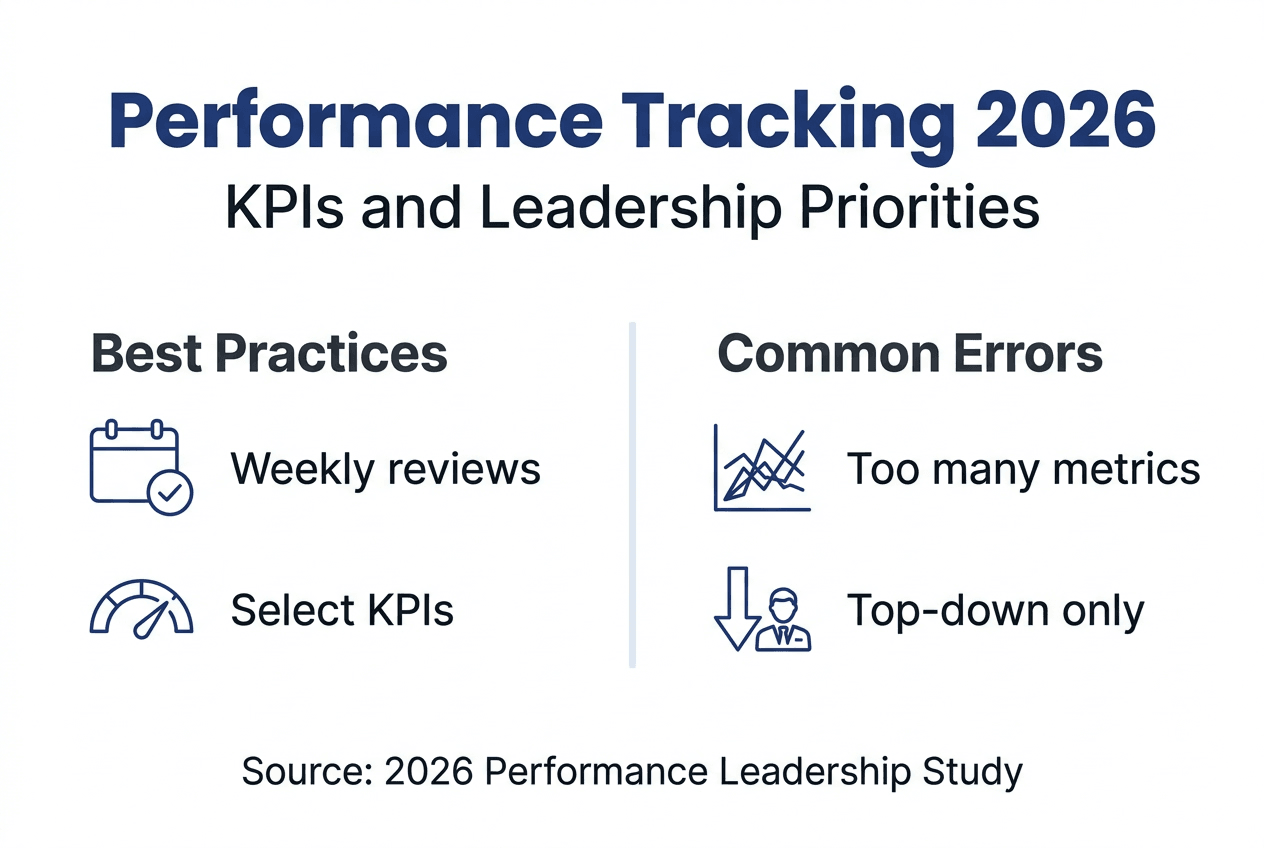
The key is selectivity. Research shows that companies tracking 5 to 7 carefully chosen KPIs outperform those monitoring dozens of metrics. Too many indicators create noise, dilute attention, and overwhelm teams. The best KPIs directly reflect your strategic priorities and provide actionable insights.
Focused KPI tracking improves goal achievement by 25% compared to scattered measurement approaches. This improvement stems from clearer priorities, reduced confusion, and better resource allocation. When everyone knows which numbers matter most, alignment naturally improves.
Selecting the right KPIs requires understanding your business model and strategic objectives. Revenue-focused companies might track monthly recurring revenue and customer acquisition cost. Operations-driven organizations often monitor cycle time and defect rates. The metrics you choose should answer the question: what must we excel at to succeed?
Practical tips for KPI selection:
- Align each KPI directly to a specific strategic objective
- Ensure metrics are measurable with available data
- Choose indicators your team can actually influence
- Balance leading indicators (predictive) with lagging indicators (outcome-based)
- Review and refine KPIs quarterly as priorities evolve
Learn more about building effective KPIs that drive results. Understanding how high-performing leadership teams use KPIs differently can also provide valuable benchmarks for your approach.
Common misconceptions about performance tracking
Many leaders believe that tracking more KPIs provides better visibility. The opposite is true. Monitoring excessive metrics creates confusion, dilutes focus, and makes it harder to identify what truly matters. Teams become overwhelmed trying to improve everything simultaneously, resulting in marginal gains across the board instead of breakthrough performance in critical areas.
Another widespread error is limiting performance tracking to top management only. When only executives monitor KPIs, frontline teams lose connection to organizational goals. This top-down approach reduces engagement and limits the performance impact. Effective tracking involves managers and team members who can directly influence outcomes.
Many organizations also treat tracking as retrospective reporting rather than real-time improvement. Monthly or quarterly reviews provide historical data but miss opportunities for immediate course correction. By the time problems appear in reports, damage is already done. Real-time tracking enables proactive management.
Research indicates that 45% of performance measurement initiatives fail due to unclear KPI definitions or objectives. Vague metrics like