
TL;DR:
- Sprint planning is a crucial, strategic meeting where team commitments and priorities are aligned for upcoming work. It involves the entire Scrum Team and results in a clear sprint goal, selected backlog items, and an actionable plan. Effective planning requires proper preparation, realistic capacity assessment, and fostering open communication to avoid common mistakes and improve results.
Sprint planning is one of those meetings that teams schedule without thinking much about it. It shows up on the calendar, people join, estimates get thrown around, and then everyone scatters to "just get things done." But that attitude is exactly what separates struggling teams from high-performing ones. Sprint planning is not a formality. It is the moment where strategy meets execution, where priorities become commitments, and where the next two weeks of your team's work either make sense or fall apart. This guide breaks down exactly how sprint planning works, who owns what, and how to run it in a way that actually moves the needle.
Table of Contents
- Defining sprint planning: Purpose, participants, and process
- The sprint planning agenda: Key steps and proven frameworks
- Forecasting, capacity, and commitment: How teams plan realistic sprints
- Common sprint planning mistakes and expert fixes
- Why most teams get sprint planning wrong—and how to break the cycle
- Level up your sprint planning with Outsprinter
- Frequently asked questions
Key Takeaways
| Point | Details |
|---|---|
| Sprint planning sets the tone | A focused sprint planning session is critical for team alignment and predictable delivery. |
| Realistic commitments matter | Effective planning relies on accurate capacity forecasts and buffers for unknowns. |
| Expert prep prevents mistakes | Backlog refinement and clear goals before the meeting save time and boost outcomes. |
| Continuous improvement is key | Learning from mistakes and collecting team feedback helps make every planning session more effective. |
Defining sprint planning: Purpose, participants, and process
Now that we've set the stage for why sprint planning deserves attention, let's clarify exactly what it is and who makes it happen.
Sprint planning is a timeboxed Scrum event occurring at the start of each sprint. A sprint, for context, is a fixed period (usually one to four weeks) during which a team completes a set amount of work. Sprint planning kicks off that window by answering three core questions: What is the goal? What work gets selected? How will the team get it done?
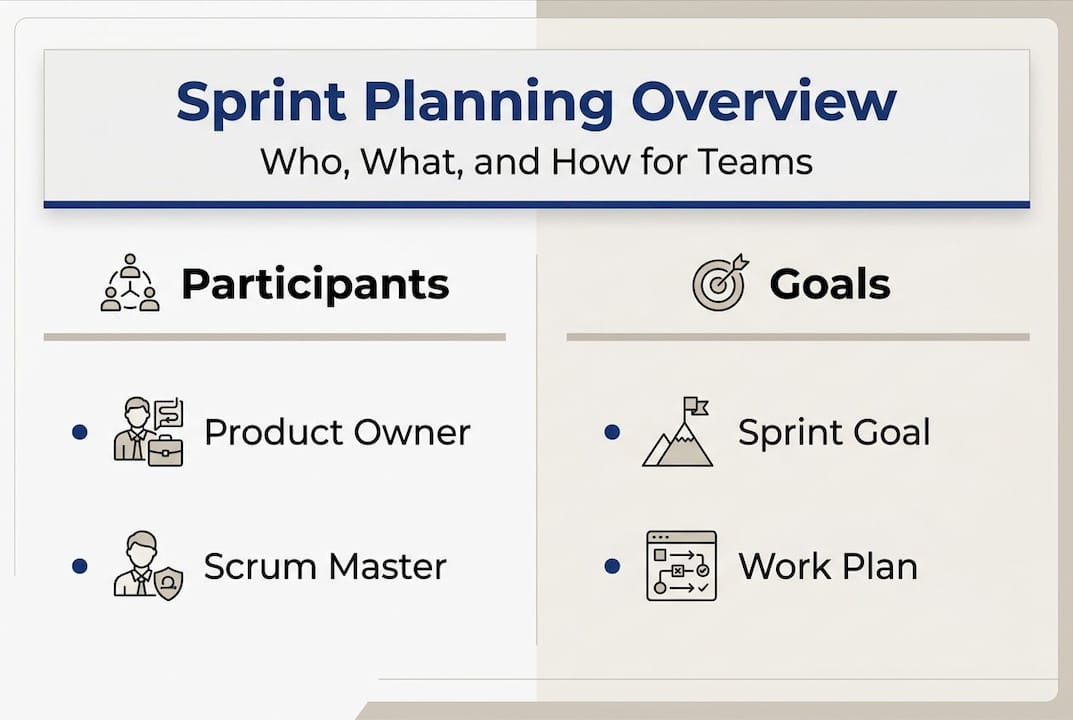
The entire Scrum Team collaborates during sprint planning, meaning the Product Owner, Scrum Master, and all Developers are present. Each plays a distinct role:
- Product Owner: Prioritizes the product backlog and communicates what matters most to the business.
- Scrum Master: Facilitates the session, keeps it on track, and removes process blockers.
- Developers: Estimate effort, identify dependencies, and commit to what is realistically achievable.
Think of it like a flight crew pre-departure check. The captain (Product Owner) sets the destination, the co-pilot (Scrum Master) runs the checklist, and the crew (Developers) confirms the plane is ready to fly. Skipping any of these roles creates gaps.
The primary outputs of sprint planning are:
- A clear Sprint Goal that gives the work direction and meaning.
- A selected set of backlog items that the team believes they can complete.
- A plan for how to accomplish that work.
Following agile sprint best practices means keeping the session focused on these three outputs, not getting lost in tangents or over-designing solutions before the sprint even begins.
| Sprint length | Recommended planning time |
|---|---|
| 1 week | Up to 2 hours |
| 2 weeks | Up to 4 hours |
| 3 weeks | Up to 6 hours |
| 4 weeks | Up to 8 hours |
One thing worth noting: sprint planning is not just for software teams. From marketing to operations, execution rhythm for every team depends on this kind of structured, time-boxed commitment cycle. Even a pilot team planning workflow benefits from sprint principles adapted to its own context.
"The Sprint Goal is the single objective for the Sprint. It gives the Developers flexibility in how they reach it, while maintaining focus on what matters." — Scrum Guide
The sprint planning agenda: Key steps and proven frameworks
Understanding who participates and what the basic purpose is sets us up to dive deeper into the structure. How does a sprint planning session actually flow?
Most effective sprint planning sessions follow a clear sequence. Here is a practical numbered checklist you can use immediately:
- Open with the Sprint Goal. Align the team on the "why" before touching any backlog items.
- Review the backlog. The Product Owner walks through prioritized items and explains acceptance criteria.
- Select backlog items. Developers pull items into the sprint based on capacity and priority.
- Break down the work. Larger items get split into tasks, and dependencies are mapped.
- Confirm commitment. The team verbally (or digitally) agrees on what they are committing to.
- Close with clarity. Everyone leaves knowing the Sprint Goal, their tasks, and the first step.
The timebox guideline recommends a maximum of eight hours for a four-week sprint, or roughly two hours per sprint week. Most teams violate this not because they are slow, but because they have not refined the backlog beforehand.
Pro Tip: Run a backlog refinement session at least two days before sprint planning. This means acceptance criteria are written, stories are sized, and the team is not meeting a backlog item for the first time during planning. It makes planning dramatically faster.
Here is a quick comparison of how traditional Scrum and hybrid agile approaches handle the session:
| Element | Traditional Scrum | Hybrid or adapted agile |
|---|---|---|
| Sprint length | Fixed (1-4 weeks) | Flexible or rolling |
| Planning meeting | Formal, structured | Often lighter, async prep |
| Commitment style | Team-driven estimates | May include manager input |
| Sprint Goal | Required | Sometimes optional |
| Backlog refinement | Separate event | Often embedded in planning |
For teams running agile sprint management at scale, hybrid formats are increasingly common. A detailed sprint planning checklist can help hybrid teams stay consistent without enforcing rigid Scrum ceremonies. Connecting sprint planning to sprint retrospectives creates a continuous improvement loop that compounds over time.
Forecasting, capacity, and commitment: How teams plan realistic sprints
With the agenda set, the question becomes: How does the team actually decide what they can deliver?

This is where most teams make a critical error. They look at available hours and try to fill them completely. Capacity planning is not about maximization. It is about finding the realistic delivery range for this specific sprint, with this specific team, under these specific conditions.
Capacity planning considers team size, sprint length, holidays and paid time off, part-time roles, historical velocity, and aims for 80 to 105 percent commitment. That last point surprises many leaders. A buffer is not laziness. It is a buffer for reality: unexpected bugs, a sick team member, a stakeholder request, or a critical review that was not planned.
Factors teams should account for when committing to a sprint:
- Historical velocity: How many story points or tasks has the team completed in recent sprints?
- Planned absences: Vacations, holidays, and appointments reduce real capacity.
- Part-time contributors: A developer working on two products is not fully available to either.
- Technical debt: If tech debt is not tracked, it silently consumes sprint capacity.
- WIP limits: Work-in-progress limits prevent teams from starting too many things and finishing none.
Velocity (the number of story points completed per sprint) is your most honest planning tool. New teams often overestimate because they have no baseline. Running KPI-driven sprint planning makes the invisible visible: you can see patterns, track progress, and identify where commitments keep slipping.
| Utilization target | Outcome |
|---|---|
| Under 70% | Underutilized team, slow delivery |
| 80 to 105% | Realistic, sustainable delivery |
| 110% or more | Overcommitment, burnout risk |
Pro Tip: Use the last three sprints of velocity data as your planning anchor. Average it, apply your capacity modifier for this sprint, and let that number guide how much you pull from the backlog. No guessing. No pressure. Just data.
For growing organizations, scaling team capacity requires the same rigor applied across multiple teams. Weekly KPI tracking helps leaders catch overload signals before they become crises.
Common sprint planning mistakes and expert fixes
Knowing how to forecast and set commitments is powerful, but even experienced teams fall prey to some common traps.
Research identifies the most common sprint planning mistakes as overcommitment, poor backlog refinement, missing Sprint Goal, ignoring technical debt, and allowing mid-sprint changes to the plan. Each of these has a recognizable symptom:
- Overcommitment: Sprint ends with several items still in progress, every sprint.
- Poor backlog refinement: Stories are vague, requirements shift during the sprint.
- No Sprint Goal: The team lacks direction; any task feels equally important.
- Ignored tech debt: Code quality degrades; future sprints slow down unexpectedly.
- Mid-sprint scope changes: Morale drops because effort spent earlier gets discarded.
The fix for most of these is preparation, not more planning time. Effective sprint planning includes pre-meeting backlog refinement, a clear Definition of Done (DoD) and Definition of Ready (DoR), and a post-planning confidence check. The DoD defines what "finished" actually means. The DoR defines what must be true before a story enters the sprint. Without both, teams are guessing.
For distributed and hybrid teams, the stakes are even higher. Misalignment that a co-located team might catch in a hallway conversation goes unresolved for days in a remote setup. Asynchronous preparation tools, polls for task confidence, and shared documents before the meeting all reduce the risk of confusion.
Sprint execution in marketing teams illustrates how even non-technical teams fall into the same traps: vague goals, overloaded sprints, and no shared definition of what "done" looks like. The fix is identical regardless of department.
"Every planning mistake is ultimately a communication failure in disguise. The solution is almost never more process. It's more clarity, earlier." — Agile team ownership
Why most teams get sprint planning wrong—and how to break the cycle
Here is something most agile guides will not tell you: the biggest problem with sprint planning is not a lack of methodology knowledge. It is that teams treat planning as a box to check rather than a thinking exercise.
High-performing teams approach sprint planning with ruthless prioritization. They do not ask "what can we fit in?" They ask "what absolutely must happen this sprint, and what can wait?" That shift in framing changes everything. It forces visible trade-offs. It surfaces disagreements before the sprint starts instead of mid-execution.
Another uncomfortable truth is that perfect forecasting is not the goal. Confidence is. A team that leaves planning feeling aligned on the goal and realistic about the work will outperform a team with a mathematically optimized plan but low buy-in. Velocity data helps, but shared understanding drives results.
The practical audit: At your next planning session, pay less attention to whether estimates are accurate and more attention to whether everyone is engaged. Are Developers nodding along without asking questions? That is a red flag. Healthy planning sessions are slightly uncomfortable because real trade-offs are being made. Following agile sprint best practices means building a culture where that honesty is expected and welcomed.
Level up your sprint planning with Outsprinter
For leaders ready to put these insights to work, technology can streamline the process considerably.
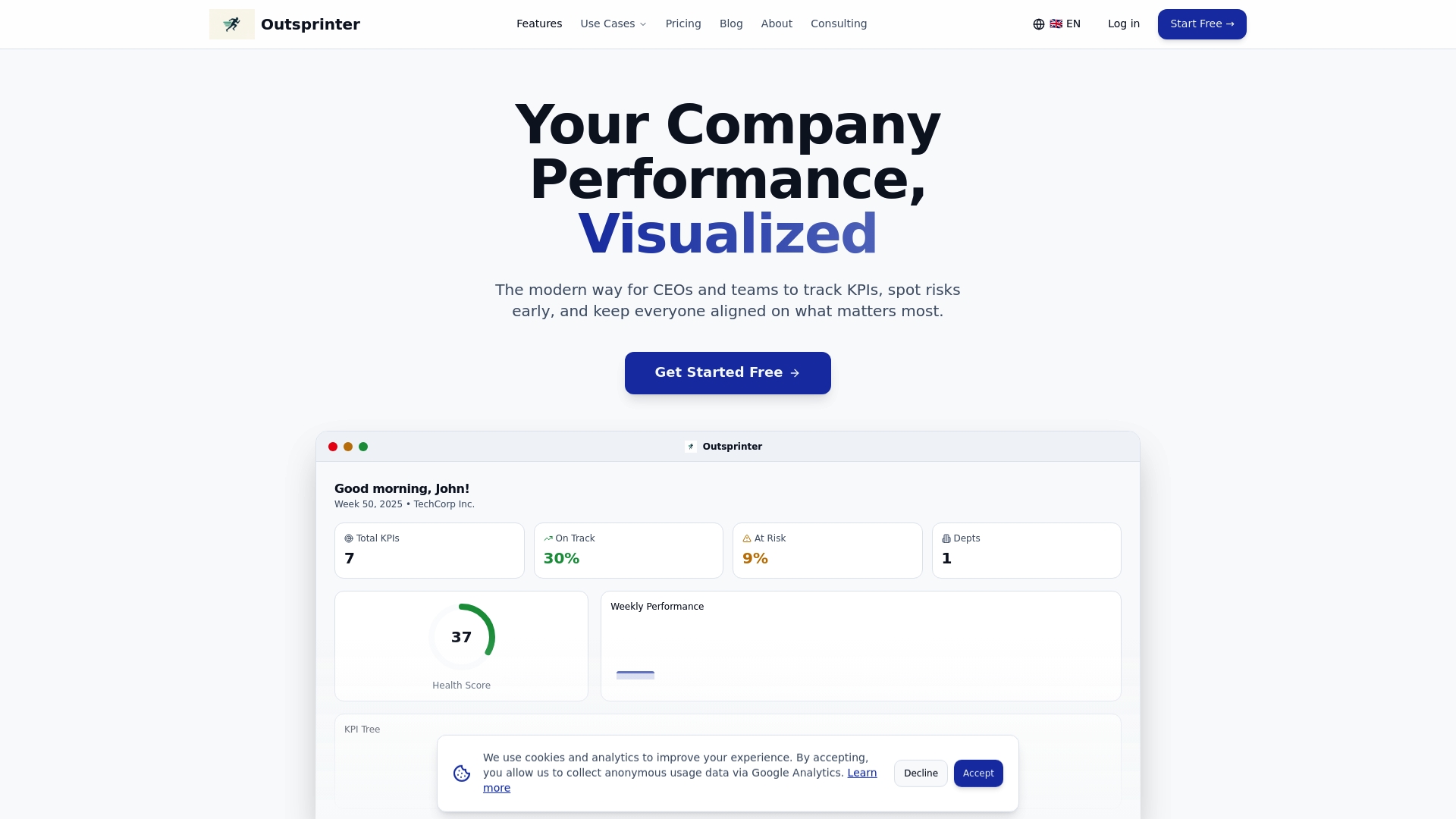
Outsprinter was built for exactly this kind of challenge. With a real-time project management platform, your team can organize sprints, track task health, and monitor workload without switching between five different tools. The real-time KPI tracking feature gives you instant visibility into delivery performance, so you are not flying blind when sprint planning comes around.
Explore project management use cases to see how teams across industries use Outsprinter to run structured, predictable sprints. From goal planning to AI-powered insights, the platform gives project managers and team leaders the clarity they need to turn sprint planning from a calendar event into a genuine competitive advantage.
Frequently asked questions
How long should a typical sprint planning meeting take?
Sprint planning should take about two hours per sprint week, with a maximum of eight hours for a four-week sprint. Shorter sprints mean shorter sessions.
Who needs to attend sprint planning?
The entire Scrum Team must attend: the Product Owner, Scrum Master, and all Developers. Their combined input ensures the plan is realistic and aligned.
What happens if the team overcommits during sprint planning?
Overcommitment leads to burnout or work rolling over to the next sprint. Teams should target 80 to 105 percent capacity utilization and use historical velocity as a guide.
How can distributed teams improve their sprint planning?
Distributed teams benefit from asynchronous preparation, shared digital tools, and confidence polls to ensure everyone is aligned before and after the session.
Recommended
- Sprints Are Not Just for IT: Why Every Team Needs an Execution Rhythm | Outsprinter
- Agile Sprint Management: Best Practices for High-Performance Teams | Outsprinter
- Sprint Retrospectives: Turning Team Experience Into Continuous Improvement | Outsprinter
- Outsprinter - Team Performance & Sprint Management Platform
- How to streamline your SaaS team with workflow automation | Rule27 Design