
Most CEOs believe they understand their organization's health, but fewer than 40% use structured performance tracking systems to inform decisions. The gap between intuition and data-driven insight costs companies millions in missed opportunities and strategic missteps. Tracking organizational performance enables data-driven decisions, alignment with strategy, and identification of improvement areas for CEOs. This guide reveals proven frameworks, modern tools, and critical pitfalls to avoid so you can transform raw data into competitive advantage.
Table of Contents
- Key Takeaways
- Why organizational performance tracking is essential for CEOs
- Core frameworks and approaches for effective performance tracking
- Practical tips and technology for continuous performance monitoring
- Balancing benefits and risks: avoiding common pitfalls in performance tracking
- Explore Outsprinter for team performance management
- FAQ
Key Takeaways
| Point | Details |
|---|---|
| Data driven decisions | Structured performance tracking helps CEOs base decisions on evidence, reducing missed opportunities and missteps. |
| Vital few metrics | Leaders should track a small set of 5 to 10 core KPIs rather than chasing vanity metrics. |
| Leading indicators | Nonfinancial indicators from customer experience and internal processes predict future performance. |
| Real time monitoring | Real time tools enable continuous monitoring and quick responses to emerging issues. |
| Balanced Scorecard | The Balanced Scorecard balances financial and nonfinancial measures across four perspectives: financial, customer, internal processes, and learning and growth. |
Why organizational performance tracking is essential for CEOs
Your organization generates thousands of data points daily. Without systematic tracking, you're flying blind. Research from Deloitte shows companies that embrace data-driven decision-making are five times more likely to make faster, more effective strategic choices than competitors relying on gut instinct alone.
Performance tracking creates alignment across your entire organization. When teams understand which metrics matter most, they naturally orient their efforts toward strategic priorities. This alignment becomes especially critical during periods of rapid growth or market disruption when maintaining focus separates winners from those who lose their way.
The real power emerges in early problem detection. Tracking reveals performance gaps before they become crises. You spot declining customer satisfaction scores three months before churn accelerates. You notice productivity dips in specific departments while there's still time to intervene. This forward visibility transforms reactive management into proactive leadership.
CEOs who master performance tracking focus ruthlessly on the vital few metrics that actually move the business. Industry leaders typically monitor just 5-10 core KPIs rather than drowning in dozens of vanity metrics. This disciplined approach to organizational performance creates clarity for executive teams and eliminates the confusion that comes from tracking everything.
The biggest mistake? Ignoring non-financial dimensions entirely. Revenue and profit matter, but they're lagging indicators that tell you what already happened. Leading indicators from customer experience, internal processes, and employee development predict future performance. A balanced measurement approach captures the full picture of organizational health.
Consider these essential tracking benefits:
- Strategic alignment across departments and leadership levels
- Early warning systems that flag problems before they escalate
- Objective performance conversations replacing subjective opinions
- Resource allocation guided by data rather than politics
- Continuous improvement cycles based on measurable outcomes
"The metrics you choose to track become the metrics your organization optimizes for. Choose wisely, because you'll get exactly what you measure." — Performance management expert
Your tracking system becomes the nervous system of your organization. It senses changes, transmits signals, and enables coordinated responses. Without it, you're managing by anecdote and assumption. With it, you lead with confidence grounded in reality.

Core frameworks and approaches for effective performance tracking
The Balanced Scorecard methodology provides a comprehensive framework with four perspectives: financial, customer, internal processes, learning/growth to balance short-term and long-term objectives. This approach prevents the tunnel vision that comes from obsessing over quarterly earnings while ignoring the capabilities that drive sustainable success.
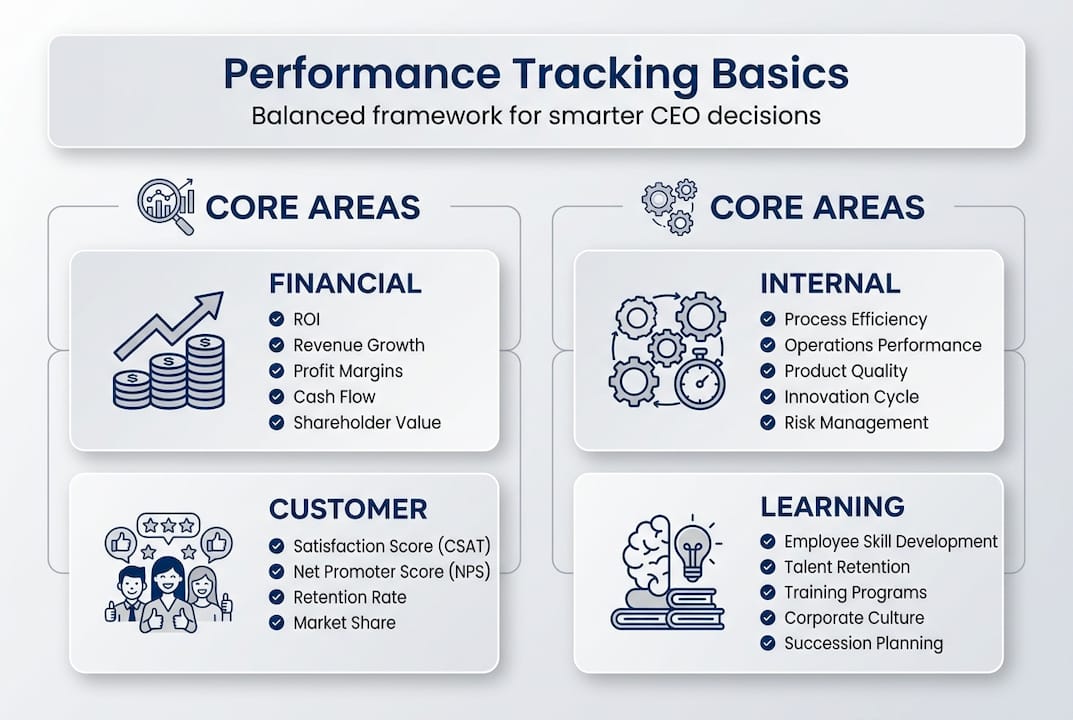
Each perspective answers a critical question. Financial metrics ask if we're creating shareholder value. Customer measures reveal whether we're building loyalty and market position. Internal process indicators show operational excellence and efficiency. Learning and growth dimensions assess whether we're developing the capabilities needed for future success.
| Framework element | Focus area | Example metrics |
|---|---|---|
| Financial perspective | Shareholder value creation | Revenue growth, profit margins, ROI |
| Customer perspective | Market position and loyalty | Net promoter score, customer lifetime value, retention rate |
| Internal processes | Operational excellence | Cycle time, defect rates, process efficiency |
| Learning and growth | Future capabilities | Employee engagement, training hours, innovation rate |
The power of this framework lies in its balance. Companies that track only financial metrics optimize for short-term gains at the expense of long-term health. Those that ignore financial reality while chasing customer satisfaction scores eventually run out of runway. The Balanced Scorecard forces you to maintain tension between competing priorities.
Choosing the right KPIs requires strategic thinking. Start by identifying your organization's critical success factors, then work backward to determine which metrics best indicate progress. Leading indicators predict future performance and enable proactive adjustments. Lagging indicators confirm what happened but offer limited insight for course correction.
Pro Tip: Limit your executive dashboard to 5-10 core KPIs that directly connect to strategic objectives. More than that creates cognitive overload and dilutes focus. Each metric should trigger specific actions when thresholds are crossed.
Integrating KPIs with Objectives and Key Results (OKRs) creates powerful alignment. OKRs define ambitious goals and measurable outcomes, while KPIs track ongoing operational health. Together, they balance transformation initiatives with operational excellence. Your OKRs push the organization toward breakthrough performance while KPIs ensure you don't break core operations in the process.
The most effective tracking systems share common characteristics:
- Clear ownership for each metric with accountability assigned
- Regular review cycles that match the metric's natural rhythm
- Defined thresholds that trigger investigation or action
- Transparent visibility so teams understand current performance
- Flexibility to evolve as strategy and market conditions change
Avoid the temptation to track metrics simply because data is available. Every KPI should answer a specific strategic question. If you can't articulate why a metric matters and what decisions it informs, eliminate it. The goal is insight, not information overload.
When building effective KPIs, ensure each one meets the SMART criteria: specific, measurable, achievable, relevant, and time-bound. Vague aspirations like "improve customer satisfaction" lack the precision needed for meaningful tracking. "Increase NPS from 42 to 55 by Q4" provides clear direction and accountability.
Practical tips and technology for continuous performance monitoring
The shift from periodic reporting to continuous monitoring represents a fundamental change in how CEOs stay connected to organizational performance. KPI tracking tools integrate real-time data for continuous monitoring, goal alignment, and performance management in modern systems. This constant pulse on performance enables agile decision-making that matches today's business velocity.
Traditional quarterly business reviews feel like autopsies. You examine what died three months ago with limited ability to revive it. Continuous monitoring transforms this dynamic entirely. Real-time dashboards surface issues within days or hours, creating opportunities for immediate intervention before small problems compound into major crises.
The concept of Performance Intelligence has emerged as traditional annual reviews are abandoned for continuous systems due to lagging indicators and KPI overload risk. This evolution recognizes that annual snapshots miss the dynamic reality of modern business. Performance Intelligence combines leading indicators, predictive analytics, and real-time data streams to provide forward-looking insight rather than historical summaries.
Modern KPI platforms offer capabilities that were impossible just five years ago:
- Automated data collection from multiple source systems
- Real-time dashboard updates that reflect current performance
- Alert systems that notify stakeholders when metrics cross thresholds
- Mobile access so leaders stay informed regardless of location
- Collaborative features enabling team discussions around data
The risk of tracking too many KPIs remains significant. Research indicates organizations monitoring more than 30 KPIs face substantially higher rates of confusion and misaligned focus. The cognitive load of processing dozens of metrics exceeds human capacity, leading to analysis paralysis or selective attention that misses critical signals.
Pro Tip: Implement a tiered KPI structure with 5-7 executive-level metrics, 10-15 departmental indicators, and operational metrics at the team level. This hierarchy ensures each leadership level focuses on metrics appropriate to their scope of control while maintaining line of sight to overall strategy.
| Monitoring approach | Update frequency | Best use case |
|---|---|---|
| Real-time dashboards | Continuous | Operational metrics requiring immediate response |
| Weekly KPI reviews | Weekly | Tactical performance and short-term goal tracking |
| Monthly scorecards | Monthly | Strategic initiatives and departmental performance |
| Quarterly business reviews | Quarterly | Long-term trends and strategic adjustments |
Leveraging technology effectively requires more than installing software. You need to build a performance culture where data informs conversations at every level. Train managers to interpret metrics correctly and ask probing questions when numbers tell unexpected stories. Create routines where teams regularly review performance data and discuss implications together.
The most sophisticated tracking systems incorporate predictive analytics that forecast future performance based on current trends. Machine learning algorithms identify patterns humans miss, flagging subtle correlations between leading indicators and ultimate outcomes. This predictive capability transforms tracking from reporting what happened to anticipating what's coming.
Avoiding KPI overload requires discipline and regular pruning. Every quarter, review your KPI portfolio and eliminate metrics that no longer serve strategic objectives. Add new indicators only when they fill genuine information gaps. This continuous refinement keeps your tracking system lean and focused on what truly matters.
Engagement with performance data should feel natural, not forced. When dashboards become part of daily workflow rather than separate reporting exercises, adoption increases dramatically. Integrate KPI visibility into existing tools and processes so checking performance becomes as routine as checking email.
Balancing benefits and risks: avoiding common pitfalls in performance tracking
Performance tracking delivers tremendous value, but poorly designed systems create problems as serious as having no metrics at all. KPIs can cause measurement traps, internal competition, and illusion of progress if not balanced well. Understanding these risks helps you design tracking systems that illuminate rather than obscure reality.
The measurement trap occurs when metrics become targets divorced from underlying objectives. Teams optimize for the number rather than the outcome the number represents. Call centers reduce average handle time by rushing customers off the phone, technically hitting targets while destroying satisfaction. Sales teams push unqualified deals to meet quota, inflating revenue numbers while creating future churn.
KPI overload affects roughly 35% of organizations according to recent surveys. When executives track too many metrics, several problems emerge simultaneously. Attention becomes fragmented across dozens of indicators. Teams receive mixed signals about priorities. The cognitive burden of processing excessive data leads to decision fatigue and analysis paralysis. Focus dissipates instead of concentrating on the vital few drivers of success.
Internal competition triggered by performance metrics can damage collaboration. When departments optimize their individual KPIs without considering system-wide effects, suboptimization occurs. Marketing generates leads that sales can't convert. Operations cuts costs in ways that hurt customer experience. Finance delays payments to improve cash flow metrics while damaging supplier relationships.
Critical pitfalls to avoid:
- Gaming behaviors where teams manipulate metrics rather than improve performance
- Myopic focus on easily measured factors while ignoring important intangibles
- Threshold effects where performance clusters just above minimum targets
- Ratchet effects where success leads to unrealistic target increases
- Tunnel vision that ignores important factors outside the measurement framework
Testing causal links between actions and outcomes represents essential discipline for CEOs. Just because two metrics correlate doesn't mean one causes the other. Rigorous analysis separates genuine drivers from coincidental associations. This testing prevents wasted resources on initiatives that appear effective but deliver no real impact.
Maintaining balance requires combining quantitative KPIs with qualitative feedback. Numbers tell you what happened but rarely explain why. Customer interviews, employee surveys, and stakeholder conversations provide context that makes data meaningful. The most effective performance systems integrate both perspectives into a complete picture.
To maintain healthy tracking practices:
- Regularly audit metrics for unintended consequences and gaming
- Rotate responsibility for metric definition to prevent ownership bias
- Create safe spaces for discussing metric limitations and blind spots
- Balance short-term and long-term indicators in your portfolio
- Emphasize learning over punishment when metrics reveal problems
- Test new metrics in pilot mode before rolling out organization-wide
The illusion of progress represents perhaps the most insidious measurement trap. Dashboards show green indicators and upward trends while underlying business fundamentals deteriorate. This disconnect occurs when metrics lose connection to strategic objectives or when targets are set too low to drive meaningful improvement.
High-performing teams use KPIs differently than average organizations. They view metrics as conversation starters rather than final judgments. They update KPIs as strategy evolves rather than treating them as permanent fixtures. They celebrate learning from failed experiments as much as hitting targets. This mature approach to measurement maximizes benefits while minimizing risks.
The key to avoiding pitfalls lies in remembering that metrics serve strategy, not the reverse. When KPIs stop providing useful insight or start driving counterproductive behavior, change them. Your tracking system should evolve continuously as you learn what works and what doesn't in your specific context.
Explore Outsprinter for team performance management
Transforming performance tracking from concept to reality requires the right platform. Outsprinter provides comprehensive KPI management and performance tracking tools designed specifically for executive teams who need clear visibility into organizational health. The platform combines real-time dashboards, goal alignment features, and continuous monitoring capabilities in an intuitive interface that your entire leadership team can use effectively.
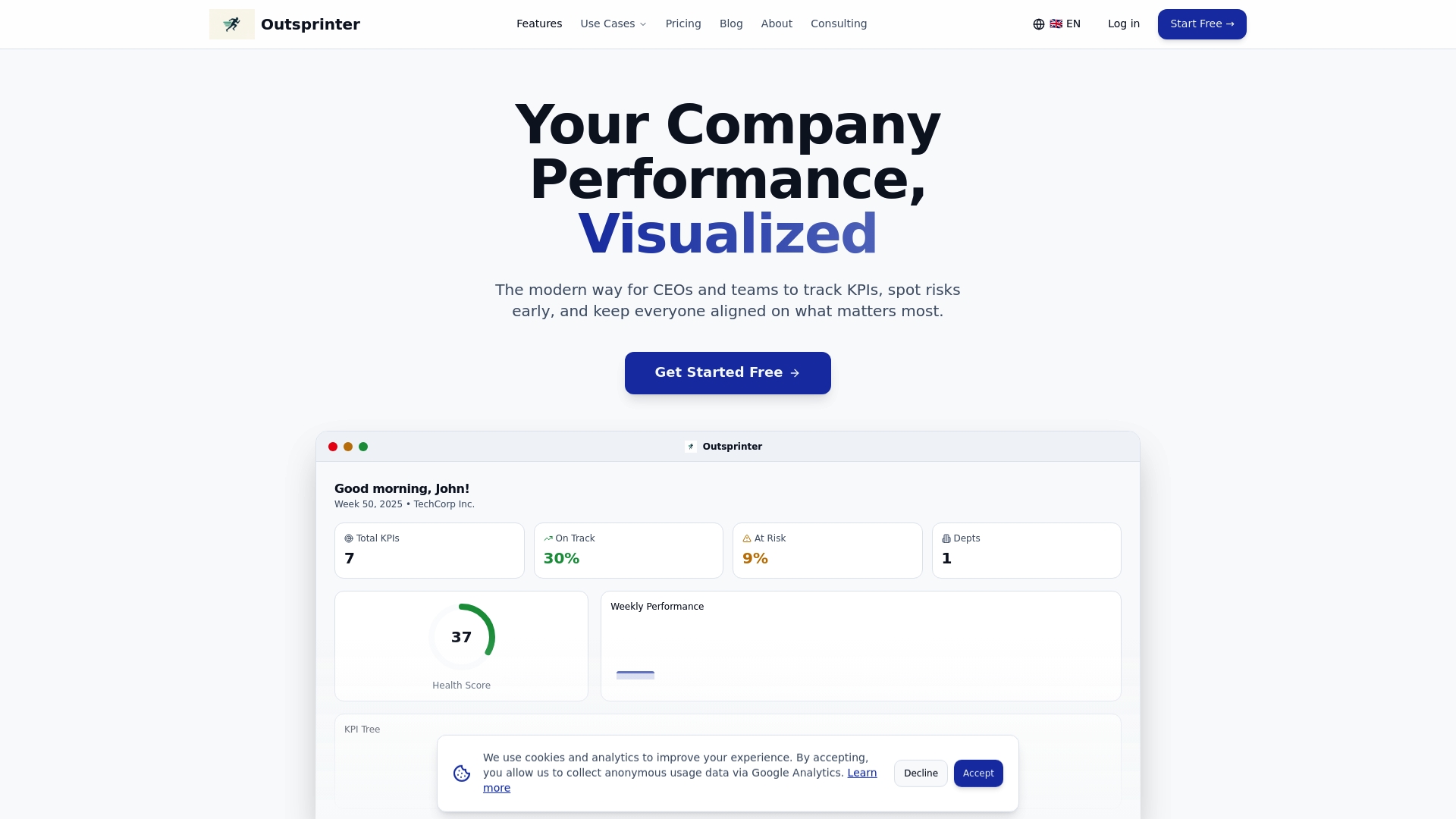
Customizable dashboards let you visualize the specific metrics that matter most to your organization. Track financial performance, customer indicators, operational efficiency, and team development in one unified view. The system integrates seamlessly with existing data sources, eliminating manual reporting while ensuring accuracy. Whether you're focused on management board oversight or detailed project management, Outsprinter adapts to your leadership needs and scales as your organization grows.
FAQ
What key performance indicators should CEOs focus on?
Focus on 5-10 core KPIs that directly connect to strategic objectives rather than tracking dozens of metrics. Essential indicators typically include revenue growth rate, customer acquisition cost, customer lifetime value, gross margin, and employee productivity. Use frameworks like the Balanced Scorecard to ensure you're measuring financial, customer, internal process, and learning dimensions. The specific KPIs depend on your industry and strategy, but the principle remains constant: measure what matters most and ignore the rest.
How can CEOs avoid KPI overload and the measurement trap?
Limit your executive dashboard to the vital few metrics that actually inform decisions and drive action. Regularly test causal links between tracked metrics and strategic outcomes to ensure you're measuring genuine drivers rather than vanity indicators. Complement quantitative KPIs with qualitative stakeholder feedback to capture context that numbers alone miss. Review your KPI portfolio quarterly and eliminate metrics that no longer serve strategic objectives. This disciplined approach to avoiding KPI overload maintains focus on what truly moves your organization forward.
What role do modern KPI tracking tools play in performance management?
Modern platforms enable real-time data integration that transforms periodic reporting into continuous performance monitoring. They automate data collection from multiple sources, eliminating manual reporting while improving accuracy. Alert systems notify stakeholders immediately when metrics cross critical thresholds, enabling rapid response to emerging issues. These tracking tools support goal alignment across teams and facilitate ongoing agile adjustments as market conditions change. The result is a performance management system that matches the velocity of modern business rather than lagging weeks or months behind reality.