
TL;DR:
- Leadership is crucial for translating KPIs into meaningful organizational performance.
- Effective KPI success depends on strategic alignment, purposeful communication, and accountability from leaders.
- Choosing outcome-focused metrics and fostering transparency and ownership enhances team engagement and long-term results.
Most organizations invest heavily in KPI frameworks, dashboards, and tracking tools, then wonder why results still disappoint. The problem is rarely the metrics. Leadership plays a pivotal role in KPI success by setting strategic alignment, communicating metrics with purpose, and fostering accountability cultures. Without executive leadership driving the narrative behind the numbers, even the most carefully designed KPIs become wallpaper. This article delivers practical, step-by-step strategies for CEOs and executive teams who want to close the gap between metric design and real organizational performance.
Table of Contents
- Why leadership is the missing link in KPI execution
- Strategic alignment: How executives guide KPI design and rollout
- Fostering accountability and engagement: The leadership multiplier
- Choosing leadership KPIs: Nuance, pitfalls, and real-world metrics
- The uncomfortable truth: KPIs are only as strong as leadership
- Next steps: Elevate your leadership and KPI results
- Frequently asked questions
Key Takeaways
| Point | Details |
|---|---|
| Leadership multiplies KPI impact | Strong executive engagement drives higher profitability and meaningful KPI results. |
| Strategic alignment is essential | KPIs should be aligned with organizational vision and customer outcomes, not just activity. |
| Accountability boosts performance | Leadership fosters accountability and engagement, leading to measurable gains in productivity and retention. |
| Choose nuanced leadership KPIs | Select leadership-focused KPIs like succession readiness and crisis confidence for real organizational improvement. |
| Avoid KPI pitfalls | Don’t let KPIs replace judgment—context and narrative are vital for healthy performance cultures. |
Why leadership is the missing link in KPI execution
There is a persistent gap in most organizations: KPIs are defined, systems are set up, and then performance stays flat. The disconnect is not a data problem. It is a leadership problem. Metrics do not self-execute. They require human interpretation, context, and direction to translate into behavior change.
Executive teams that treat KPIs as a reporting exercise rather than a leadership tool are missing the point entirely. When leaders step back from the metrics conversation, teams fill the vacuum with their own interpretations, often defaulting to gaming numbers rather than improving outcomes. This is how organizations end up with green dashboards and declining customer satisfaction at the same time.
The research is clear. CEOs must allocate 35% of focus to strategic metrics alignment, connecting KPIs to human experience and customer impact rather than treating them as abstract data points. That is a significant share of executive attention, and it signals just how central leadership involvement is to making metrics meaningful.
The financial case is equally compelling. High employee engagement from leadership correlates with 23% higher profitability. That is not a marginal improvement. It is the kind of gain that separates market leaders from average performers. And it does not come from better spreadsheets. It comes from leaders who know how to contextualize data and connect it to purpose.
Consider what happens when metrics lack narrative. Teams see a number drop and feel fear rather than curiosity. They cover up problems instead of surfacing them. A culture of boosting organizational KPI results only emerges when leaders actively frame metrics as learning tools, not judgment tools.
"Metrics without narrative create fear. Leaders who only share numbers without context are unintentionally building a culture of defensiveness rather than improvement."
The organizations that crack this code share a common trait: high-performing leadership KPI use is deliberate, contextual, and tied to a broader story about where the company is going. Understanding why the metrics that matter are changing is essential for any CEO who wants to stay ahead of this shift.
- KPIs without leadership context produce compliance, not commitment
- Executive narrative transforms raw data into directional clarity
- Metrics tied to purpose drive discretionary effort from teams
- Leadership visibility around KPIs signals organizational priorities
Strategic alignment: How executives guide KPI design and rollout
Once leadership is committed to driving KPI execution, the next challenge is making sure the metrics themselves are pointing in the right direction. Strategic alignment means your KPIs are not just measuring activity. They are measuring progress toward the outcomes that actually matter to the organization and its customers.
CEOs must connect KPIs to customer impact, dedicating roughly 35% of strategic focus to this alignment work. That means asking hard questions during KPI design: Does this metric reflect something a customer would care about? Does it connect to our three-year vision, or just this quarter's targets?
A phased rollout approach prevents the common mistake of launching too many KPIs at once and overwhelming teams. Effective rollout strategies follow a structured sequence:
- Foundation phase: Define the strategic goals, identify the two or three metrics that best represent progress, and establish baseline data.
- Pilot phase: Test the KPI framework with one team or department. Gather feedback on clarity, data availability, and relevance before scaling.
- Deployment phase: Roll out across the organization with unified dashboards, real-time alerts, and clear ownership assigned to each metric.
Technology plays a critical role in the deployment phase. Weekly KPI tracking for growing teams becomes sustainable when dashboards update in real time and leaders receive alerts when metrics shift outside acceptable ranges. Without this infrastructure, even well-designed KPIs get reviewed too infrequently to drive timely decisions.
| Phase | Key action | Leadership role |
|---|---|---|
| Foundation | Define strategic metrics | Set vision and priorities |
| Pilot | Test with one team | Review feedback and adjust |
| Deployment | Scale with dashboards | Monitor and communicate results |
Setting KPI thresholds correctly is another area where executive judgment is irreplaceable. Thresholds that are too tight create constant alarm fatigue. Thresholds that are too loose allow problems to fester undetected.
Pro Tip: Resist the urge to track everything. Five meaningful KPIs with strong executive ownership will outperform twenty metrics that nobody champions. Focus on outcomes, not activity volume.
Fostering accountability and engagement: The leadership multiplier
With strategic alignment in place, leadership must double down on team engagement and accountability for KPIs to deliver true value. Accountability is not about pressure. It is about clarity, ownership, and the psychological safety to report bad news without consequences.

The numbers behind engagement are striking. Leadership programs deliver ROI of up to $7 per $1 invested, and top organizational health yields three times the shareholder returns. These are not soft benefits. They are measurable, financial outcomes tied directly to how leaders engage their teams around performance.
Leadership fosters accountability cultures by modeling transparency, asking questions rather than issuing verdicts, and treating missed KPIs as diagnostic signals rather than failures. When executives demonstrate this behavior consistently, it cascades through the organization.
What separates high-accountability cultures from low-accountability ones is rarely the KPI framework. It is the daily leadership behavior around metrics.
- Transparency: Share KPI results openly across teams, not just with senior leadership
- Non-micromanaged accountability: Assign clear ownership and let teams problem-solve
- Consistent cadence: Review metrics on a predictable schedule so teams prepare meaningfully
- Recognition: Celebrate KPI progress publicly to reinforce the behaviors that drive results
| Low accountability culture | High accountability culture |
|---|---|
| KPIs reviewed only in crisis | KPIs reviewed weekly with context |
| Data hoarded by leadership | Dashboards visible to all teams |
| Missed targets trigger blame | Missed targets trigger curiosity |
| Ownership unclear | Every KPI has a named owner |
Building accountability with KPIs through weekly commitments is one of the most effective practices available to executive teams. It creates a rhythm where teams surface challenges early rather than hiding them until the quarterly review. Data transparency reinforces this by making performance visible to everyone, which naturally encourages ownership.
Pro Tip: Open dashboards are one of the fastest ways to shift team behavior. When people can see their own metrics alongside their peers, accountability becomes self-reinforcing without requiring constant managerial intervention.
Choosing leadership KPIs: Nuance, pitfalls, and real-world metrics
To maximize impact, executives must choose KPIs that reflect real business outcomes rather than comfortable activity metrics. This is harder than it sounds, because the metrics that are easiest to measure are often the least meaningful.
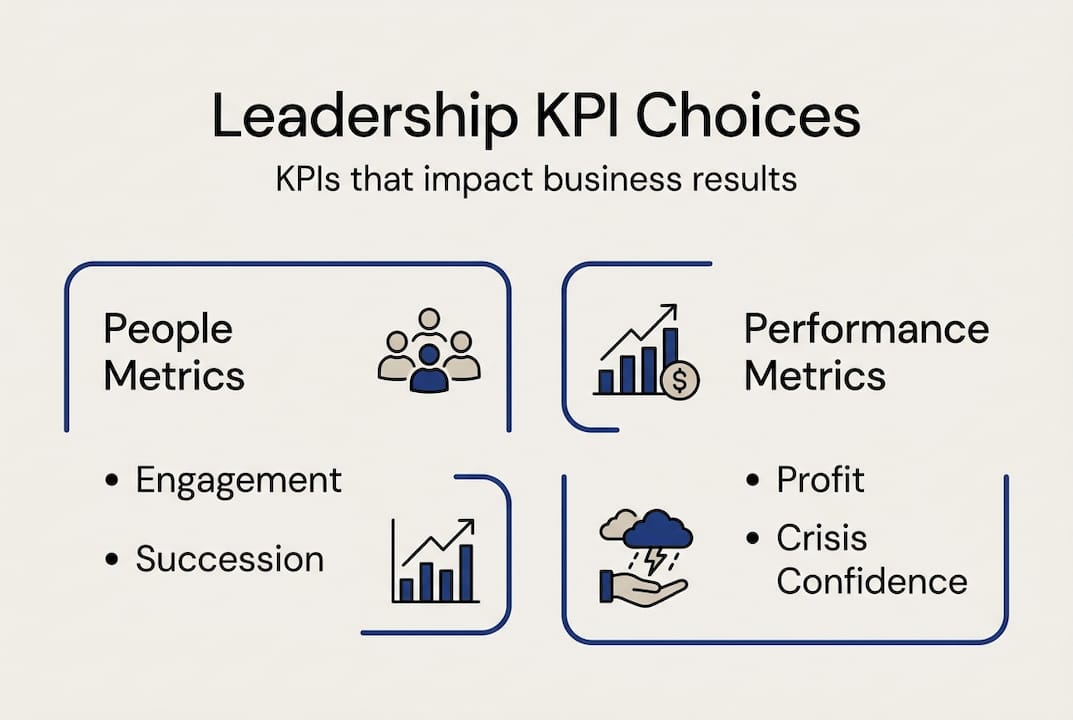
Proven leadership KPIs include succession readiness, employee engagement scores, and crisis confidence ratings. These connect directly to organizational resilience and long-term performance. Engagement improvements alone can drive 12% to 18% productivity gains and significant retention improvements. Crisis confidence ratings above 70% correlate with stronger stakeholder trust during periods of uncertainty.
Here is a practical framework for selecting leadership KPIs:
- Tie every KPI to a strategic outcome: If you cannot explain how a metric connects to customer value or competitive advantage, remove it.
- Measure leading indicators, not just lagging ones: Revenue is a lagging indicator. Engagement and succession readiness are leading indicators that predict future revenue.
- Limit the portfolio: Three to five leadership KPIs per executive is a manageable and meaningful set.
- Review and retire regularly: KPIs that no longer reflect current strategy should be replaced, not preserved out of habit.
Statistic to know: Organizations that track succession readiness as a formal KPI see up to 18% better retention among high-potential employees, according to leadership performance research.
The biggest pitfall is allowing KPIs to replace leadership judgment. Transformational leadership impacts firm performance through innovation and dynamic capabilities, but there is no direct link between KPI tracking and improved performance without considering leadership style. A metric is a signal, not a decision. Executives who treat KPI results as automatic verdicts are abdicating the interpretive responsibility that defines effective leadership.
Understanding how the metrics that matter are changing is essential context for any executive refining their KPI portfolio. The shift toward qualitative and predictive metrics is accelerating, and leaders who cling to purely financial KPIs will find themselves measuring the past rather than shaping the future. See how leadership teams use KPIs differently to stay ahead of this curve.
The uncomfortable truth: KPIs are only as strong as leadership
Here is what most KPI conversations miss entirely. Data creates the illusion of objectivity. When a dashboard turns red, it feels like the situation is clear. But metrics are always a simplified model of a complex reality, and leaders who forget this end up making confident decisions based on incomplete pictures.
The temptation to metricize everything is real, especially for executives under pressure to demonstrate accountability. But KPIs signal management failure when they replace judgment rather than inform it. Leadership style is crucial for KPI impact, and no framework compensates for a leader who has stopped thinking critically about what the numbers actually mean.
The executives we have seen get this right share one habit: they always ask "what is this metric not telling us?" before acting on it. That question keeps judgment alive in a data-rich environment. It prevents the false security that comes from a green dashboard while customers are quietly churning.
If you want to see how high-performing leadership teams use KPIs differently, the answer is almost always this: they treat metrics as conversation starters, not conversation enders.
Next steps: Elevate your leadership and KPI results
The strategies in this article only deliver value when they are put into practice consistently. That requires the right infrastructure behind your leadership decisions.
Outsprinter is built for exactly this. With real-time KPI tracking that updates instantly as teams enter data, executives get the visibility they need without waiting for weekly reports. The advanced task management tools let you assign ownership, set deadlines, and track accountability at every level of the organization. And the team performance platform brings dashboards, goal planning, and AI-powered insights together in one place. If you are ready to move from metric design to real performance improvement, Outsprinter gives your leadership team the tools to make it happen.
Frequently asked questions
How can CEOs ensure KPIs reflect both short-term and long-term organizational goals?
CEOs should pair metric design with narrative context, allocating 35% of focus to strategic alignment that connects immediate outcomes to broader organizational vision.
What are the most impactful leadership KPIs for driving team performance?
Succession readiness, employee engagement, and crisis confidence are proven leadership KPIs, with engagement improvements linked to 12% to 18% productivity gains and measurable retention improvements.
How does leadership engagement affect KPI results?
High leadership engagement correlates with 23% higher profitability and leadership program ROI of up to $7 per $1 invested, making it one of the most financially significant levers available to executives.
What's a common pitfall when using KPIs for leadership accountability?
The most common pitfall is allowing KPIs to replace leadership judgment entirely, which signals management failure and produces hollow performance metrics that do not reflect real organizational health.