
Mid-sized organizations often struggle with team misalignment, which causes inefficiency, stalled projects, and frustrated leaders. When teams operate without shared clarity on goals or strategy, collaboration suffers and execution slows. This guide provides CEOs, operations managers, and team leaders with a proven process to achieve alignment and improve collaboration. You will learn key strategies, performance metrics, and project management tools that create transparency and accountability. The upcoming key takeaways summarize core concepts and benefits of team alignment, setting the stage for a detailed exploration of how to master this critical process.
Table of Contents
- Understanding the team alignment problem: levels, challenges, and impact
- Preparing For Alignment: Prerequisites And Setting The 'Greater Good'
- Executing the team alignment process: steps, tools, and performance metrics
- Verifying and sustaining alignment: monitoring, troubleshooting, and continuous improvement
- Enhance your team alignment with Outsprinter
- What is the difference between alignment and agreement in a team context?
- How can leadership teams prevent misalignment that slows down execution?
- What role do project management tools play in sustaining team alignment?
Key takeaways
| Point | Details |
|---|---|
| Alignment operates on multiple levels | It functions across individual, team, cross-functional, and organizational dimensions, not just agreement. |
| Coordination problems need open dialogue | Addressing conflicting goals and incentives directly is essential to move forward effectively. |
| Leadership clarity drives execution speed | Shared strategic vision and clear metrics accelerate execution and boost morale significantly. |
| Conflicting incentives stall progress | Misaligned goals between departments cause friction and reduce productivity across teams. |
| Project tools enhance transparency | Using management platforms improves visibility, accountability, and collaboration across the organization. |
Understanding the team alignment problem: levels, challenges, and impact
After introducing the basics and key ideas, this section lays a foundation by clarifying the complexity of alignment problems so you see why a structured process is necessary. Organizational alignment operates on four distinct levels: individual, team, cross-functional, and organizational. Neglecting any level causes inefficiency and confusion. Individual alignment ensures each person understands how their daily tasks contribute to larger outcomes. Team alignment means members share priorities and work cohesively. Cross-functional alignment bridges departments like sales and operations. Organizational alignment connects every layer to the company's strategic vision.
Coordination problems often arise from conflicting goals and incentives within organizations. Sales teams may prioritize revenue growth while operations focus on cost control, creating friction. Human factors such as ego and turf protection worsen alignment problems. Leaders may resist open dialogue about strategic disagreements, allowing misalignment to fester. When coordination issues remain unresolved, teams duplicate efforts, miss deadlines, and experience low morale.
Misalignment in leadership teams significantly slows down execution and reduces team confidence. Research shows leadership misalignment reduces execution speed by 20 to 30 percent and decreases employee satisfaction significantly. Mixed messages from leadership cause confusion, duplicated efforts, and productivity loss. When executives send conflicting signals about priorities, teams waste time reconciling contradictory instructions. This confusion erodes trust and accountability across the organization.
Understanding these levels and challenges helps you diagnose where misalignment exists in your organization. Once you identify the problem areas, you can apply targeted strategies to restore clarity and collaboration. The next section explains how to prepare for the alignment process by establishing foundational clarity and shared purpose.
Common coordination challenges:
- Conflicting departmental goals that create internal competition
- Unclear decision rights and accountability structures
- Incentive systems that reward siloed behavior over collaboration
- Strategic disagreements left unresolved by leadership
- Lack of transparency in performance data and project status
"When teams operate without shared clarity on goals or strategy, collaboration suffers and execution slows. Alignment is the antidote to this organizational friction."
Recognizing these challenges is the first step. Next, you will learn how to prepare your organization for successful alignment by clarifying the 'Greater Good' and addressing coordination problems openly. For more on how performance alignment drives business success, explore our performance alignment guide for B2B leaders.
Preparing for alignment: prerequisites and setting the 'Greater Good'
After understanding the problem, this section shows how to prepare by establishing foundational clarity and shared purpose, enabling smooth execution ahead. Begin alignment by articulating an overarching 'Greater Good' aligned with company objectives. This shared purpose sits above individual team goals and provides a common reference point for decision making. When teams understand the 'Greater Good,' they can prioritize actions that benefit the entire organization, not just their department.
Host honest conversations to identify and surface coordination challenges, conflicting incentives, and team viewpoints. Create a safe environment where leaders and team members can voice concerns without fear of retribution. Facilitated workshops or alignment meetings encourage psychological safety and openness. These sessions reveal hidden friction points and allow teams to address them constructively. Transparency about challenges builds trust and commitment to the alignment process.

Clarify leadership's strategic vision, decision rights, and accountability structures upfront. When executives lack shared clarity on strategy and authority, teams receive mixed messages and struggle to execute. Define who makes which decisions and who owns which outcomes. Document these roles and communicate them clearly across the organization. This clarity eliminates ambiguity and empowers teams to act decisively.
Align incentives with shared objectives to reduce friction between teams. For example, if sales and operations have conflicting incentives, they will work at cross purposes. Adjust compensation, recognition, and promotion criteria to reward collaboration and collective success. When incentives reinforce the 'Greater Good,' teams naturally cooperate rather than compete.
Pro Tip: Use facilitated workshops or alignment meetings to ensure psychological safety and openness. Bring in a neutral facilitator if internal dynamics make honest dialogue difficult. Set ground rules that prioritize listening and understanding over defending positions.
Preparation checklist:
- Articulate the 'Greater Good' and communicate it across all levels
- Conduct open dialogues to surface coordination challenges and conflicts
- Clarify leadership roles, decision rights, and accountability structures
- Align incentive systems with shared organizational objectives
- Document and communicate strategic priorities and success metrics
With these prerequisites in place, you are ready to execute the team alignment process effectively. The next section provides a detailed, step-by-step guide to implementing alignment using performance metrics, project management tools, and communication best practices. Learn how management boards use Outsprinter to maintain strategic clarity and accountability. Discover how to move from strategy to execution with practical frameworks.
Executing the team alignment process: steps, tools, and performance metrics
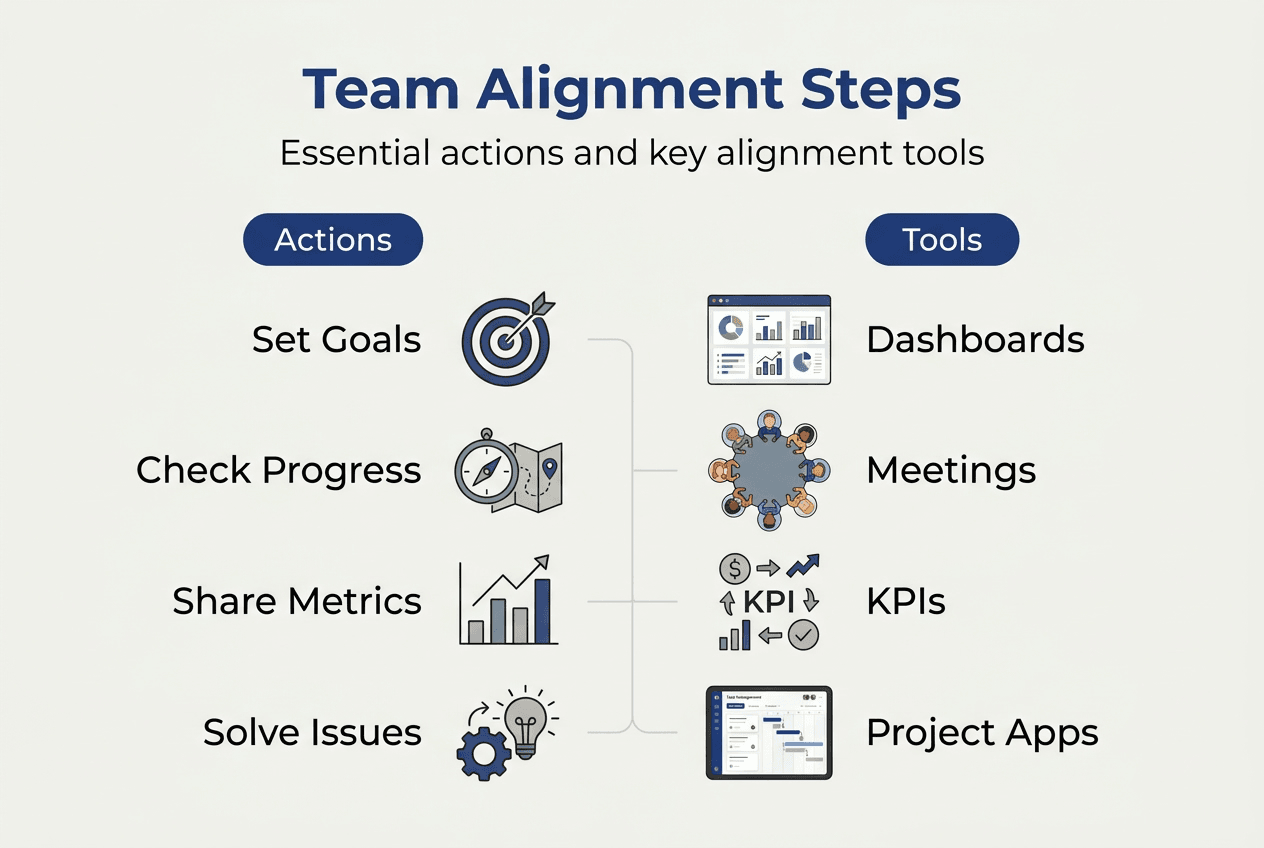
With preparation complete, this section delivers actionable steps and practical tools to implement the alignment process successfully. Follow these five steps to achieve and maintain team alignment using performance metrics, project management tools, and communication best practices.
Step 1: Clearly translate company objectives into measurable team goals and KPIs. Break down strategic objectives into specific, quantifiable targets for each team. Ensure every team understands how their KPIs connect to the 'Greater Good.' Alignment is about understanding how daily work connects to larger outcomes and feeling personally invested. When teams see the link between their tasks and company success, motivation and accountability increase.
Step 2: Use project management tools to track progress, visualize dependencies, and align workflows. Implement platforms that provide real-time visibility into project status, task assignments, and resource allocation. These tools help teams coordinate efforts, identify bottlenecks, and adjust plans proactively. Transparency in workflows reduces duplicated work and ensures everyone stays informed. Explore how project management tools enhance collaboration and execution.
Step 3: Conduct regular alignment check-ins and sprint reviews to maintain focus and adapt. Schedule weekly or biweekly meetings where teams review progress, discuss roadblocks, and adjust priorities. These cadences create accountability and ensure alignment does not drift over time. Use sprint reviews to celebrate wins, learn from setbacks, and refine processes. Consistent communication keeps teams synchronized and responsive to changing conditions.
Step 4: Promote data transparency to build mutual accountability and trust across teams. Share performance metrics, project dashboards, and KPI updates openly across the organization. Mixed messages from leadership increase project rework by 10 to 15 percent and reduce productivity. Transparent data eliminates mixed messages and ensures everyone operates from the same facts. When teams see each other's progress and challenges, they can offer support and collaborate more effectively. Read more about how data transparency builds stronger teams.
Step 5: Address conflicts early through facilitated discussions focusing on shared outcomes. When misalignment or disagreements arise, tackle them immediately rather than letting them fester. Use the 'Greater Good' as a neutral reference point to resolve conflicts. Facilitate discussions that focus on solutions and shared objectives, not blame or defensiveness. Early intervention prevents small issues from escalating into major coordination failures.
Pro Tip: Standardize alignment cadences and use dashboards to prevent mixed messages and duplication. Establish consistent meeting schedules, reporting formats, and communication channels. Dashboards provide a single source of truth that reduces confusion and keeps everyone aligned on priorities.
| Alignment Step | Key Actions | Tools and Metrics |
|---|---|---|
| Translate objectives | Define team KPIs linked to company goals | KPI dashboards, goal planning software |
| Track progress | Monitor tasks, dependencies, and workflows | Project management platforms, Gantt charts |
| Conduct check-ins | Hold regular sprint reviews and alignment meetings | Meeting agendas, retrospective templates |
| Promote transparency | Share performance data openly across teams | Real-time dashboards, shared reports |
| Resolve conflicts | Facilitate discussions focused on shared outcomes | Facilitation guides, conflict resolution frameworks |
By following these steps, you create a structured process that embeds alignment into your organization's daily operations. The next section explains how to verify that alignment is achieved and sustain it over time through monitoring, troubleshooting, and continuous improvement.
Verifying and sustaining alignment: monitoring, troubleshooting, and continuous improvement
After executing the process, you need to verify success and embed habits that keep alignment strong long-term. Use KPIs and project completion rates to monitor alignment health regularly. Track metrics like on-time delivery, team satisfaction scores, and cross-functional collaboration frequency. These indicators reveal whether alignment is holding or slipping. Regularly review dashboards and reports to spot trends and anomalies.
Watch for signs like stalled execution, duplicated work, low morale, and unclear accountability. These symptoms indicate misalignment has crept back into the organization. Unresolved strategic disagreements hinder collaboration and cause coordination failures. When you notice these warning signs, act quickly to diagnose and address the root causes. Delayed responses allow misalignment to deepen and spread.
Troubleshoot by revisiting strategic clarity, re-aligning incentives, and improving communication channels. If teams are confused about priorities, restate the 'Greater Good' and clarify objectives. If incentives drive conflicting behavior, adjust them to reward collaboration. If communication breaks down, establish clearer channels and more frequent check-ins. Leadership misalignment reduces project completion rates and team confidence, so leadership must model alignment consistently.
| Common Misalignment Issues | Effective Alignment Practices |
|---|---|
| Conflicting departmental goals | Shared 'Greater Good' and unified strategic vision |
| Unclear decision rights | Documented accountability and decision-making authority |
| Siloed incentive systems | Incentives rewarding collaboration and collective success |
| Infrequent or inconsistent communication | Regular alignment check-ins and transparent data sharing |
| Unresolved strategic disagreements | Facilitated discussions focused on shared outcomes |
Embed continuous improvement via retrospectives, feedback loops, and leadership coaching. After each project or sprint, conduct retrospectives to identify what worked and what needs improvement. Use feedback loops to gather input from teams and adjust processes accordingly. Invest in leadership coaching to strengthen alignment skills and build a culture of continuous learning. These practices ensure alignment evolves with your organization's needs.
Maintain transparency and adjust goals to evolving company priorities for sustained alignment. As market conditions, customer needs, or strategic objectives change, update team goals and KPIs to reflect new realities. Communicate these changes clearly and explain how they connect to the 'Greater Good.' Transparency about shifts in direction builds trust and keeps teams engaged.
Sustaining alignment over time:
- Monitor KPIs and project metrics to detect early signs of misalignment
- Address coordination issues promptly through open dialogue and facilitation
- Conduct retrospectives and gather feedback to drive continuous improvement
- Adjust goals and incentives as company priorities evolve
- Invest in leadership development to strengthen alignment capabilities
By verifying alignment regularly and embedding continuous improvement practices, you ensure that alignment becomes a lasting organizational strength. Learn how operations teams maintain alignment using structured processes and tools. Review our team management checklist for 2026 to boost project execution and sustain alignment.
Enhance your team alignment with Outsprinter
Having detailed how to execute and sustain alignment, consider Outsprinter as a technology partner to simplify and strengthen this process. Outsprinter offers tools focused on sprint management and team performance alignment. It integrates project management and KPI tracking for transparency and accountability. Designed for mid-sized organizations aiming to accelerate execution and boost collaboration, Outsprinter supports management boards and operations teams in maintaining alignment with strategic goals.
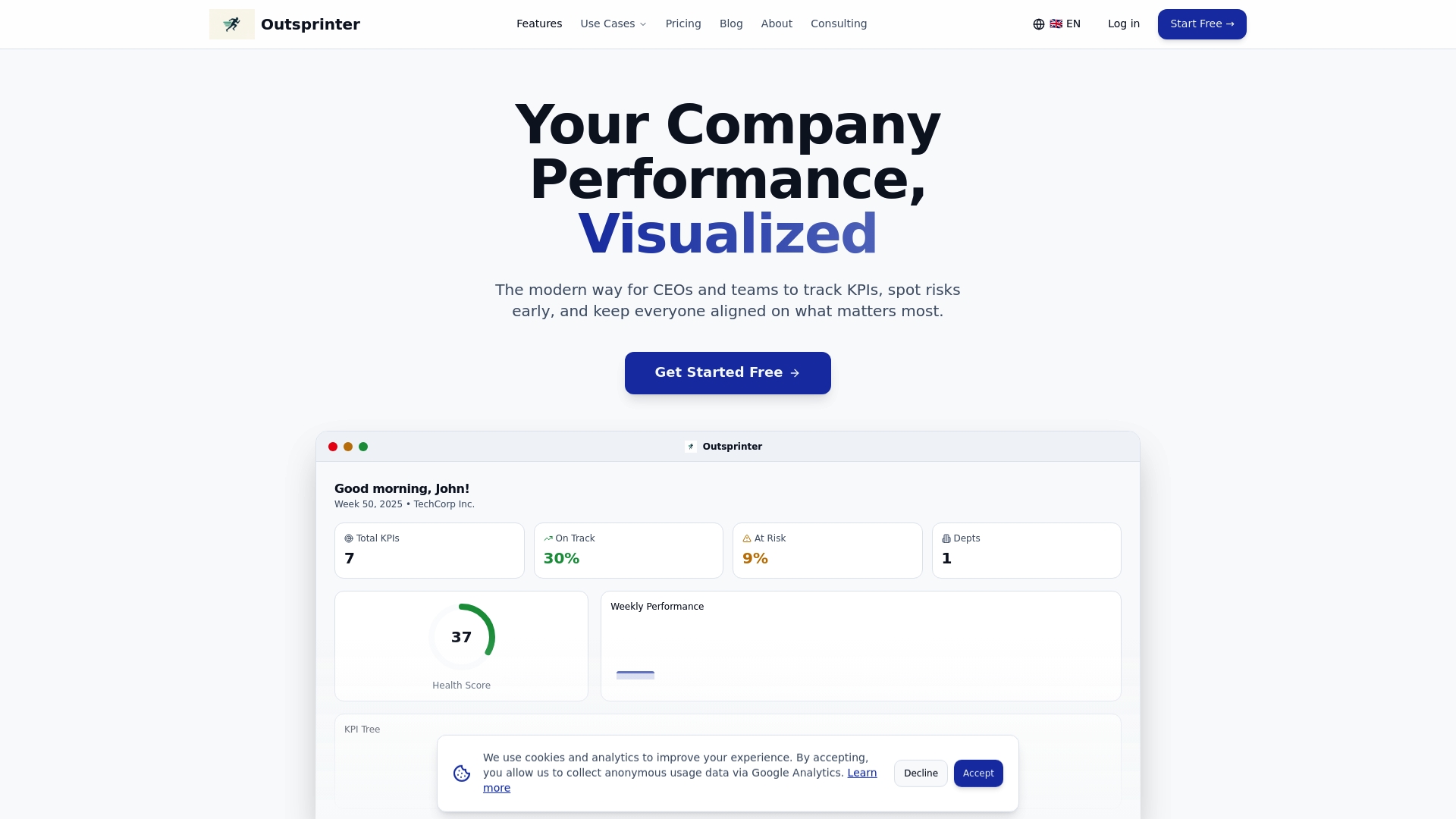
Outsprinter provides real-time dashboards that update instantly as teams enter data, ensuring everyone operates from the same facts. You can create, assign, and track tasks with priorities, deadlines, and recurring rules. Organize work into projects with health metrics, workload analysis, and progress tracking. Define, track, and visualize key performance indicators across your entire organization. Set yearly targets, break them into weekly milestones, and track progress toward strategic goals. Manage teams with org structure, role-based access, and department-level permissions. Stay informed with real-time alerts for task updates, KPI changes, and team activity.
What is the difference between alignment and agreement in a team context?
Alignment means shared clarity and commitment to goals, not necessarily full agreement on every detail. It involves understanding how daily work connects to larger outcomes and feeling personally invested. Team members can disagree on methods or tactics while remaining aligned on the ultimate objective. Agreement implies consensus on all points, which is often unrealistic and unnecessary. Alignment focuses on collective commitment to execute toward shared goals, even when individuals hold different perspectives.
How can leadership teams prevent misalignment that slows down execution?
Ensure shared clarity on strategy and decision-making authority across leadership. Leadership team misalignment is about the absence of shared clarity on strategy, decision rights, accountability, and rewarded behaviors. Communicate consistently and align incentives to reinforce collaboration and accountability. Hold regular leadership alignment sessions to surface disagreements and resolve them constructively. Document strategic priorities and communicate them transparently across the organization. Learn how high-performing leadership teams use KPIs to maintain alignment and drive results.
What role do project management tools play in sustaining team alignment?
They provide visibility into dependencies, progress, and roadblocks. Mixed messages from leadership lead to increased project rework and reduced productivity; project tools help mitigate this. They standardize communication channels, reducing confusion and duplicated work. Real-time dashboards ensure teams operate from the same facts and stay synchronized. Task tracking and workflow visualization make accountability transparent and keep teams focused on priorities. Explore our project management use case to see how tools enhance alignment and execution.