
Most managers believe they know how their teams are performing based on intuition and observation alone. Yet research shows that teams with structured performance measurement achieve 25% higher productivity and significantly better employee engagement. Without clear metrics and continuous feedback, you're flying blind, missing opportunities to align efforts with organizational goals and identify development needs before they become problems. This guide explains why measuring team performance matters, explores proven methodologies, addresses common pitfalls, and provides actionable strategies for remote and hybrid teams.
Table of Contents
- Key Takeaways
- Why measuring team performance is crucial for success
- Core methodologies and metrics for measuring team performance
- Challenges and nuances in measuring team performance effectively
- Applying measurement strategies for remote and hybrid teams
- Boost your team's performance with Outsprinter
- FAQ
Key Takeaways
| Point | Details |
|---|---|
| Clear success criteria | Structured metrics turn vague expectations into concrete goals that guide daily work. |
| Continuous feedback | Regular performance data enable early trend spotting and timely development instead of waiting for annual reviews. |
| Outcome based metrics | Remote and hybrid teams benefit from measuring results and clearly communicating expectations. |
| Balanced metrics | Using a mix of quantitative and qualitative indicators gives a fuller picture of performance. |
Why measuring team performance is crucial for success
Measuring team performance transforms vague expectations into concrete success criteria that everyone understands. When team members know exactly what good performance looks like, they can focus their energy on the right activities and make better daily decisions. This clarity eliminates the confusion that comes from subjective assessments and creates a shared understanding of priorities across the entire team.
Measuring team performance enables continuous feedback loops instead of relying on annual reviews that come too late to prevent problems. Regular performance data lets you spot trends early, celebrate wins immediately, and address issues before they escalate. This real-time insight helps you identify high performers who deserve recognition and development opportunities, while also pinpointing team members who need additional support or training.
Performance measurement aligns individual efforts with organizational objectives, ensuring everyone pulls in the same direction. Without this alignment, teams waste energy on work that doesn't move the needle on strategic goals. The data also reveals whether current initiatives actually contribute to business outcomes or simply keep people busy.
The engagement benefits are substantial. Teams with clear performance metrics report higher motivation because they can see their progress and understand how their work matters. This transparency builds trust and accountability, creating a culture where people take ownership of results rather than just completing assigned tasks.
"Performance measurement isn't about surveillance or punishment. It's about giving teams the information they need to improve, celebrate progress, and feel connected to meaningful outcomes."
Key benefits of structured performance measurement include:
- Increased productivity through focused effort on high-impact activities
- Better resource allocation based on actual performance data
- Improved employee retention when people see growth opportunities
- Faster problem identification before small issues become major obstacles
- Enhanced decision-making grounded in evidence rather than assumptions
Core methodologies and metrics for measuring team performance
Key performance indicators represent the quantitative backbone of team measurement. KPIs translate abstract goals into specific, trackable numbers that reveal progress over time. Common examples include task completion rate, which measures the percentage of assignments finished on schedule, and cycle time, which tracks how long work takes from start to finish. These metrics provide objective data points that remove subjective bias from performance conversations.

Objectives and Key Results create alignment by connecting team activities to strategic outcomes. OKRs define ambitious objectives, then identify 2-5 measurable key results that indicate progress toward each objective. This framework ensures teams focus on outcomes that matter rather than just staying busy with activities. For more on aligning team efforts with broader goals, explore our organizational performance guide.
The Balanced Scorecard integrates financial metrics with customer satisfaction, internal processes, and learning dimensions. This holistic approach prevents the tunnel vision that comes from tracking only revenue or output numbers. Team performance metrics should include both leading indicators that predict future performance and lagging indicators that confirm results.
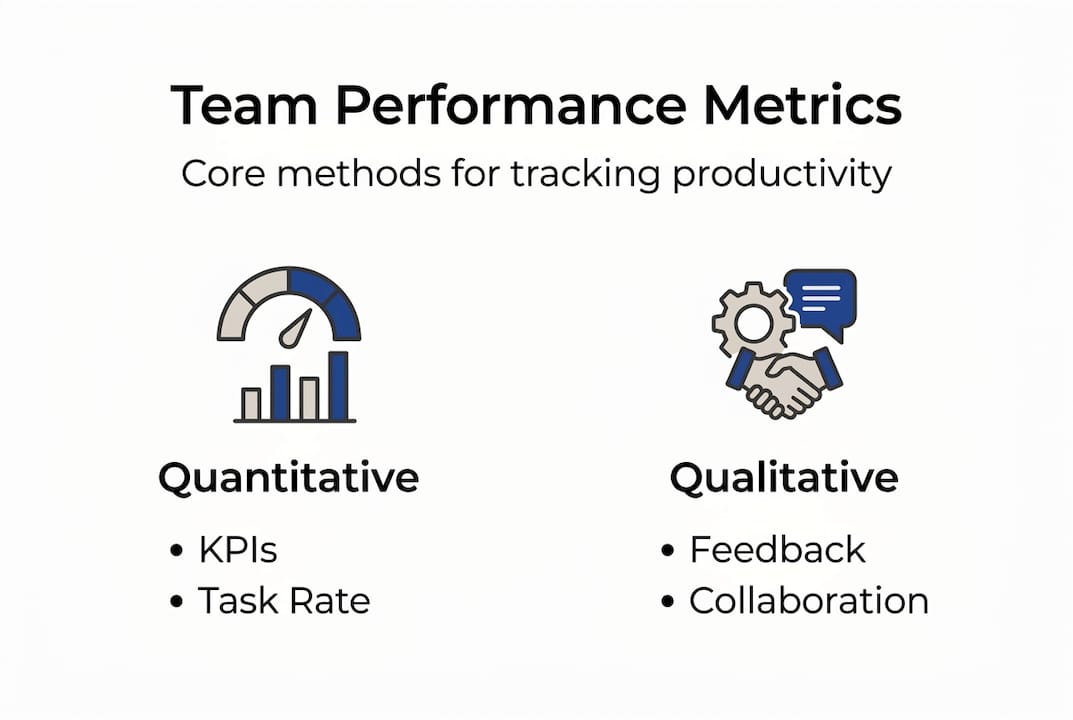
360-degree feedback gathers performance insights from multiple perspectives including peers, direct reports, and cross-functional partners. This multi-source approach reveals blind spots that managers alone might miss, particularly around collaboration quality and communication effectiveness. The feedback creates a more complete picture of how someone contributes beyond their individual deliverables.
Effective measurement combines output metrics with qualitative dimensions:
- Velocity: Story points or tasks completed per sprint
- Deployment frequency: How often code reaches production
- Collaboration quality: Peer feedback on teamwork and knowledge sharing
- Engagement scores: Survey data on motivation and satisfaction
- Innovation contributions: New ideas proposed or implemented
DORA metrics prove especially valuable for engineering teams. Measuring team performance methods include deployment frequency, lead time for changes, change failure rate, and time to restore service. These four metrics capture both speed and stability, preventing teams from sacrificing quality for velocity.
| Metric Type | Example | Calculation |
|---|---|---|
| Efficiency | Task completion rate | (Tasks completed on time / Total tasks) × 100 |
| Quality | Defect rate | (Defects found / Total deliverables) × 100 |
| Speed | Cycle time | Average days from task start to completion |
| Engagement | Participation rate | (Active contributors / Total team members) × 100 |
Pro Tip: Start with 3-5 core metrics rather than tracking everything possible. Too many metrics create confusion and dilute focus. Choose measures that directly connect to your team's primary objectives, then add complexity only when the basics are working smoothly. Our weekly KPI tracking guide helps you maintain the right balance.
Challenges and nuances in measuring team performance effectively
Quantitative metrics alone paint an incomplete picture of team performance. Output numbers miss critical signals about collaboration quality, knowledge sharing, and the innovative thinking that drives long-term success. A team might hit all their velocity targets while creating technical debt, damaging relationships with other departments, or burning out talented contributors. The numbers look good on paper, but the underlying health deteriorates.
Over-reliance on metrics creates risks of micromanagement and measurement bias. When managers obsess over every data point, teams feel surveilled rather than supported. This surveillance mentality destroys trust and shifts focus from outcomes to gaming the metrics. Team performance measurement pitfalls include tracking activity instead of results, which encourages people to look busy rather than be effective.
Input-oriented reporting particularly damages cross-functional collaboration. When teams must log hours or document every task for measurement purposes, they spend less time actually collaborating with colleagues from other departments. The administrative burden of tracking inputs consumes energy that could go toward creative problem-solving or relationship building. This effect intensifies in matrix organizations where people already juggle competing priorities.
Incentive structures tied to individual metrics can reduce teamwork, especially in environments with low social cohesion. If bonuses depend solely on personal output, why would someone help a struggling colleague or share knowledge that might make others more competitive? The measurement system inadvertently punishes collaboration and rewards selfish behavior.
Task type matters when designing measurement approaches. Routine, independent work responds well to quantitative tracking. Complex, interdependent projects require more qualitative assessment of how people navigate ambiguity and coordinate across boundaries. Applying the wrong measurement style to a task creates frustration and poor data.
| Approach | Strengths | Weaknesses |
|---|---|---|
| KPIs | Objective, easy to track, clear targets | May miss quality and collaboration, can encourage gaming |
| OKRs | Aligns with strategy, ambitious goals | Requires discipline, can feel abstract without clear metrics |
| Qualitative feedback | Captures collaboration and soft skills | Subjective, time-intensive, harder to aggregate |
| 360-degree review | Multiple perspectives, reveals blind spots | Can be political, requires psychological safety |
Common measurement mistakes to avoid:
- Changing metrics too frequently, preventing meaningful trend analysis
- Comparing individuals without accounting for role differences or project complexity
- Publishing performance data without context or explanation
- Using measurement as punishment rather than development tool
- Ignoring leading indicators until lagging indicators show problems
Pro Tip: Balance accountability with learning by separating developmental feedback from performance evaluation. Create safe spaces where teams can discuss failures and experiments without fear that honest reflection will hurt their ratings. This psychological safety enables the continuous improvement that rigid measurement systems often prevent. Learn more about avoiding KPI overload while maintaining accountability.
The most effective measurement systems evolve based on team maturity and changing business needs. What works for a startup differs from what works for an established enterprise team. Regularly review whether your metrics still align with current priorities, and adjust when they no longer drive the behaviors you need. Understanding high-performing teams KPIs can inform your approach.
Applying measurement strategies for remote and hybrid teams
Remote and hybrid teams require fundamentally different measurement approaches than co-located groups. The shift from office-based work eliminates casual observation, making outcome-based metrics essential. Activity monitoring through time tracking or surveillance software damages trust and misses the point entirely. Remote team performance measurement should focus on deliverables, impact, and results rather than hours logged or keyboard activity.
Frequent communication becomes a critical performance dimension for distributed teams. Regular video check-ins, async updates, and collaborative tools maintain alignment when people work across time zones and schedules. Measuring communication effectiveness through response times, meeting participation, and documentation quality reveals whether the team stays connected despite physical distance.
Input-focused reporting creates particular problems for remote cross-functional collaboration. When people must justify their time or document every activity, they hesitate to jump on quick calls with colleagues from other departments or spend time building relationships. The measurement overhead discourages the informal collaboration that often produces breakthrough solutions.
Implementing effective measurement for hybrid teams requires five key steps:
- Define clear outcomes and success criteria for each role and project before work begins
- Establish regular check-in cadences that balance accountability with autonomy
- Use collaborative tools that make progress visible without requiring manual reporting
- Create shared dashboards where everyone can see team metrics and individual contributions
- Solicit feedback on the measurement system itself and adjust based on what actually helps performance
Benchmarking metrics help identify performance gaps early in remote settings. Team performance benchmarking compares your team's results against similar groups or industry standards, revealing where you excel and where improvement is needed. This comparative data enables targeted interventions before small gaps become major problems.
Remote measurement best practices include:
- Emphasize asynchronous communication quality over real-time availability
- Track project milestones and deliverable completion rather than daily activities
- Measure collaboration through peer feedback and cross-functional project success
- Monitor engagement through participation in team discussions and initiatives
- Use pulse surveys to catch motivation or connection issues early
The most successful remote teams build measurement into their workflows rather than adding it as separate overhead. When project management tools automatically capture progress data and team dashboards update in real time, measurement becomes invisible. People focus on doing great work while the system quietly tracks what matters.
For remote teams, our organizational performance benchmarks and weekly KPI tracking guide provide frameworks that work across distributed environments without creating administrative burden.
Boost your team's performance with Outsprinter
Putting these measurement principles into practice requires the right tools and systems. Outsprinter provides a comprehensive platform designed specifically for teams that want to track balanced KPIs and OKRs without drowning in spreadsheets or manual reporting. The real-time dashboard updates automatically as your team enters data, giving you continuous performance insights without the administrative overhead that kills productivity.
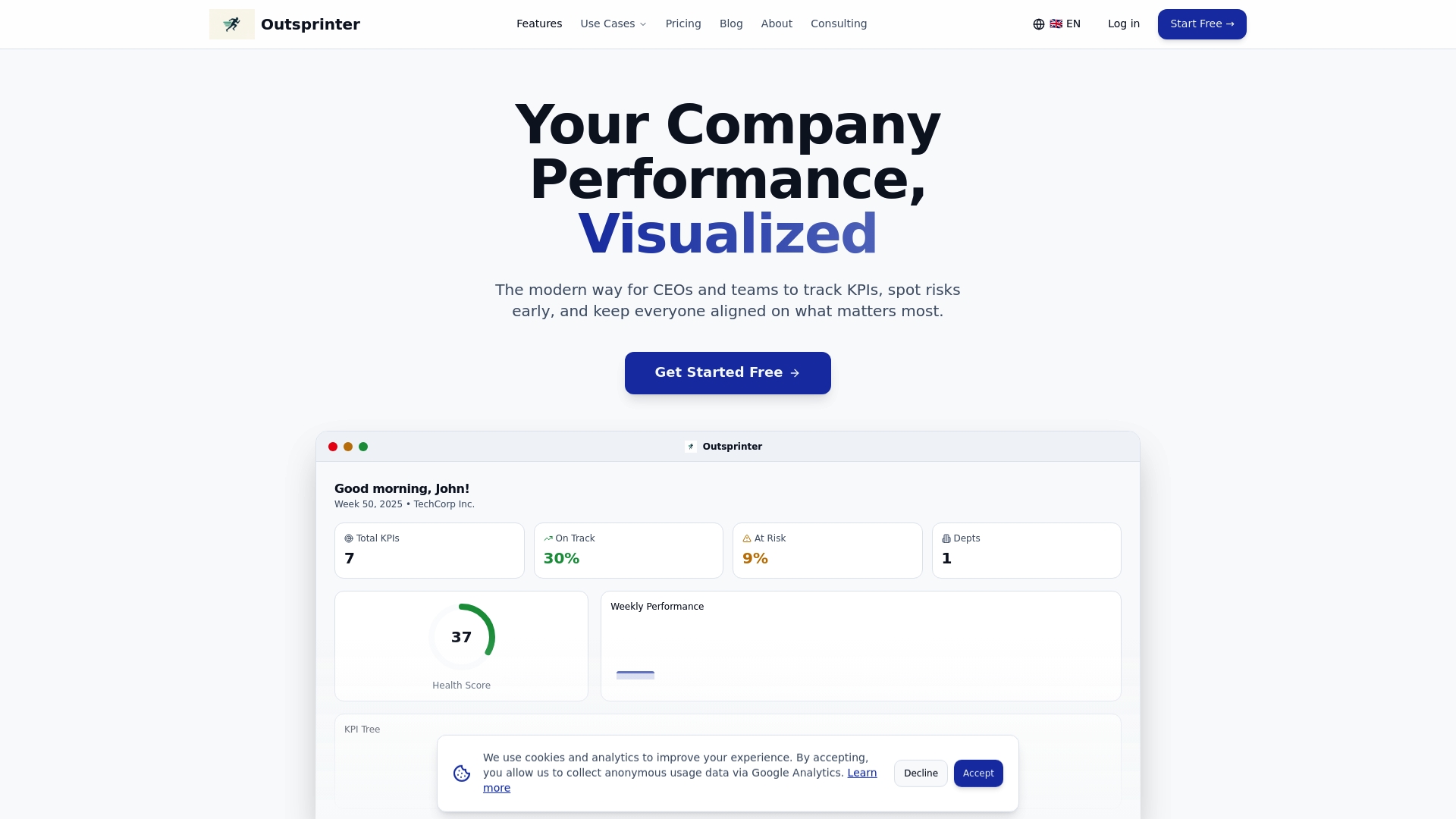
Our platform supports remote and hybrid teams with outcome-based tracking that respects autonomy while maintaining accountability. Built-in communication features keep distributed teams aligned, while customizable KPI management lets you measure what actually matters for your specific context. The AI assistant helps you design better metrics and analyze performance patterns you might otherwise miss.
Outsprinter empowers managers to align team efforts with organizational objectives efficiently through integrated goal planning that breaks yearly targets into weekly milestones. Role-based permissions ensure everyone sees relevant data without overwhelming them with information they don't need. Whether you're managing a project team or IT department, the platform adapts to your workflow rather than forcing you into rigid processes.
Pro Tip: Leverage data visualization and automated reporting features to surface insights that would take hours to find manually. When your team can see performance trends at a glance, they make better decisions faster and stay motivated by visible progress toward goals. Explore how Outsprinter can transform your team's performance measurement today.
FAQ
How often should team performance be measured?
Continuous measurement with weekly or biweekly check-ins delivers better results than annual reviews. Frequent feedback enables real-time course correction and keeps motivation high through regular recognition of progress. The exact cadence depends on your team's work cycle, but monthly intervals represent the maximum gap before measurement loses its developmental value.
What are the most effective metrics for measuring team performance?
Balanced metrics combining quantitative KPIs like task completion rate with qualitative feedback on collaboration quality work best. Effective measures align directly with team goals and role responsibilities rather than applying generic metrics across different contexts. Start with 3-5 core metrics that capture both efficiency and effectiveness, then refine based on what actually predicts success in your environment.
How can managers avoid micromanagement when measuring team performance?
Focus on outcome-based metrics and continuous feedback rather than tracking inputs or activities. Communicate the purpose of measurement clearly as a tool for team development and alignment, not surveillance or punishment. Give teams autonomy over how they achieve results while maintaining accountability for the results themselves. Trust combined with transparency prevents measurement from feeling like micromanagement.
What adjustments are needed for measuring remote team performance?
Emphasize outcome-driven metrics over activity tracking, and leverage communication tools for frequent connection. Avoid input-based reporting that creates administrative burden and disrupts the informal collaboration remote teams need. Measure asynchronous communication quality, project milestone completion, and engagement through participation rather than physical presence or hours logged. The focus shifts from observing work to evaluating results and maintaining team cohesion across distance.