
Many HR leaders worry AI will replace the human touch in performance management, turning nuanced employee evaluations into cold algorithms. The reality is far more promising. AI enhances rather than eliminates managerial judgment, automating tedious tasks while preserving the empathy and context only humans provide. This guide explores how AI transforms performance management, the measurable benefits enterprises achieve, critical challenges to navigate, and practical steps to implement AI solutions that amplify your team's effectiveness without sacrificing the personal connection employees need.
Table of Contents
- Key Takeaways
- Core AI technologies transforming performance management
- Measurable benefits from AI integration: time, productivity, and retention
- Navigating challenges: bias, ethics, and the irreplaceable human element
- Best practices for implementing AI in performance management
- Explore AI-powered solutions with Outsprinter
- What can AI realistically automate in performance management?
- How can organizations reduce bias when using AI for employee evaluations?
- What are best practices for piloting AI in performance management?
Key Takeaways
| Point | Details |
|---|---|
| AI augments judgment | AI enhances managerial judgment by automating routine tasks while preserving empathy and context. |
| Time and productivity gains | Enterprise case studies show substantial time savings and higher quality evaluations when AI handles administrative work. |
| Productivity and retention gains | Delta, IBM, and Windmill examples show large productivity improvements, hours saved, and reduced turnover through AI enabled reviews. |
| Pilot with metrics transparency | HR leaders should pilot AI initiatives with clear metrics and open communication to optimize outcomes and fairness. |
Core AI technologies transforming performance management
Three foundational technologies power modern AI performance systems. Machine learning algorithms analyze historical performance data to predict attrition risks and identify high-potential employees before traditional indicators surface. These models learn patterns from thousands of performance cycles, spotting subtle correlations human reviewers miss.
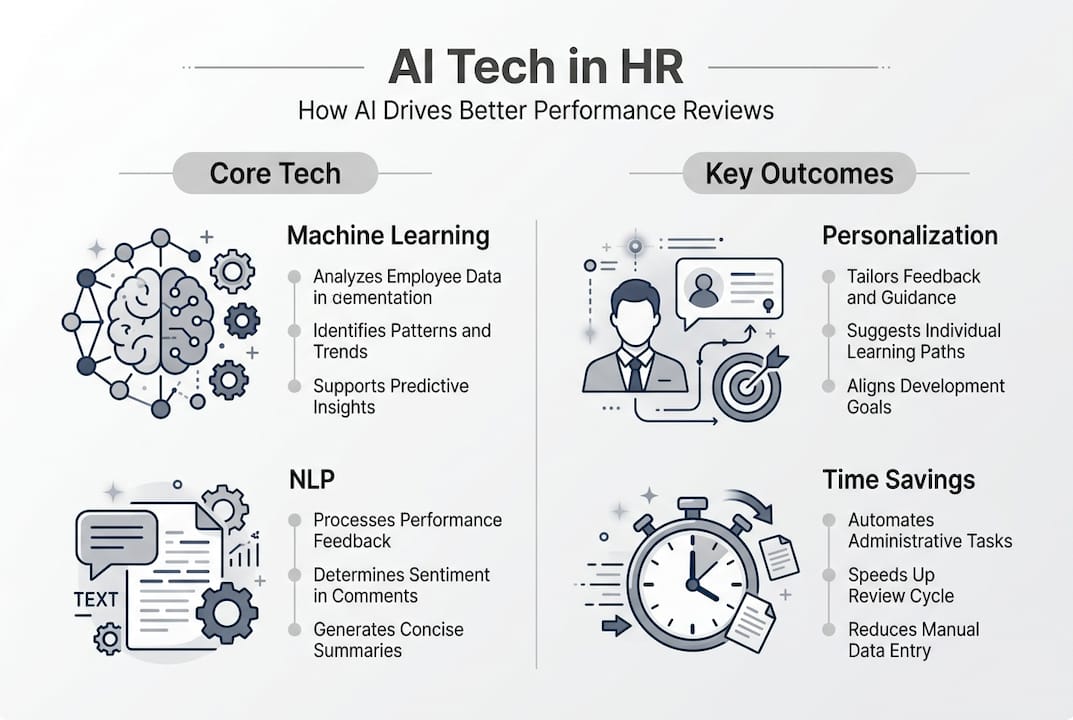
Natural language processing transforms unstructured feedback into actionable insights. NLP engines parse manager comments, peer reviews, and self-assessments to draft coherent performance summaries and identify recurring themes across teams. This technology eliminates hours of manual synthesis while surfacing blind spots in evaluation consistency.
Predictive analytics combines performance metrics with external factors like project complexity and team dynamics to forecast future outcomes. These systems recommend personalized development paths by matching skill gaps with training resources and suggest optimal goal targets based on historical achievement rates. Recommender algorithms cluster employees with similar growth trajectories to enable peer learning and targeted coaching interventions.
AI in HR teams reduces the administrative burden that typically consumes 40% of HR professionals' time. By automating routine tasks like review scheduling, reminder notifications, and data aggregation, these technologies free managers to focus on meaningful conversations and strategic talent decisions. The result is higher-quality evaluations delivered faster with less friction.
Pro Tip: Prioritize AI tools offering API integrations with your existing HRIS and performance systems to avoid data silos and duplicate entry.
Measurable benefits from AI integration: time, productivity, and retention
The business case for AI in performance management rests on hard numbers, not speculation. Delta's AI coaching implementation delivered a 90% reduction in time spent on performance reviews while achieving a 96% manager recommendation rate and 93% mid-year review completion. These metrics represent thousands of hours returned to productive work across the organization.

At enterprise scale, the gains multiply dramatically. IBM's AI-powered HR automation generated $4.5 billion in productivity improvements and saved 3.9 million labor hours annually. The company redirected this capacity toward strategic initiatives like leadership development and culture transformation rather than administrative processing.
Retention improvements provide another compelling return. Windmill's AI-enabled processes accelerated reviews by 90% while reducing employee turnover by 14.9%. Faster, more consistent feedback loops help employees course-correct quickly and feel valued through regular recognition, directly addressing top drivers of voluntary attrition.
| Organization | Time Savings | Business Impact | Manager Satisfaction |
|---|---|---|---|
| Delta Airlines | 90% faster reviews | 93% completion rate | 96% would recommend |
| IBM | 3.9M hours saved | $4.5B productivity gain | Not disclosed |
| Windmill | 90% faster cycle | 14.9% lower turnover | High adoption rate |
These outcomes stem from AI handling repetitive tasks while managers concentrate on coaching conversations. Automated goal tracking surfaces progress blockers in real time, enabling proactive support rather than reactive problem solving. Sentiment analysis flags disengagement signals before they escalate into resignation decisions.
The technology also improves fairness perception when implemented transparently. Employees appreciate consistent evaluation criteria applied uniformly across teams, reducing favoritism concerns that plague subjective review processes. This consistency builds trust in the performance system itself.
Boost organizational KPIs with AI by connecting individual performance data to strategic objectives. Dashboards visualize how each employee's contributions ladder up to company goals, creating alignment and purpose that traditional annual reviews rarely achieve.
Pro Tip: Calculate your current cost per performance review cycle including manager time, HR administration, and system overhead to establish a baseline ROI measurement before implementing AI solutions.
Navigating challenges: bias, ethics, and the irreplaceable human element
AI's promise comes with significant pitfalls that demand vigilant management. Algorithmic bias remains inevitable when training data reflects historical inequities in promotion rates, compensation, or performance ratings. Models trained on biased datasets perpetuate and sometimes amplify these patterns, creating legal exposure and eroding employee trust.
Three bias sources require ongoing attention. Data bias occurs when training sets underrepresent certain demographic groups or job functions, causing models to perform poorly for these populations. Algorithmic bias emerges from design choices like feature selection or optimization targets that inadvertently disadvantage protected classes. Interaction bias develops when users game the system or when feedback loops reinforce initial errors.
Mitigation strategies center on transparency and continuous monitoring. Diverse training data spanning multiple years, locations, and demographic segments reduces representation gaps. Regular audits comparing AI recommendations across protected groups reveal disparate impact before it affects actual decisions. Explainability features showing which factors influenced each rating enable human reviewers to catch nonsensical correlations.
Privacy concerns intensify as AI systems collect granular behavioral data. Keystroke monitoring, email sentiment analysis, and calendar activity tracking provide performance signals but cross ethical lines when employees lack awareness or consent. Legal frameworks lag behind technological capabilities, leaving organizations to self-regulate in a murky compliance landscape.
"AI integration may create employee perceptions of alienation if overused, underscoring the need for empathy and human oversight in performance decisions."
High task substitution where AI handles too much decision making disengages employees who feel reduced to data points. Performance management requires nuanced judgment about context, potential, and intangible contributions that algorithms struggle to capture. A manager knows when an employee's poor quarter resulted from taking on a struggling teammate's workload, context invisible in raw productivity metrics.
The solution lies in human-in-the-loop architectures where AI recommends but humans decide. Managers review AI-generated performance summaries and adjust ratings based on qualitative factors. HR teams audit model outputs for fairness before finalizing decisions. This approach preserves AI's efficiency gains while maintaining the empathy and judgment employees deserve.
Data transparency in AI reviews builds trust by showing employees which metrics inform their evaluations and how AI recommendations factor into final ratings. Clear communication about AI's role prevents the black box perception that fuels resistance and anxiety.
Performance alignment strategies balance AI-driven insights with collaborative goal setting that gives employees agency over their development paths. Technology should enable better conversations, not replace them.
Pro Tip: Establish an AI ethics committee including HR, legal, IT, and employee representatives to review performance AI implementations quarterly and update governance policies as risks evolve.
Best practices for implementing AI in performance management
Successful AI adoption follows a disciplined methodology that proves value before scaling. Start with limited pilots targeting specific pain points like review cycle completion rates or feedback quality. Randomized controlled trials comparing AI-assisted groups against control groups isolate true impact from confounding factors like seasonal trends or concurrent initiatives.
Measurement frameworks must track both technical performance and business outcomes. Technical metrics like model AUC, precision, and recall validate that AI predictions align with actual performance trajectories. Business KPIs including promotion velocity, voluntary turnover, and manager satisfaction reveal whether AI improves the employee experience and organizational health.
- Define success criteria before implementation including baseline measurements for comparison
- Select a representative pilot group spanning departments, seniority levels, and demographics
- Train managers on interpreting AI recommendations and overriding when context demands
- Collect qualitative feedback through surveys and focus groups to surface usability issues
- Analyze results after one full performance cycle to assess statistical significance
- Refine algorithms and processes based on pilot learnings before broader rollout
- Scale gradually with ongoing monitoring for performance degradation or bias drift
Vendor evaluation requires scrutiny beyond feature lists. Prioritize platforms offering explainability tools that show which factors drove each recommendation, enabling managers to validate logic and catch errors. Audit logs tracking all AI decisions and human overrides provide accountability and support compliance investigations.
Integration capabilities determine practical usability. APIs connecting to your HRIS, payroll, and project management systems eliminate manual data entry and ensure AI models access complete information. Real-time data feeds keep recommendations current rather than stale.
| Evaluation Criteria | Why It Matters | Questions to Ask |
|---|---|---|
| Explainability | Enables validation and bias detection | Can managers see which factors influenced ratings? |
| Audit trails | Supports compliance and accountability | Are all AI recommendations and overrides logged? |
| Integration depth | Reduces friction and data gaps | Which systems connect via API vs manual import? |
| Bias testing | Mitigates legal risk | How often are models audited for disparate impact? |
| Customization | Aligns with your evaluation philosophy | Can we adjust weighting of different performance factors? |
Change management determines adoption success as much as technology quality. Communicate AI's role transparently, emphasizing augmentation rather than replacement of human judgment. Involve managers in pilot design to build buy-in and surface concerns early. Celebrate quick wins publicly to build momentum and demonstrate value to skeptics.
Leadership review master guide principles apply to AI implementations, requiring clear objectives, stakeholder alignment, and iterative refinement. Technology alone never solves process problems, it amplifies existing strengths and weaknesses.
Build accountability with KPIs by connecting AI performance insights to team dashboards that visualize progress toward strategic goals. Transparency about how individual contributions aggregate into organizational outcomes motivates performance improvement more effectively than opaque ratings.
Pro Tip: Budget 20-30% of your AI implementation timeline for change management activities including training, communication, and feedback collection to ensure technology adoption translates into actual behavior change.
Explore AI-powered solutions with Outsprinter
Applying these AI performance management principles requires platforms built for the reality of modern work. Outsprinter combines AI-driven insights with intuitive interfaces that make performance tracking feel natural rather than burdensome. The platform's AI assistant analyzes your team's KPI data to surface patterns, recommend goal adjustments, and predict blockers before they derail progress.
Integration with existing systems eliminates the data silos that plague traditional performance tools. Import KPI data from Excel or connect via API to your project management and HRIS platforms for real-time visibility. Managers access performance dashboards showing individual and team progress without toggling between applications or requesting reports from HR.
The management board use case demonstrates how executives gain strategic visibility into organizational performance through AI-synthesized insights rather than manual report compilation. Project management capabilities link task completion and milestone achievement directly to performance evaluations, creating objective foundations for ratings.
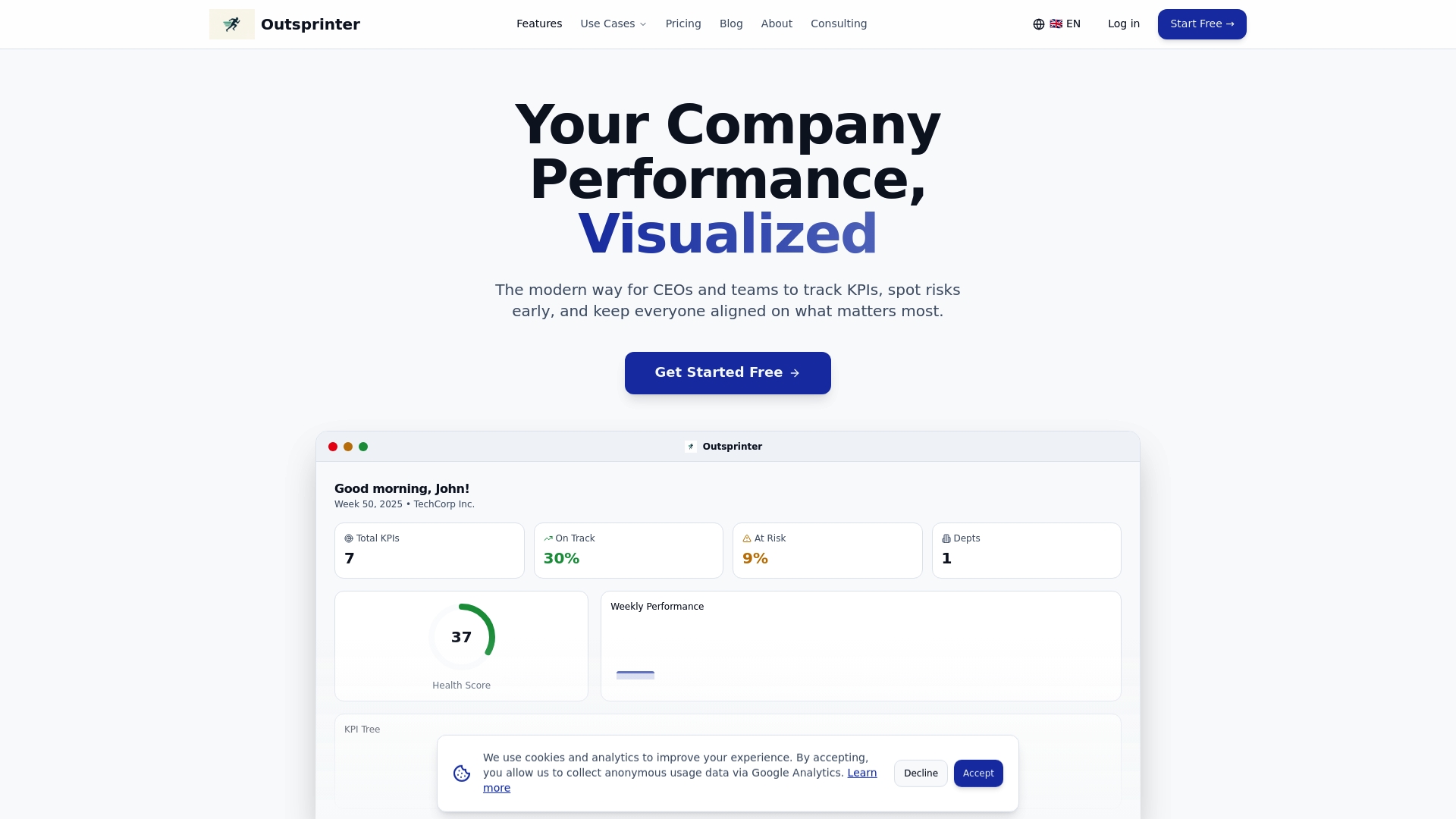
Outsprinter's goal planner breaks annual targets into weekly milestones, making ambitious objectives feel achievable through incremental progress tracking. AI recommendations adjust milestone targets based on actual velocity, preventing the demoralization that comes from unrealistic expectations. This approach keeps teams motivated and aligned without the micromanagement that erodes trust.
What can AI realistically automate in performance management?
AI excels at automating review drafting, feedback synthesis, goal tracking, and attrition prediction by processing structured performance data and unstructured text at scale. Natural language models generate coherent performance summaries from multiple input sources, saving managers hours per review cycle. Predictive algorithms identify flight risk employees by analyzing engagement patterns, enabling proactive retention conversations.
However, AI cannot replace human judgment in nuanced situations requiring context about personal circumstances, team dynamics, or strategic priorities. Managers must interpret AI recommendations through the lens of factors invisible to algorithms, like an employee's potential despite recent struggles or contributions that don't show up in metrics. The technology augments rather than replaces managerial expertise.
How can organizations reduce bias when using AI for employee evaluations?
Diverse training data, continuous audits, and explainable AI models form the foundation of bias mitigation. Training datasets must represent all demographic groups, job functions, and performance levels to prevent models from performing poorly for underrepresented populations. Regular statistical analysis comparing AI recommendations across protected classes reveals disparate impact before it affects actual decisions.
Transparency with employees about AI's role in evaluations builds trust and enables them to raise concerns about unfair treatment. Publishing the factors AI considers and allowing employees to review their performance data creates accountability that discourages both algorithmic and human bias. Human oversight remains essential, with managers empowered to override AI recommendations when context demands.
What are best practices for piloting AI in performance management?
Run randomized pilots with control groups to isolate AI's impact from confounding variables like seasonal trends or concurrent HR initiatives. Measure both technical metrics like model accuracy and business outcomes including turnover rates, promotion velocity, and manager satisfaction to assess holistic value. Pilot duration should span at least one complete performance cycle to capture the full employee experience.
Select vendors providing audit logs tracking all AI recommendations and human overrides for compliance and continuous improvement. Explainability features showing which factors influenced each rating enable managers to validate logic and catch nonsensical correlations. The leadership review process guide offers additional frameworks for evaluating AI implementations against strategic talent objectives.