
Leadership performance reviews often miss the mark. Executives and HR leaders struggle with vague feedback, misaligned metrics, and reviews that fail to drive real development. When done right, these evaluations become powerful tools for strategic alignment and team effectiveness. This guide walks you through preparing, executing, and verifying a leadership performance review process that delivers measurable results and genuine growth for your organization in 2026.
Table of Contents
- Preparing your leadership performance review process
- Executing the leadership performance review effectively
- Verifying outcomes and driving leadership development
- Common pitfalls and advanced tips for optimizing the review process
- Explore Outsprinter solutions for leadership performance management
- FAQ
Key takeaways
| Point | Details |
|---|---|
| Clear criteria drive results | Data-driven methods and objective benchmarks improve review effectiveness and reduce bias. |
| Preparation ensures alignment | Structured frameworks connect leadership assessment to organizational strategy and culture. |
| Follow-up embeds accountability | Regular check-ins and development plans turn review insights into sustained performance gains. |
| Avoid common pitfalls | Vague feedback and static KPIs undermine review value; tailored approaches prevent these failures. |
Preparing your leadership performance review process
Effective leadership reviews start with clear, objective criteria tied directly to company strategy. Effective CEO performance assessments incorporate strategic vision, operational efficiency, financial performance, team leadership, stakeholder engagement, and adaptability. Without this foundation, reviews become subjective exercises that fail to guide development or measure real impact.
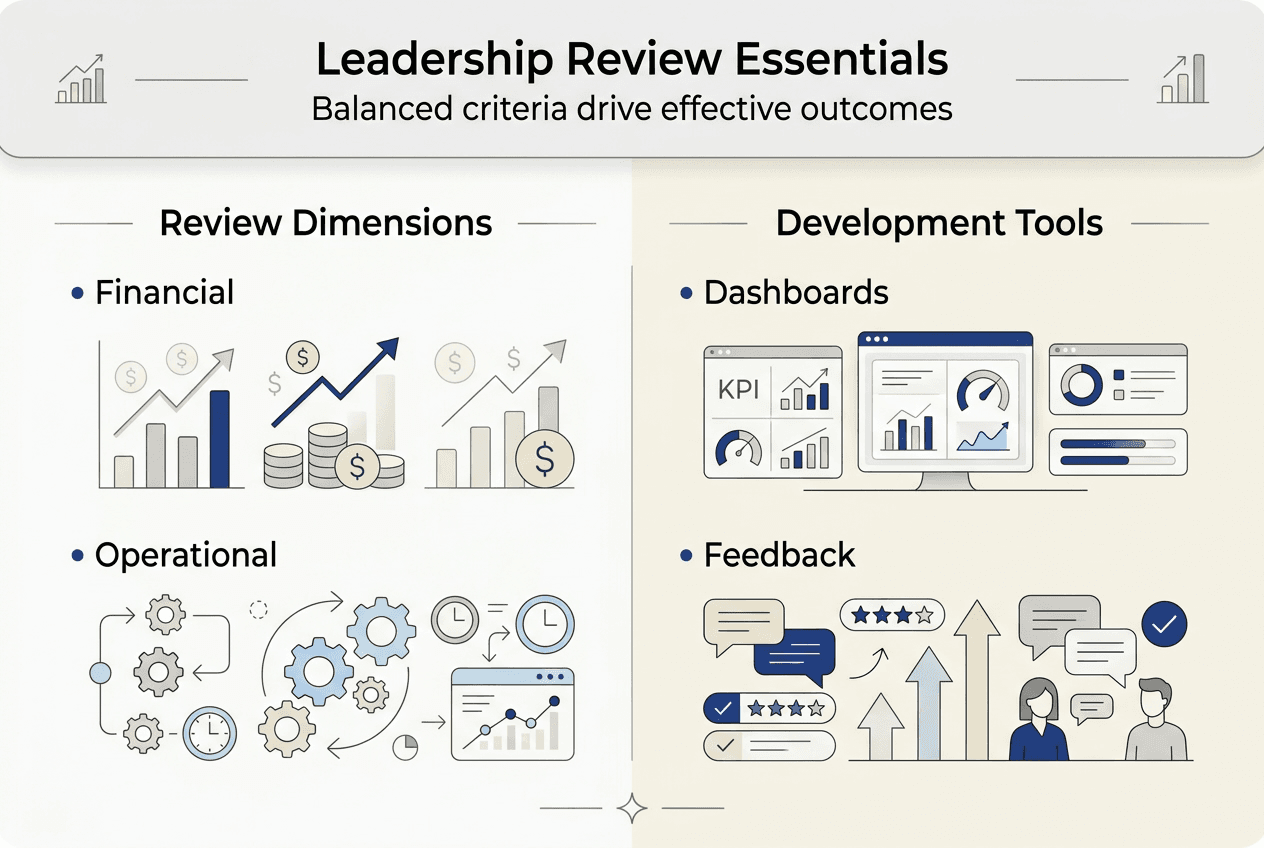
Your criteria should span three dimensions: financial results, operational execution, and leadership behaviors. Financial metrics might include revenue growth, margin expansion, or return on invested capital. Operational criteria cover process improvements, project delivery, and resource optimization. Leadership dimensions assess team engagement, talent development, and cultural influence. Each dimension needs specific, measurable indicators that reflect your organization's priorities.
Develop a review blueprint that maps each criterion to its data source and measurement method. This table becomes your evaluation roadmap:
| Criterion | Data Source | Measurement Method | | --- | --- | | Strategic vision execution | Leadership KPIs | Quarterly goal completion rate | | Team engagement | Employee surveys | Quarterly pulse scores | | Financial performance | Finance reports | Year over year growth percentage | | Stakeholder satisfaction | Client feedback | Net promoter score trends |
Prepare stakeholders on evaluation goals before reviews begin. Share the criteria, explain the data collection process, and clarify how results will inform development plans. This transparency reduces anxiety and increases buy-in. When leaders understand what success looks like and how it will be measured, they can focus energy on the right priorities.
Pro Tip: Engage multiple perspectives in the evaluation process to minimize bias and ensure balanced assessment. Combine self-assessment, peer feedback, direct report input, and board observations for a complete picture.
The preparation phase also requires reviewing past performance data to establish baselines. Look at trends over the previous 12 to 24 months to understand trajectory, not just point-in-time snapshots. This context helps you distinguish between temporary setbacks and systemic issues. It also reveals whether leaders are improving, plateauing, or declining in key areas.

Executing the leadership performance review effectively
With your framework ready, execute the review through a structured agenda that balances rigor with empathy. Start by collecting quantitative data from your predetermined sources: financial dashboards, project tracking systems, and engagement surveys. Then gather qualitative input through interviews with peers, direct reports, and key stakeholders. This combination prevents the review from becoming either purely numbers-driven or entirely anecdotal.
Follow this step-by-step process for the review conversation:
- Open with context by reviewing the evaluation criteria and the leader's self-assessment.
- Present data findings, highlighting both strengths and development areas with specific examples.
- Invite the leader to share their perspective on the data and any mitigating factors.
- Collaboratively identify 2-3 priority development goals based on the assessment.
- Document agreed-upon action steps, timelines, and support resources.
- Schedule follow-up check-ins to track progress on development goals.
Deliver feedback that is specific and behavior-based rather than general or personality-focused. Instead of "You need better communication skills," say "In the Q3 board presentation, key financial assumptions were unclear, leading to 30 minutes of clarifying questions. For Q4, prepare a one-page summary of assumptions upfront." This precision makes feedback actionable and removes ambiguity about what improvement looks like.
Create psychological safety during the review by acknowledging challenges and normalizing development needs. Leaders are more receptive to tough feedback when they trust the process serves their growth rather than punishing shortfalls. Frame the conversation as a partnership: "We're here to help you succeed in this role and prepare for future opportunities."
Edge cases and pitfalls include vague feedback, lack of follow-through, and failure to adapt KPIs to changing business conditions, requiring tailored approaches and psychological safety.
Use technology platforms to organize and document reviews systematically. Tools like Outsprinter centralize performance data, track development plans, and automate follow-up reminders. This reduces administrative burden and ensures nothing falls through the cracks. Digital documentation also creates a clear record for performance tracking over time, making it easier to spot patterns and measure progress.
The manager role in KPI tracking extends to ensuring leaders understand how their performance connects to broader organizational outcomes. During the review, explicitly link individual results to team and company KPIs. This reinforces strategic alignment and helps leaders see their impact beyond their immediate scope.
Verifying outcomes and driving leadership development
Reviews only create value when insights translate into action and accountability. Track leadership performance trends with clear metrics that reveal whether development efforts are working. Set up a dashboard that monitors the 3-5 most critical leadership KPIs for each role, updated monthly or quarterly depending on the metric's nature.
Use regular check-ins to review progress without micromanaging. Schedule brief monthly or bimonthly conversations focused on development goals, obstacles encountered, and adjustments needed. These touchpoints keep development top of mind and allow you to provide support before small issues become big problems. They also demonstrate organizational commitment to leader growth, which increases engagement and retention.
Integrate development plans directly into daily work rather than treating them as separate initiatives. If a leader needs to improve strategic thinking, assign them to lead a cross-functional initiative that requires long-term planning. If communication is the focus, have them present quarterly updates to the executive team. This experiential approach accelerates skill building and provides real-world practice.
Build accountability structures that encourage ownership without excessive oversight. Key activities for ongoing verification and development include:
- Monthly progress reviews on development goals with documented outcomes
- Quarterly 360-degree feedback pulses to track behavioral changes
- Peer coaching partnerships where leaders support each other's growth
- Executive sponsorship where senior leaders mentor those in development
- Access to external coaching or training resources as needed
The LeAD program at PepsiCo demonstrated that data-driven leadership assessment supports talent management and succession planning, fostering cultural shift. Their approach combined rigorous evaluation with personalized development, resulting in measurable improvements in leadership effectiveness and organizational performance.
This table summarizes approaches and tools for effective follow-up:
| Approach | Tool | Frequency | | --- | --- | | Progress tracking | Performance dashboard | Monthly | | Behavioral feedback | 360-degree surveys | Quarterly | | Development support | Executive coaching | Biweekly | | Accountability check | One-on-one reviews | Monthly |
Building accountability with KPIs requires balancing autonomy with visibility. Leaders should own their development journey while knowing the organization is tracking and supporting their progress. This balance fosters intrinsic motivation while maintaining clear expectations.
Common pitfalls and advanced tips for optimizing the review process
Even well-intentioned review processes fall into predictable traps. Vague or generic feedback ranks among the most common failures. Telling a leader they need to "be more strategic" or "improve execution" provides no actionable direction. Instead, specify the gap: "Your quarterly plans lack contingency scenarios for market downturns. Build three alternative scenarios into next quarter's plan."
Another frequent mistake is failing to adjust KPIs to reflect dynamic business contexts. A metric that made sense in a growth phase may become irrelevant during restructuring. Common pitfalls include vague feedback, failure to adapt KPIs, and insufficient follow-up; expert nuance calls for tailored reviews by leadership level and fostering psychological safety. Review your evaluation criteria annually to ensure they align with current strategic priorities and market conditions.
Insufficient follow-through on review outcomes undermines the entire process. When development plans sit in a drawer until the next annual review, leaders learn that the process is performative rather than meaningful. Embed follow-up into regular management rhythms through standing agenda items in executive meetings and automated tracking systems.
This comparison shows traditional versus optimized approaches:
| Traditional Approach | Optimized Approach |
|---|---|
| Annual review only | Quarterly check-ins plus annual comprehensive review |
| Single evaluator | Multi-source feedback from peers, reports, and board |
| Generic criteria | Role-specific, strategy-aligned criteria |
| Verbal feedback only | Documented feedback with specific examples and data |
| No follow-up system | Structured development tracking with accountability |
Advanced process improvements to consider:
- Calibrate ratings across evaluators to ensure consistency and fairness
- Use KPI thresholds to create objective performance bands
- Incorporate external benchmarking to contextualize internal performance
- Separate development conversations from compensation decisions to reduce defensiveness
- Train all evaluators on feedback delivery and bias recognition
Pro Tip: Customize the review method to leadership role and team culture. A startup CEO needs different evaluation criteria than a division president in a mature corporation. Frontline leaders require more frequent, operational feedback while C-suite executives benefit from strategic, long-term assessments.
The most sophisticated organizations treat leadership reviews as ongoing conversations rather than annual events. They build feedback loops into weekly team meetings, monthly one-on-ones, and quarterly business reviews. This continuous approach makes formal reviews a synthesis of known information rather than a surprise revelation, reducing anxiety and increasing developmental impact.
Explore Outsprinter solutions for leadership performance management
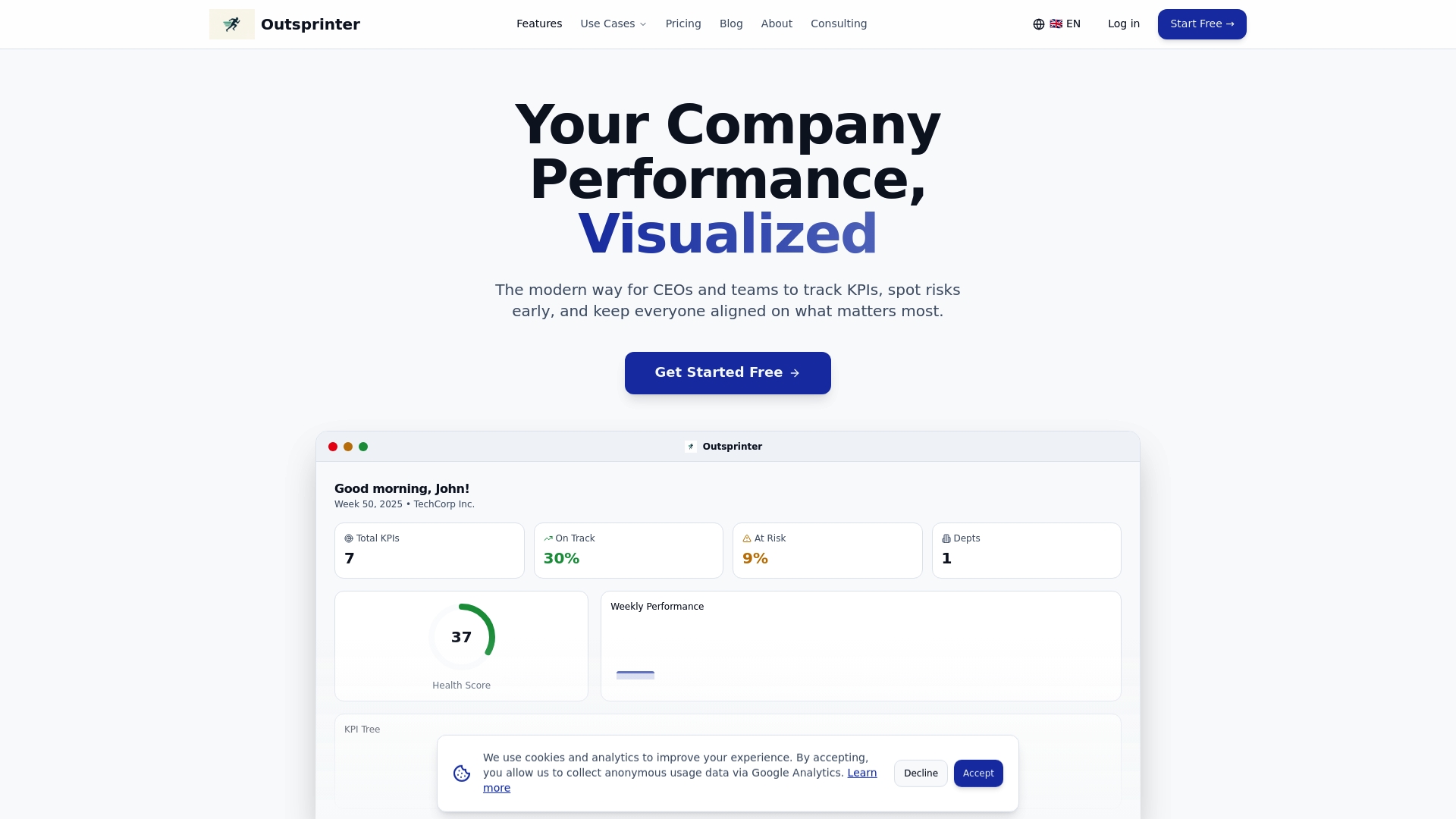
Managing leadership performance reviews manually creates unnecessary complexity and risk. Outsprinter offers comprehensive tools to track leadership KPIs, facilitate transparent communication, and align leadership goals with organizational strategy. The platform centralizes performance data from multiple sources, automates review workflows, and provides real-time visibility into development progress.
Key features supporting your review process include:
- Real-time KPI dashboards that update as performance data changes
- Customizable review templates aligned to your evaluation criteria
- Automated reminders for check-ins and development milestones
- Multi-source feedback collection and aggregation
- Trend analysis showing leadership performance over time
The Outsprinter performance platform enables you to move from spreadsheets and email threads to a unified system where all stakeholders access the same information. Management board solutions provide executive teams with strategic oversight while project management features help track development initiatives tied to review outcomes.
Pro Tip: Leverage Outsprinter to minimize manual effort and bias by standardizing data collection and creating consistent evaluation processes across your leadership team.
FAQ
How often should leadership performance reviews be conducted?
Annual comprehensive reviews remain standard practice, but supplementing them with quarterly check-ins significantly improves agility and responsiveness. Quarterly touchpoints allow you to course-correct quickly and provide timely feedback when it's most relevant. The optimal frequency depends on your organizational pace and the leadership level being evaluated.
What are the most effective criteria to evaluate CEOs and senior leaders?
Use a balanced mix of financial results, strategic execution, leadership behaviors, and stakeholder engagement metrics. Financial criteria might include revenue growth and profitability, while strategic measures assess goal achievement and market positioning. Leadership dimensions cover team development, culture building, and change management. Adapt these criteria to your company strategy and current market conditions for maximum relevance.
How can organizations reduce bias in leadership performance reviews?
Implement multi-source feedback that incorporates perspectives from peers, direct reports, and board members alongside supervisor assessments. Use data-driven approaches with objective metrics wherever possible. Train all evaluators on unconscious bias recognition and employ standardized rating scales with clear behavioral anchors. Calibration sessions where evaluators discuss ratings together also help ensure consistency and fairness across the leadership team.
What role does psychological safety play in performance reviews?
Psychological safety fosters open dialogue and receptiveness to developmental feedback. When leaders trust the process serves their growth rather than punishment, they engage more honestly in self-reflection and are more willing to acknowledge weaknesses. This openness increases the chances of constructive development and builds trust between leaders and the organization, ultimately improving retention and performance outcomes.