
TL;DR:
- Project tracking failure is often due to poor visibility and inconsistent updates rather than lack of talent.
- Effective tracking improves project success, reduces overruns, and enhances team accountability through visual tools and KPIs.
- Most failures stem from cultural issues like unclear ownership and poor communication, which can be mitigated with the right habits and tools.
Projects derail quietly. One missed update, one unclear owner, one KPI nobody checks, and suddenly you're explaining a 20% cost overrun to leadership. Projects fail 12% of the time and experience a 27% cost overrun on average, and the root cause is almost never a shortage of talent. It's a shortage of visibility. This guide walks you through a practical, evidence-based system for tracking project progress, managing tasks, and keeping your team accountable from kickoff to delivery. You'll come away with concrete tools, a repeatable process, and the mindset shifts that separate high-performing teams from the rest.
Table of Contents
- Understand the project tracking process: Key concepts and outcomes
- Prepare for success: Essential tools and preconditions
- Step-by-step project tracking: From kickoff to delivery
- Troubleshooting, optimization, and measuring success
- What most teams get wrong about project tracking
- See how Outsprinter simplifies project tracking
- Frequently asked questions
Key Takeaways
| Point | Details |
|---|---|
| Track what matters | Focusing on a few high-impact KPIs leads to better project results and less overwhelm. |
| Prep drives execution | Setting up the right tools and clear baselines is critical for smooth project tracking. |
| Continuous review | Regular check-ins and adaptation prevent overruns and boost team accountability. |
| Software multiplies gains | Choosing the right project management platform can improve productivity and quality significantly. |
Understand the project tracking process: Key concepts and outcomes
Project tracking is the continuous process of monitoring progress against a plan. It covers timelines, budgets, resource allocation, and KPIs (key performance indicators, meaning the measurable values that show whether a project is on course). When tracking is done well, problems surface early. When it's done poorly, surprises show up at the worst possible moment.
The most common pain points project managers report are late tasks, budget leakage, and unclear accountability. These aren't random. They're symptoms of a tracking system that either doesn't exist or isn't being used consistently. High-performing teams are 2.5x more likely to succeed, and small to mid-sized companies see 25% fewer overruns when they apply effective tracking practices.
Here's what disciplined tracking actually produces:
- Fewer budget overruns because deviations are caught early
- Higher team productivity through clear task ownership
- On-time delivery driven by milestone accountability
- Better stakeholder confidence from regular, data-backed updates
A few terms worth defining upfront. A Gantt chart is a visual timeline showing tasks, durations, and dependencies. A sprint is a short, fixed work period (usually one to four weeks) where a defined set of tasks must be completed. A dashboard is a real-time visual display of project health metrics. These tools feed into your task management features and give you a live picture of where things stand.
| Tracking output | Purpose | Frequency |
|---|---|---|
| Status report | Summarize progress vs. plan | Weekly |
| KPI dashboard | Visualize key metrics in real time | Daily/ongoing |
| Sprint review | Assess completed work and blockers | End of each sprint |
| Budget variance report | Track spend against forecast | Bi-weekly |
| Status meeting | Align team on priorities and issues | Weekly |
Using task management tools alongside these outputs creates a closed feedback loop where data informs decisions, not just documentation.
Prepare for success: Essential tools and preconditions
Understanding the process sets the stage. The next step is ensuring you have the right setup and tools before tracking begins.
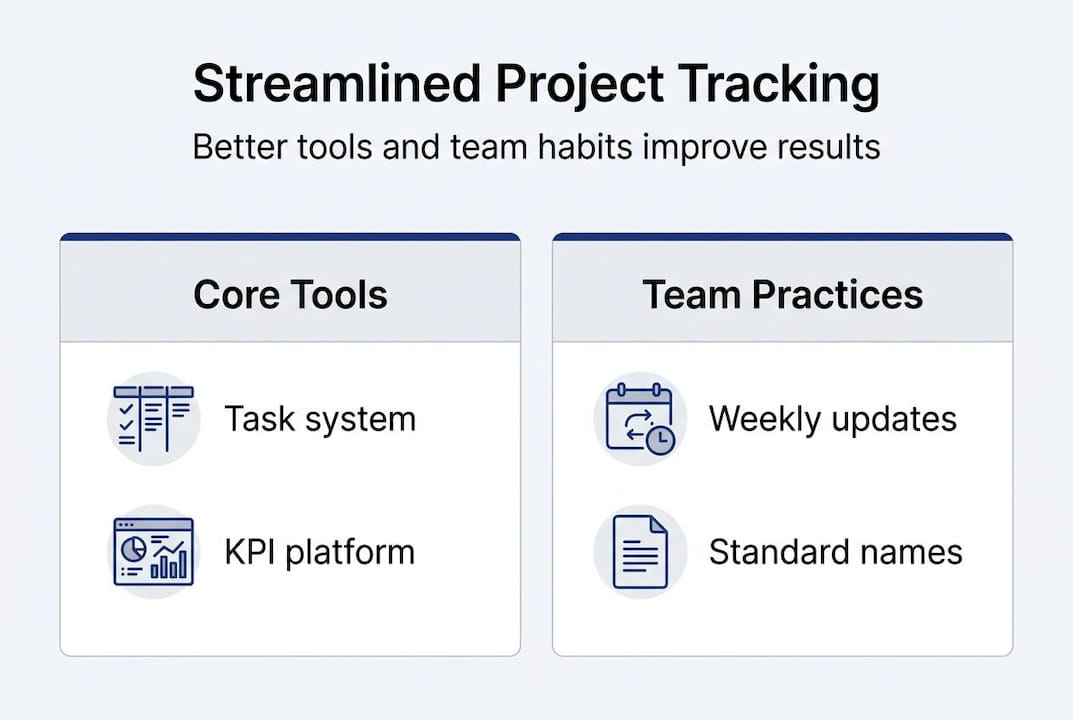
Every reliable project tracking environment needs four core components: a task management system, a KPI tracking platform, a reporting or dashboard tool, and a communication hub. Miss any one of these and you'll have gaps in visibility that turn into gaps in performance.

PM software improves quality by 44% and productivity by 25%, which means the choice between manual and software-based tracking isn't just about convenience. It's about results.
| Factor | Manual tracking | Software-based tracking |
|---|---|---|
| Ease of setup | High | Moderate |
| Real-time visibility | Low | High |
| Collaboration | Limited | Built-in |
| Error risk | High | Low |
| Scalability | Poor | Strong |
Before you launch any tracking system, a few preconditions must be in place:
- Goal clarity: Every team member must know what success looks like for this project
- Stakeholder buy-in: Tracking only works if people actually use it, which requires leadership support
- Baseline KPIs: You need a starting point to measure improvement against
- Defined roles: Accountability requires clear ownership, not shared responsibility for everything
Pro Tip: Standardize naming conventions for tasks, projects, and KPIs before you start. "Website redesign phase 2" and "Web redesign P2" are the same thing to a human but create confusion in reports and filters.
A marketing agency that implemented structured tracking with best task management software reported doubling their campaign output within two quarters. The change wasn't headcount. It was visibility. Once managers could see which tasks were blocked and why, they unblocked them faster. Your project management features should support that kind of real-time awareness from day one.
Step-by-step project tracking: From kickoff to delivery
With your project tracking environment ready, it's time to put the process into action.
Here is a proven, repeatable sequence that works across industries and team sizes:
- Project kickoff and scope definition. Document what's in scope, what's out, and who owns what. A poorly scoped project will defeat any tracking system.
- Define KPIs. Choose three to five metrics that directly reflect project health. Avoid tracking everything. Focus on what signals success or failure.
- Map milestones. Break the project into major checkpoints with firm dates. Milestones create natural accountability moments.
- Assign and track tasks. Every task needs an owner, a deadline, and a priority level. This is where task management software earns its keep.
- Monitor through sprints. Run short execution cycles of one to two weeks. Each sprint ends with a review of what was completed and what's blocked. Agile sprint management practices are especially effective here.
- Course corrections. When a KPI drifts or a milestone slips, act immediately. Don't wait for the next monthly review. Short feedback loops are your best defense against overruns.
- Delivery and retrospective. Close the project with a formal review. What worked? What didn't? Document lessons so the next project starts smarter.
Automation offers the most leverage at steps 4, 5, and 6. Automated task reminders, KPI alerts, and dashboard updates reduce the manual burden and keep data current without relying on people to remember to update spreadsheets.
Implementing Agile reduces cost overruns by 28%, which is why the sprint-based approach in step 5 isn't just for software teams. Any team that needs execution rhythm benefits from short cycles and structured reviews.
Pro Tip: Tie your weekly standup meetings directly to updated dashboard metrics. Instead of asking "what did you work on?", ask "what does the dashboard show, and what's causing any red flags?" This keeps conversations grounded in data, not memory.
Troubleshooting, optimization, and measuring success
Even with the best process, hiccups happen. Here's how to spot and solve them, then keep raising your standard.
The most common tracking pitfalls are surprisingly consistent across teams:
- Poor communication: Updates don't flow to the right people at the right time
- Metric overload: Tracking 20 KPIs dilutes focus and creates reporting fatigue
- Ignoring baseline data: Without a starting point, you can't measure improvement
- Inconsistent updates: When team members skip updates, the dashboard becomes fiction
When something goes wrong, run through these quick checks before assuming the process is broken:
- Are task owners clearly assigned and aware of their responsibilities?
- Is the dashboard being updated in real time or manually after the fact?
- Are sprint reviews happening consistently, or being skipped under pressure?
- Are KPIs connected to actual project outcomes, or just activity metrics?
"Quantifying KPIs and course correction is the key difference between high and average performers."
Projects fail or are challenged in nearly 60% of cases, but teams that quantify KPIs and act on them consistently beat those odds. The team management checklist approach helps you build that habit systematically.
| Area | Before optimization | After optimization |
|---|---|---|
| Milestone hit rate | 55% | 82% |
| Budget variance | +18% over | +4% over |
| Team update compliance | 60% | 95% |
| Issue resolution time | 5 days | 1.5 days |
Tracking KPI tracking ROI isn't just about proving value to leadership. It's about giving your team a feedback signal that motivates improvement. When people see the numbers move, they stay engaged.
What most teams get wrong about project tracking
Here's the uncomfortable truth: most teams that struggle with project tracking aren't missing tools. They're missing culture.
More data doesn't automatically mean better decisions. We've seen teams with 15-metric dashboards consistently underperform teams tracking just three well-chosen KPIs. Selective focus is more powerful than exhaustive measurement. The goal is signal, not volume.
The second issue is psychological safety. Tracking systems only work when people feel safe reporting slippages honestly. If your team knows that a red status update triggers blame rather than problem-solving, they'll keep it yellow until it's too late. Accountability and safety aren't opposites. The best tracking cultures have both.
Software is a multiplier, not a fix. A team with poor habits and great software will produce bad data faster. But a team with good habits and the right tools, including strong improving team collaboration practices, will outperform almost any benchmark. Think of project tracking as a living practice that evolves with your team, not a system you set up once and forget.
See how Outsprinter simplifies project tracking
For teams ready to put everything covered here into practice, having the right platform makes all the difference.
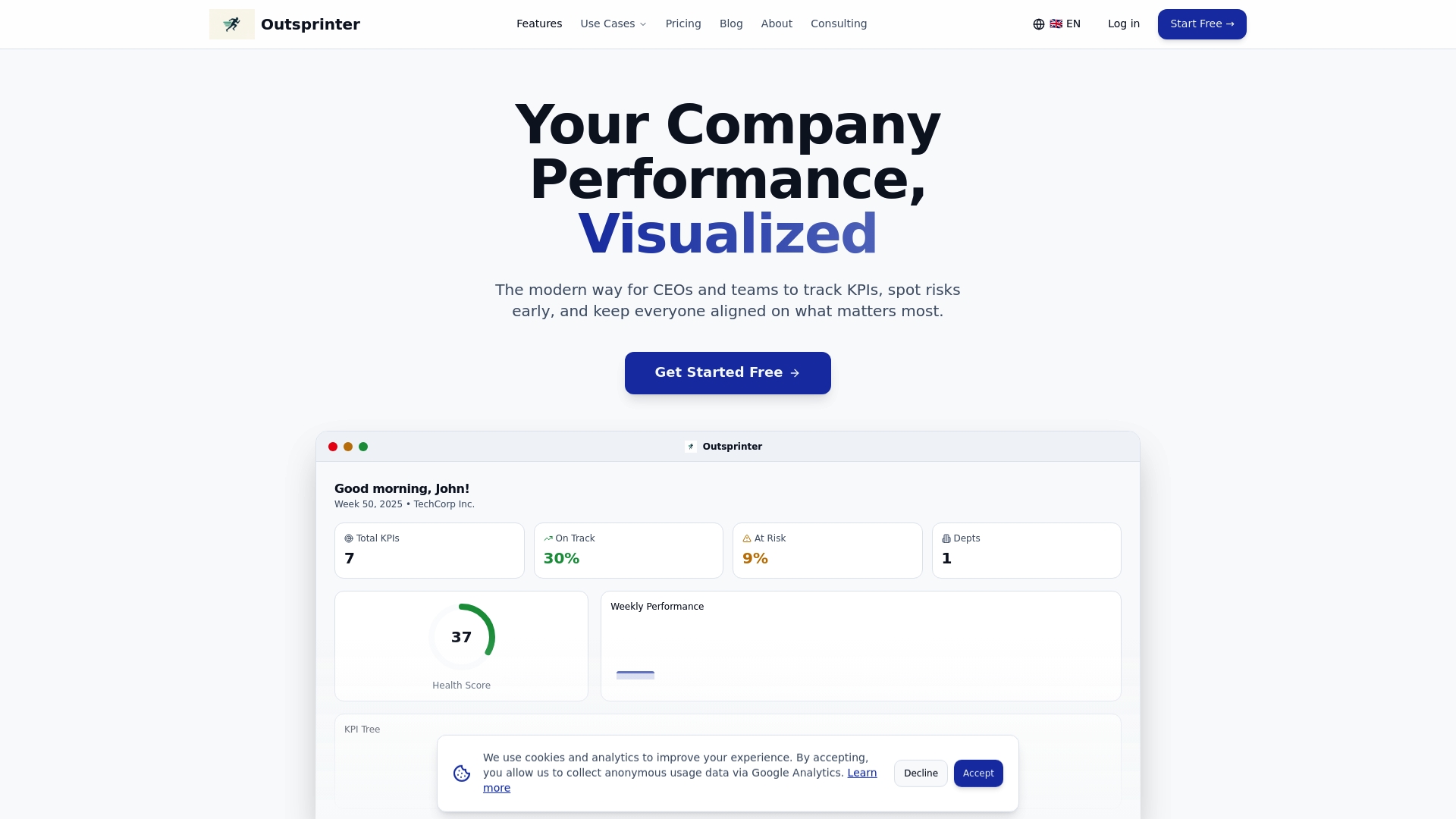
Outsprinter brings together every phase of the process in one place. The project management platform gives you health metrics, workload analysis, and progress tracking across all your projects. Real-time KPI tracking lets you define, visualize, and act on the metrics that matter most, with dashboards that update instantly as your team enters data. And task management solutions handle everything from priorities and deadlines to subtasks and recurring rules. If you're serious about reducing overruns and improving delivery, Outsprinter is built for exactly that.
Frequently asked questions
What is the number one cause of project tracking failure?
The most common cause is inconsistent updates and unclear accountability, which leads to missed deadlines and resource confusion. Projects fail 12% of the time often because no one owns the tracking process consistently.
How quickly can project tracking improvements show results?
Well-implemented tracking processes can reduce overruns and errors within one or two completed project cycles. BBC reduced lead times by 37% and defects by 24% after applying structured process improvements.
Which project tracking metrics matter most?
The most critical metrics are milestone completion rates, cost variance, and key deliverable deadlines tracked against the plan. High performers focus on a few critical KPIs rather than every available data point.
Is specialized software required for effective project tracking?
While manual tracking is possible, dedicated software dramatically improves quality, collaboration, and productivity. PM software improves quality by 44% and productivity by 25%, making it a strong investment for most mid-sized teams.