
TL;DR:
- Team alignment requires shared understanding of goals and roles, not just agreement.
- Regular practices like OKRs and weekly check-ins improve long-term alignment effectiveness.
- Sustained alignment depends on trust, psychological safety, and a culture of honest dialogue.
Imagine your team working hard every single day, yet somehow pulling in opposite directions. Deadlines slip, priorities conflict, and nobody is quite sure whose version of "the plan" is correct. This is misalignment, and it quietly drains productivity and morale before anyone notices the damage. This guide walks you through a proven, step-by-step approach to diagnosing misalignment, applying the right tools, and building leadership habits that keep teams moving together. By the end, you will have a practical framework to drive better collaboration and measurable results.
Table of Contents
- Understanding team alignment and why it matters
- Essential tools and methods for aligning teams
- Leadership actions: Building clarity and trust across teams
- Verifying alignment: Empirical metrics, audits, and continuous improvement
- The uncomfortable truth: Why alignment is harder than it looks
- Integrate alignment solutions with Outsprinter
- Frequently asked questions
Key Takeaways
| Point | Details |
|---|---|
| Alignment drives results | Teams with shared goals and clear priorities perform measurably better and achieve project outcomes more efficiently. |
| Strong leadership is crucial | Clear vision, trust, and open communication from leaders are essential for achieving real team alignment. |
| Use proven rituals and audits | Regular check-ins, shared OKRs, and quarterly alignment audits help sustain team cohesion and prevent drift. |
| Measure and improve continuously | Team alignment is an ongoing process and should be measured through metrics, audits, and feedback loops. |
| Culture beats technology | Alignment tools support the process, but fostering a healthy, feedback-rich culture is what truly drives cohesion. |
Understanding team alignment and why it matters
Team alignment is not the same as simple agreement. Agreement means everyone nods in the same meeting. Alignment means everyone understands the same goals, knows their role in achieving them, and makes daily decisions that support the shared direction. That distinction matters enormously in practice.
Misaligned teams leave clear footprints. You will recognize them by these symptoms:
- Duplicated effort: Two people solve the same problem independently without knowing it.
- Unclear priorities: Team members cannot rank their tasks because nobody has defined what matters most.
- Low engagement: People disengage when their work feels disconnected from a larger purpose.
- Conflicting timelines: Departments set deadlines that contradict each other, creating friction at handoff points.
The cost of these symptoms is not abstract. Research on team variance shows that managers account for 70% of variance in team performance, which means leadership behavior and communication quality are the single biggest lever you control. That is a striking number, and it reframes alignment from a "nice to have" into a core operational priority.
A useful way to assess your current state is to run a quick alignment audit. Ask every team member to write down the top three organizational priorities. Compare answers. If they diverge significantly, you have a misalignment problem, not a performance problem. The performance alignment guide breaks this diagnostic process down for B2B teams in detail.
Here is a snapshot of alignment health indicators:
| Indicator | Healthy signal | Warning signal |
|---|---|---|
| Priority clarity | Everyone names the same top 3 goals | Answers vary widely across the team |
| Role ownership | Each task has one clear owner | Multiple owners or no owner |
| Feedback frequency | Weekly check-ins are standard | Monthly or ad-hoc only |
| Goal visibility | Goals are visible and updated | Goals exist only in a document nobody reads |
Regular audits reveal gaps that leadership often overlooks. Most misalignment is not caused by bad intentions; it grows from information silos and infrequent communication. Catching it early is far cheaper than fixing it after a missed quarter.
Essential tools and methods for aligning teams
Once you understand what misalignment looks like, the next question is practical: what tools actually work? The good news is that a small set of well-executed practices outperforms a long list of complicated frameworks.
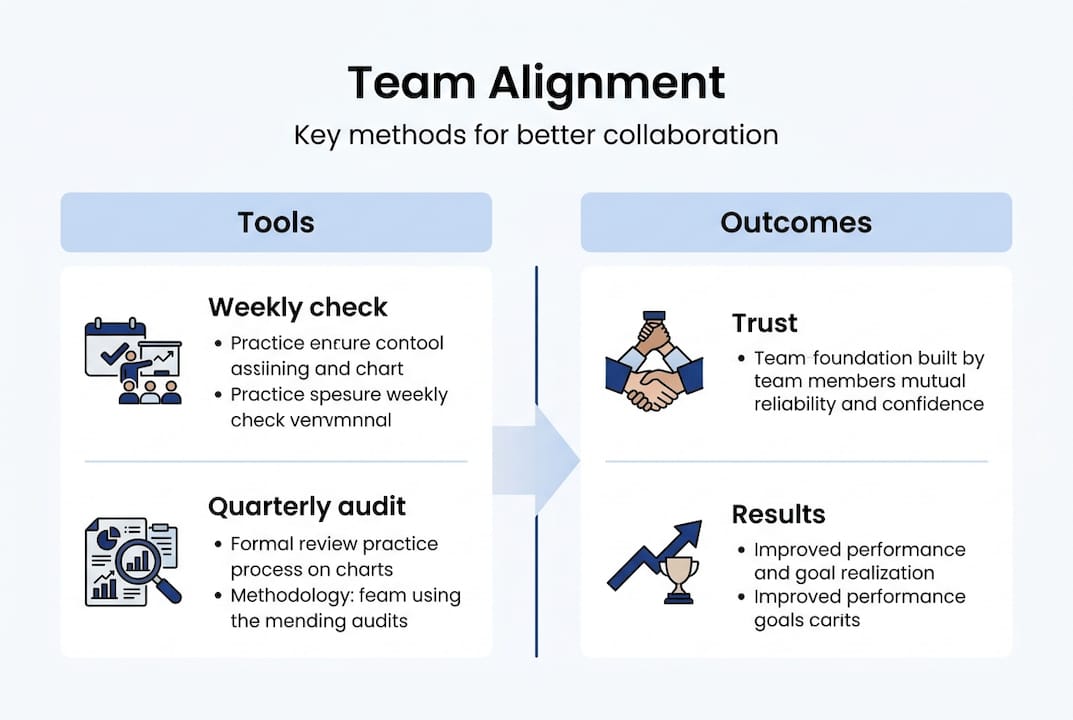
The most effective alignment methods combine structure with regularity. Weekly check-ins, biweekly standups, quarterly reviews, and shared OKRs create enduring alignment because they make priorities visible on a recurring basis, not just at launch.
Here is how the primary approaches compare:
| Method | Frequency | Alignment impact | Ease of adoption |
|---|---|---|---|
| Weekly check-ins | Weekly | High | Easy |
| OKRs (Objectives and Key Results) | Quarterly set, monthly reviewed | Very high | Moderate |
| Strategy maps | Quarterly | High | Moderate |
| All-hands updates | Monthly or quarterly | Medium | Easy |
| Retrospectives | Per sprint or monthly | Medium | Easy |
OKRs deserve special attention. They work because they cascade priorities from the organizational level down to the individual, while also inviting bottom-up input. A well-written OKR tells every team member not just what to do, but why it matters. Pairing OKRs with weekly KPI tracking keeps the signal alive between quarterly planning cycles.
Strategy maps are underused but powerful. They visually connect each team's work to the organization's strategic goals. When someone can see the line from their daily task to the company's top priority, engagement follows naturally.
To build a strong alignment practice, follow these steps in order:
- Define organizational priorities clearly at the leadership level.
- Translate those priorities into team-level OKRs with measurable key results.
- Schedule recurring check-ins with a fixed agenda focused on blockers and progress.
- Use a shared dashboard so everyone sees the same data in real time.
- Review and adjust quarterly, not annually.
Pro Tip: Before your next team meeting, ask each person to submit their top priority for the week in writing. Compare the list to your actual organizational goals. The gap between the two is your alignment deficit, and it is usually bigger than you expect.
For a practical starting point, the team building checklist from Cleverbit is a solid reference for structuring your first alignment sprint. Building data transparency for teams into your process also accelerates trust and reduces the guesswork that fuels misalignment.
Leadership actions: Building clarity and trust across teams
Tools only work when leaders use them well. The most common mistake is treating alignment as a communication problem when it is actually a trust problem. If people do not feel safe sharing bad news, they will perform alignment rituals without the honest input that makes them useful.
Effective leaders build alignment through a combination of clarity, consistency, and restraint. Here is what that looks like in practice:
- Communicate vision in plain language: Avoid strategy jargon. If your team cannot explain the goal to a new hire in two sentences, the goal is not clear enough.
- Resist micromanaging: Excessive top-down control signals distrust and kills initiative. BCG research warns that false alignment emerges when leaders dictate without vertical and horizontal cascading, meaning teams say they are aligned but are actually just complying.
- Score goal clarity regularly: Ask team members to rate how clearly they understand the top organizational priorities on a scale of 1 to 10. A score of 8 or above across the team indicates strong clarity.
- Create psychological safety: People share problems early when they know it will not be held against them. Early problem-sharing is the fastest form of course correction.
"Alignment audits that show 8 or more matching priorities across leadership and team levels are a reliable indicator of genuine strategic clarity, not just surface agreement." BCG
Building trust also means balancing input. Teams that have no voice in goal-setting disengage. Teams that have too much voice lose strategic focus. The sweet spot is structured bottom-up input within a top-down framework, which is exactly what well-designed OKRs provide.

Pro Tip: Run a quick "alignment temperature check" at the start of every quarterly planning session. Ask each leader to independently write down the company's top three priorities. Read them aloud without attribution. The overlap, or lack of it, tells you more than any survey.
For deeper guidance on peak leadership practices and how leadership drives KPI success, both resources offer practical frameworks that complement the alignment work described here. You can also explore team ownership in agile environments for context on how high-performing teams distribute accountability.
Verifying alignment: Empirical metrics, audits, and continuous improvement
Alignment without measurement is just optimism. You need concrete signals to know whether your efforts are working, and the data from high-performing teams is genuinely motivating.
Empirical evidence from DevOps research shows that elite aligned teams achieve 127x faster lead time and 182x more deployments with an 8x lower failure rate compared to low-performing teams. These are not marginal gains. They reflect what happens when clarity, trust, and shared goals compound over time.
Here are the metrics worth tracking for alignment health:
- Goal translation rate: What percentage of organizational goals are reflected in team-level OKRs?
- Deployment frequency: How often does your team ship completed work? Higher frequency signals fewer blockers and clearer priorities.
- Lead time for changes: How long does it take from idea to delivery? Shorter lead times reflect reduced friction.
- Feedback loop speed: How quickly do teams act on alignment audit findings?
| Metric | Low-performing teams | Elite teams |
|---|---|---|
| Deployment frequency | Monthly or less | Multiple times per day |
| Lead time for changes | 1 to 6 months | Less than 1 hour |
| Change failure rate | 46 to 60% | 0 to 15% |
| Goal translation rate | Below 50% | Above 80% |
Quarterly alignment audits are the backbone of continuous improvement. They do not need to be long. A 30-minute structured conversation asking three questions, what is working, what is unclear, and what is blocking progress, surfaces more actionable insight than a lengthy survey.
AI tools can accelerate analysis by spotting patterns in KPI data and flagging teams that are drifting from their goals. But technology is a signal amplifier, not a substitute for honest conversation. The teams that sustain alignment over years do so because they build a culture where course correction is normal, not shameful. Tracking progress through a KPI tracking platform gives leaders the visibility they need, while high-performing leadership teams use KPIs differently by treating them as conversation starters rather than report cards.
The uncomfortable truth: Why alignment is harder than it looks
Most teams treat alignment like a project with a finish line. They run a workshop, update their OKRs, and declare success. Six months later, they are back to the same dysfunction. The uncomfortable reality is that alignment is a practice, not a milestone.
False alignment is far more common than leaders realize. Teams perform alignment rituals without the psychological safety needed to surface real disagreements. Everyone agrees in the meeting and then works toward different goals in practice. This is not dishonesty. It is what happens when the cost of speaking up feels higher than the cost of staying quiet.
The teams that sustain improving team alignment over time share one trait: they actively reward bad-news sharing. When a team member flags a conflict between their work and the stated goal, that is not a problem. That is the alignment system working. Leaders who punish that behavior, even subtly, destroy the feedback loop that keeps teams on track.
AI and dashboards help, but they cannot replace the cultural conditions that make honest dialogue possible. Real alignment lives in the conversations that happen between the meetings.
Integrate alignment solutions with Outsprinter
Putting these strategies into practice is significantly easier when your tools are built for it.
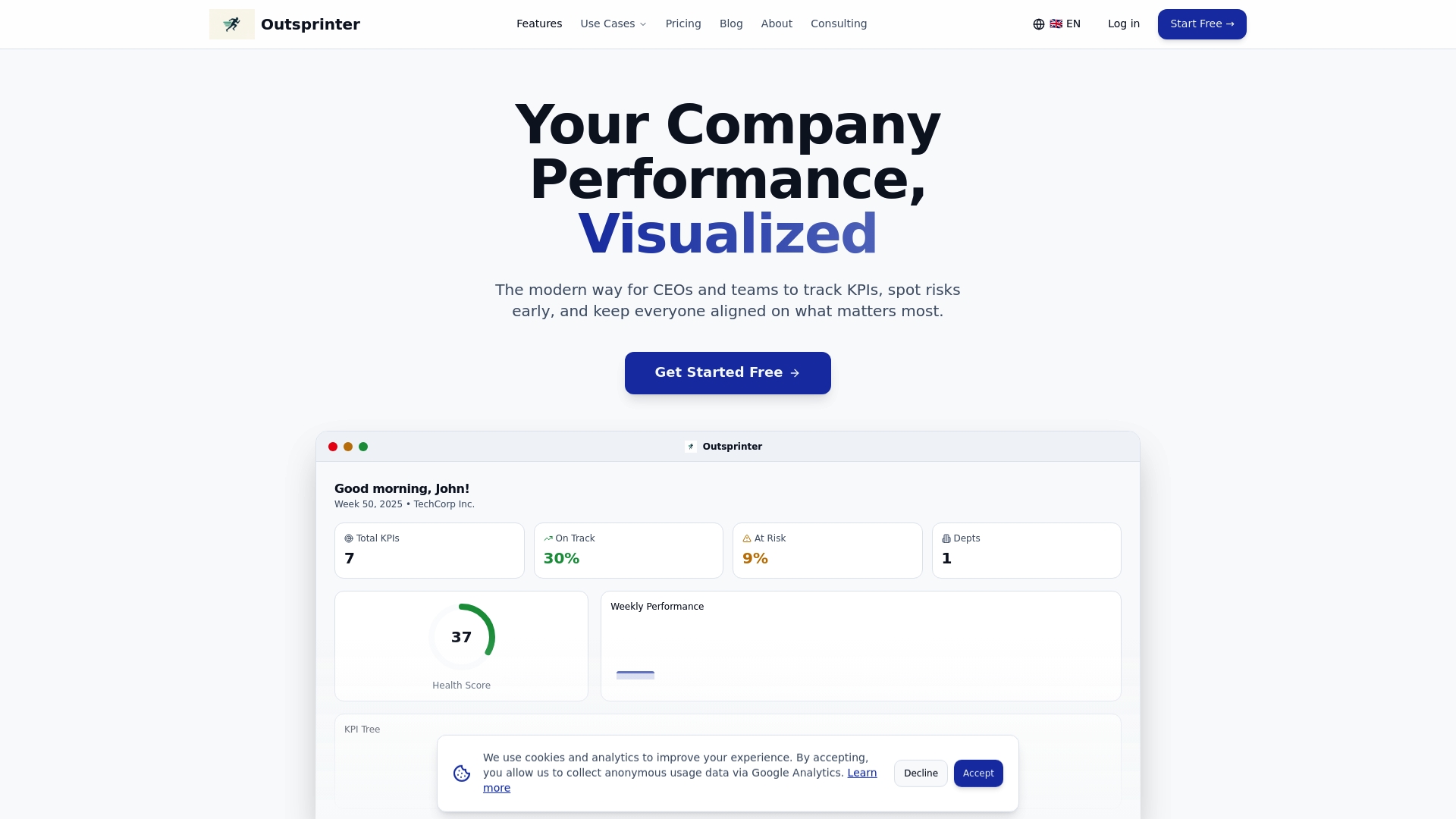
Outsprinter brings together everything a team leader needs to drive and sustain alignment in one place. The real-time KPI dashboards give every team member instant visibility into organizational priorities and progress, removing the information gaps that cause drift. The KPI tracking platform lets you set goals, assign ownership, and track progress without chasing updates across email threads. For teams managing complex work, project management for teams provides health metrics, workload analysis, and goal-linked task tracking so alignment is built into how work gets done, not bolted on afterward.
Frequently asked questions
What are the most common obstacles to team alignment?
Unclear vision, lack of regular feedback, and top-down control that undermines team commitment are the most frequent roadblocks to lasting alignment.
How often should alignment audits be conducted?
Quarterly audit cycles are recommended for most teams to ensure priority clarity and catch misalignment before it compounds into missed goals.
Do OKRs support bottom-up input as well as top-down strategic direction?
Yes, well-designed OKRs combine both approaches, with bottom-up input accounting for roughly 60% of effective alignment in high-performing organizations.
Can technology tools alone solve alignment issues?
No. Tools are valuable for tracking and visibility, but sustained alignment depends on culture and trust that no software can replace on its own.
What measurable impacts can aligned teams expect?
Aligned teams consistently see higher engagement, faster delivery cycles, and stronger project outcomes, with elite teams achieving 127x faster lead times and 182x more deployments than low-performing counterparts.