
TL;DR:
- Clear role definitions and goal alignment are essential for team accountability.
- Regular structured check-ins and visibility tools foster ongoing progress tracking.
- Peer accountability and data transparency cultivate ownership beyond top-down management.
Accountability issues don't announce themselves. They show up quietly: missed deadlines, unclear ownership, and projects that stall despite everyone being "busy." When team members don't know exactly what they own or how their work connects to bigger goals, trust erodes and performance suffers. The good news is that accountability isn't a personality trait you either have or don't. It's a system. Regular progress check-ins and structured peer accountability are among the most effective tools leaders can deploy. This article walks you through role clarity frameworks, visibility systems, peer accountability strategies, and how to diagnose breakdowns before they become crises.
Table of Contents
- Clarifying roles and expectations with RACI and OKRs
- Creating visibility and structured check-ins
- Fostering peer and collective accountability
- Diagnosing, troubleshooting, and tracking accountability metrics
- Our take: Why true accountability isn't about micromanagement
- Enhance team accountability with Outsprinter
- Frequently asked questions
Key Takeaways
| Point | Details |
|---|---|
| Clarify roles instantly | Using frameworks like RACI and OKRs removes ambiguity and increases individual responsibility. |
| Make progress visible | Regular, structured check-ins and dashboards keep everyone on track without needing constant supervision. |
| Foster peer accountability | Peer and collective accountability, not just leader-driven supervision, leads to lasting team ownership. |
| Track what matters | Leaders should diagnose issues and use clear KPIs to measure and improve accountability outcomes. |
Clarifying roles and expectations with RACI and OKRs
Most accountability failures start before a single task is assigned. When people aren't sure who owns what, work falls through the cracks and blame gets passed around. Two frameworks fix this fast: the RACI matrix and OKRs (Objectives and Key Results).
The RACI matrix assigns one of four roles to every person on every task. Responsible means the person doing the work. Accountable means the person who answers for the outcome (only one per task). Consulted means those whose input is needed. Informed means those who need updates but aren't involved in decisions. Used together, RACI and OKRs create a complete picture of who does what and why it matters.
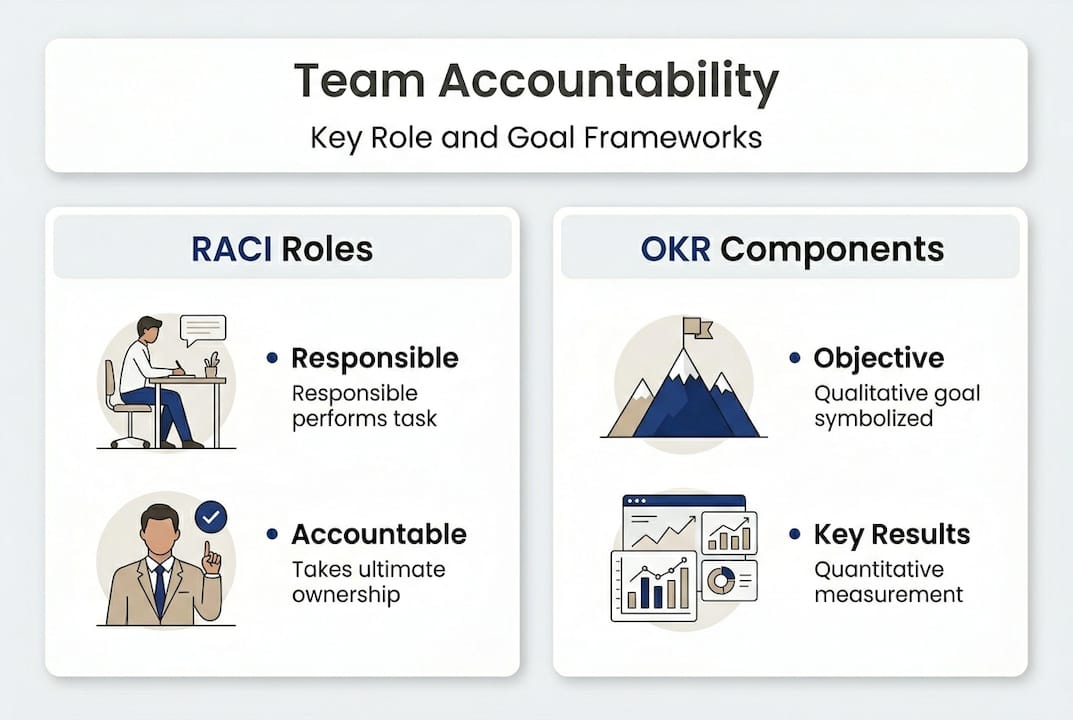
OKRs pair an ambitious qualitative Objective with 2 to 4 measurable Key Results. The objective answers "where are we going?" and the key results answer "how will we know we got there?" Together, they connect individual effort to team strategy.
| Framework | Primary focus | Best for | Key benefit |
|---|---|---|---|
| RACI matrix | Role and task ownership | Cross-functional projects | Removes ambiguity on who decides |
| OKRs | Goal setting and measurement | Quarterly planning cycles | Aligns effort to strategic outcomes |
Here's how to implement both frameworks effectively:
- Map every active project to a RACI chart before work begins
- Assign only one Accountable person per task, never two
- Set OKRs at the team level first, then cascade to individuals
- Review and update your RACI whenever team structure changes
- Score OKRs weekly or biweekly to keep momentum visible
- Integrate both into your project management best practices so they live where work happens
Pro Tip: Schedule a 30-minute quarterly review of your RACI charts. Teams grow, roles shift, and an outdated RACI is almost worse than none at all because it creates false confidence.
When you combine RACI with OKRs, you get something powerful: every person knows their role AND understands how their work connects to outcomes. That's the foundation of performance accountability with KPIs that actually sticks.
Creating visibility and structured check-ins
With roles clarified, the next pillar is systematizing visibility and regular tracking. Accountability without visibility is just hope. When team members can see progress (or lack of it) in real time, behavior changes without a manager having to say a word.

Visibility tools fall into three categories. Kanban boards show task status at a glance. Dashboards aggregate KPIs and project health in one view. Huddles are short, structured conversations that surface blockers before they become delays. None of these require micromanagement. They require consistency.
| Check-in type | Recommended frequency | Time investment | Primary purpose |
|---|---|---|---|
| Daily standup | Every workday | 10-15 minutes | Surface blockers quickly |
| Weekly team sync | Once per week | 20-30 minutes | Review commitments and KPIs |
| Monthly review | Once per month | 45-60 minutes | Assess trends and adjust goals |
| Quarterly retrospective | Every quarter | 90 minutes | Evaluate systems and processes |
Here's how to implement structured check-ins without adding meeting fatigue:
- Pick one format per cadence and stick to it for at least 60 days
- Use a shared dashboard so everyone sees the same data before the meeting starts
- Start each check-in with commitments from the last session, not new topics
- Assign a rotating facilitator so accountability doesn't fall only on the manager
- End every check-in with explicit next-step owners and deadlines
Pro Tip: Keep weekly check-ins to 25 minutes maximum. When meetings run long, people disengage. A tight agenda with a visible timer signals that you respect everyone's time.
The goal is building accountability without micromanaging. When your team can see their own progress on a live dashboard, they self-correct. Your weekly KPI tracking guide becomes a coaching tool, not a surveillance mechanism. Research on designing accountability without micromanagement confirms that visibility cadences reduce the need for top-down intervention significantly.
Fostering peer and collective accountability
Visibility is powerful, but peer and group accountability drive sustainable results. When team members hold each other to commitments, accountability becomes part of the culture rather than a management function.
Peer accountability works because social commitment is a stronger motivator than hierarchical pressure for most people. When someone tells a colleague "I'll have this done by Thursday," the stakes feel more personal. Collective ownership takes this further by tying group goals to a shared "North Star" metric that everyone can influence.
Leader modeling is non-negotiable here. If you miss your own deadlines or skip check-ins, your team will follow your lead. Demonstrating personal accountability, owning mistakes publicly, and updating your own commitments in shared tools sends a louder signal than any policy document.
Psychological safety is the often-missed ingredient. Teams need to feel safe surfacing problems early, disagreeing respectfully, and admitting when they're behind. As top-performing teams show, avoiding conflict doesn't protect performance. It quietly destroys it.
"Accountability without psychological safety creates a culture of blame. Safety without accountability creates a culture of comfort. You need both to build a team that actually performs."
Practical strategies to foster a collective accountability mindset:
- Create shared team goals that no single person can hit alone
- Use peer check-ins where team members report progress to each other, not just the manager
- Celebrate group wins publicly and visibly
- Normalize saying "I'm behind" without fear of punishment
- Build consequence structures that the team designs together, not just top-down rules
- Study leadership best practices that model accountability from the top
Pro Tip: Use conflict productively. When two team members disagree on a deadline or priority, that tension is data. Facilitate the conversation rather than resolving it for them. Teams that work through disagreement build stronger commitment to outcomes.
Building collective accountability takes time, but the payoff is a team that holds itself to high standards even when the manager isn't in the room. That's the shift from compliance to ownership, and it's what separates average teams from exceptional ones. Explore team performance improvement steps to support this transition.
Diagnosing, troubleshooting, and tracking accountability metrics
Even with systems in place, leaders must diagnose issues and track progress. Accountability breakdowns have symptoms. The earlier you spot them, the cheaper they are to fix.
Common symptoms include: tasks consistently marked complete but outcomes not delivered, the same person always rescuing others' work, meeting commitments made but never followed up on, and KPIs that haven't moved in weeks despite reported activity.
Here's a numbered troubleshooting process for the most common accountability failures:
- Identify the pattern, not the incident. One missed deadline is noise. Three in a row is a signal. Look for recurring gaps before intervening.
- Trace the root cause. Is the issue unclear ownership (fix with RACI), unrealistic timelines (fix with planning), or low motivation (fix with goal alignment)?
- Adjust the system before addressing the person. Most accountability issues are system failures, not character flaws.
- Set a threshold and communicate it. Define what "off track" looks like numerically so the team knows when a conversation is triggered.
- Review consequences together. Consequences shouldn't be surprises. Co-create them with the team so they feel fair.
Key metrics to track accountability health:
- Task completion rate: percentage of tasks finished by their original deadline
- Commitment fulfillment rate: percentage of check-in commitments delivered by the next session
- KPI status distribution: ratio of green/yellow/red KPIs across the team
Teams that track these metrics consistently save significant time on rework and escalation. Setting KPI thresholds with green, yellow, and red zones gives everyone a shared language for performance status. When a KPI turns yellow, it triggers a conversation, not a crisis. When it turns red, the consequence structure you built together kicks in automatically. That's accountability by design, not by pressure.
Our take: Why true accountability isn't about micromanagement
Here's the uncomfortable truth most leadership advice skips: leader-driven consequences often backfire. When accountability flows only from the top down, it creates compliance, not ownership. People do just enough to avoid consequences rather than genuinely committing to outcomes.
What we've seen work consistently is this: when KPIs are visible to the whole team, peer pressure (the healthy kind) does more work than any manager could. Teams start comparing their completion rates. They start asking each other for help before asking the manager. They feel the gap between their output and the team's goals personally.
The real leverage isn't in tighter oversight. It's in data transparency that makes performance visible to peers, not just managers. Most teams miss the importance of consequence structures that the team itself designs. When people co-create the rules, they enforce them on each other. That's not a management technique. That's culture.
Enhance team accountability with Outsprinter
If these strategies resonate, the next step is putting them into a system that works automatically. Outsprinter is built specifically for team leaders who want accountability without the overhead of manual tracking.
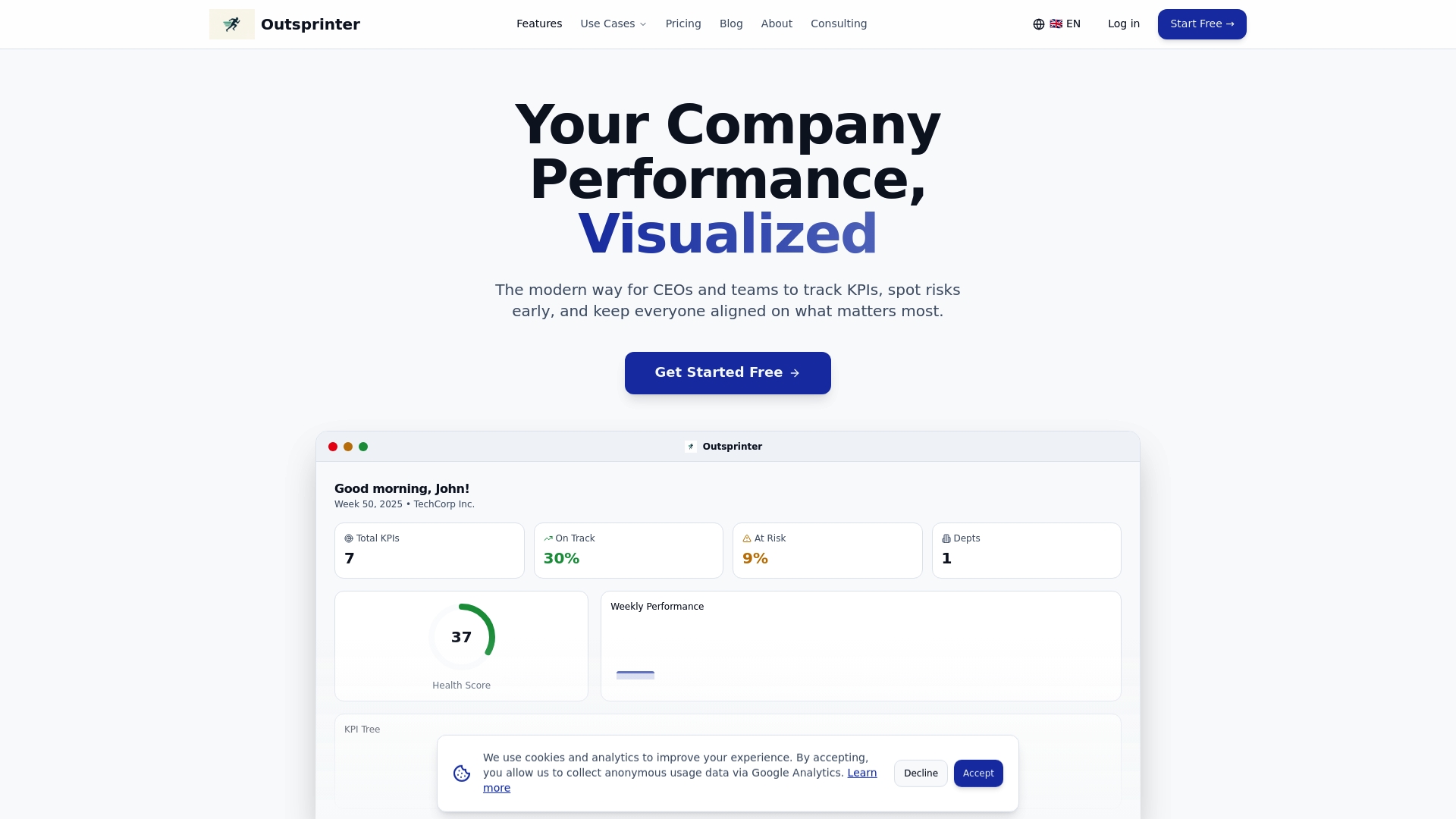
With Outsprinter's KPI tracking software, you can define thresholds, visualize team performance in real time, and get instant alerts when something goes off track. The task management solutions let you assign ownership, set deadlines, and track completion rates across every project. And the project management platform ties it all together with health metrics and workload analysis. Stop chasing updates. Start leading with data.
Frequently asked questions
What is the RACI matrix and how does it improve team accountability?
The RACI matrix defines team roles as Responsible, Accountable, Consulted, and Informed for each task, removing ambiguity and ensuring every deliverable has a clear owner.
How often should teams hold accountability check-ins?
Weekly check-ins of 20 to 30 minutes are ideal to keep commitments visible, surface blockers early, and maintain consistent forward momentum.
How do leaders avoid micromanagement while improving accountability?
Leaders should rely on structured visibility tools and peer accountability systems rather than top-down supervision, so ownership stays with the team.
What metrics should teams track to verify accountability?
Teams should track task completion rates, commitment fulfillment rates, and KPI status distribution to get a clear, objective picture of accountability health over time.
Recommended
- How to Build Accountability Without Micromanaging: KPIs and Weekly Commitments | Outsprinter
- How Data Transparency Builds Stronger Teams and Better Accountability | Outsprinter
- Leadership team best practices for peak performance
- Leadership team productivity tips: 5 proven strategies
- Role of accountability in coaching for business growth
- Boost Team Productivity 2025 | TECHTRON