
TL;DR:
- Performance accountability is a proactive, data-driven system focused on measurable outcomes. Strong leadership, clear goals, regular reviews, and balanced KPIs are essential for success. Properly designed systems improve long-term performance, but culture and leadership behavior are critical for sustainability.
Most leaders think accountability means catching people doing something wrong. That instinct is understandable, but it's also the reason so many accountability initiatives quietly collapse. Performance accountability is actually a proactive, data-driven system built around measurable outcomes, not punishment. When structured correctly, it becomes one of the most powerful levers you have for sustained team performance. This article breaks down how these systems work, which KPIs matter, what the research actually shows, and how to avoid the traps that derail even well-intentioned efforts.
Table of Contents
- Defining performance accountability: More than just responsibility
- How performance accountability systems work: From goals to KPIs
- Real-world impact: The evidence for performance accountability
- Pitfalls, risks, and best practices for sustainable accountability
- Practical steps for building a culture of performance accountability
- Why most organizations get accountability wrong (and what actually works)
- Put accountability into action with the right tools
- Frequently asked questions
Key Takeaways
| Point | Details |
|---|---|
| Accountability is systemic | Structured accountability connects clear goals, KPIs, and outcomes, not just blame. |
| Data drives improvement | Balanced KPIs and regular reviews power better team performance and growth. |
| Culture beats compliance | Leadership modeling and transparency are essential for sustainable results. |
| Mitigate risks wisely | Balanced metrics and outcome focus prevent gaming and burnout. |
| Tools reinforce habits | The right platforms can automate, track, and sustain meaningful accountability. |
Defining performance accountability: More than just responsibility
Accountability gets misused constantly. In most organizations, it surfaces as a reaction: someone missed a target, now there are consequences. That's not accountability. That's blame with a professional label.
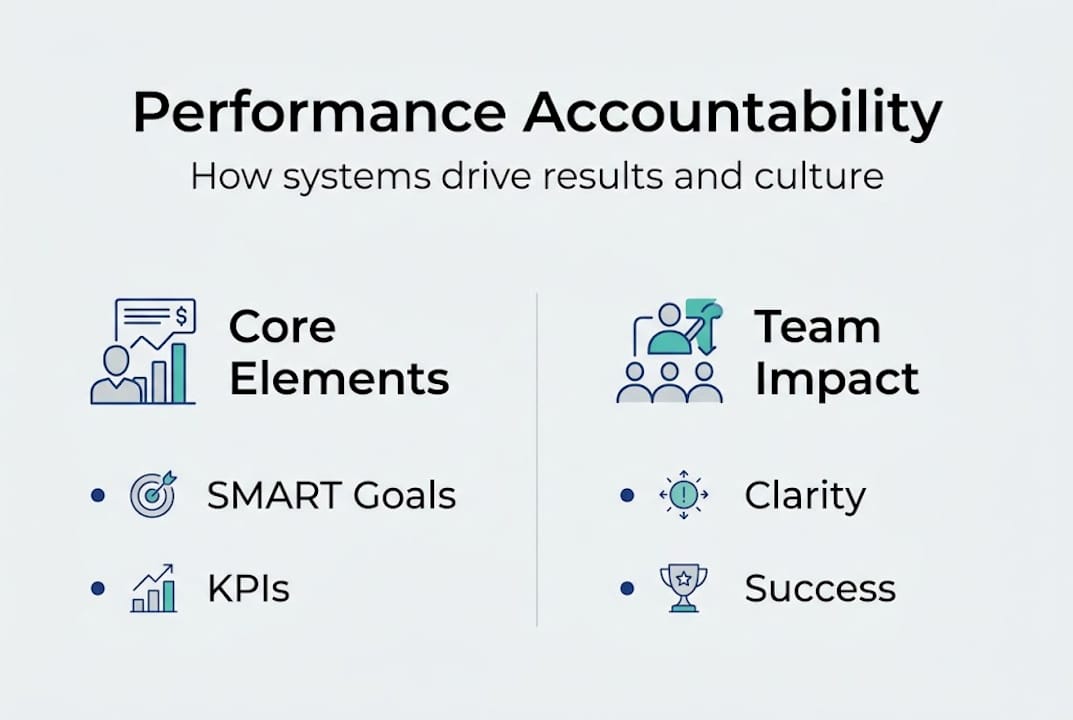
True performance accountability is a forward-looking system. OPM's framework defines it as holding people or teams responsible for achieving measurable outcomes through structured systems: clear goals, KPIs, feedback, and consequences. The emphasis is on structure. Without it, accountability becomes arbitrary and demoralizing.
The core elements of a functioning accountability system include:
- Clear goal setting: Expectations must be specific, measurable, and tied to organizational priorities
- KPI selection: Metrics that actually reflect performance, not just activity
- Feedback mechanisms: Regular, structured conversations about progress and barriers
- Consequences: Both positive (recognition, advancement) and corrective (coaching, development plans)
- Transparency: Everyone knows what success looks like and how it's measured
"Accountability without clarity is just pressure. Clarity without feedback is just hope. You need both working together to get real results."
The difference between accountability and blame culture comes down to timing and intent. Blame is retrospective and punitive. Accountability is prospective and developmental. When workplace accountability systems are designed with clarity and consistency, they actually build trust rather than erode it.
Leaders who want to implement performance management strategies that stick need to start here: with a shared definition that the whole team understands. If accountability means different things to different people on your team, the system will fracture under pressure. A step-by-step management guide can help you build that shared foundation before you ever introduce a single metric.
With a shared understanding of what performance accountability is and isn't, we can now explore how these systems actually work in organizations.
How performance accountability systems work: From goals to KPIs
A well-built accountability system follows a logical sequence. Skip a step and the whole structure weakens.
- Set SMART goals: Specific, measurable, achievable, relevant, and time-bound targets at the organizational level
- Cascade priorities: Break organizational goals into team and individual objectives so everyone sees the connection
- Select KPIs: Choose 5 to 10 metrics that reflect both financial outcomes and behavioral indicators
- Establish regular reviews: Weekly check-ins for task-level work, monthly or quarterly for strategic KPIs
- Run feedback and coaching sessions: Address gaps early, recognize wins, and adjust targets when context changes
- Link outcomes to consequences: Rewards, development opportunities, or corrective action based on results
The OPM playbook confirms this sequence: SMART goals, KPI selection, regular check-ins, feedback and coaching, and structured consequences form the backbone of any effective system. Popular frameworks like OKRs, Balanced Scorecard, and MBO each apply this logic differently, but the underlying mechanics are consistent. Performance.gov recognizes all four as proven methodologies for government and enterprise accountability.
| Framework | Best for | Key strength |
|---|---|---|
| OKRs | Fast-moving teams | Ambitious goal alignment |
| Balanced Scorecard | Large organizations | Multi-perspective tracking |
| MBO | Individual contributors | Personal ownership |
| Performance Contracts | Formal accountability | Legal and structural clarity |
For performance metric examples that work across industries, the best systems mix hard financial metrics with softer behavioral ones. Revenue per employee matters, but so does collaboration quality and customer sentiment.

Pro Tip: The difference between a check-in and micromanagement is the question you ask. "Did you do this?" is micromanagement. "What's blocking you?" is accountability. Structure your reviews around barriers and support, not surveillance. For a deeper look at this distinction, the accountability without micromanaging framework is worth studying before you design your review cadence.
Once you understand the structure, it's crucial to see how these systems affect real outcomes.
Real-world impact: The evidence for performance accountability
The research on performance accountability is more compelling than most leaders realize. Two case studies stand out.
The U.S. Army's performance-based budgeting initiative improved over half of quality measures sustained across five or more years. That's not a short-term spike. That's structural improvement baked into operations. The Dallas Independent School District showed similarly striking results: 16% gain in math and a 6% gain in reading scores when performance pay and structured accountability were introduced.
What drove these results?
- Clear, measurable targets tied to funding and compensation
- Regular review cycles that kept performance visible
- Rewards linked directly to outcomes, not seniority or effort alone
- Leadership commitment to the system over multiple years
"A culture of continuous improvement doesn't happen by accident. It's the result of consistent measurement, honest feedback, and leaders who take the data seriously."
| Organization | Intervention | Outcome |
|---|---|---|
| U.S. Army | Performance-based budgeting | 50%+ quality measures improved, 5+ years |
| Dallas ISD | Performance pay system | +16% SD math, +6% SD reading |
The pattern across both cases is the same: management trends for 2026 consistently point toward structured tracking and outcome-linked rewards as the highest-leverage interventions available to leaders. The evidence isn't anecdotal. It's replicated across sectors.
While the benefits are compelling, smart leaders also need to be aware of potential pitfalls and how to mitigate them.
Pitfalls, risks, and best practices for sustainable accountability
Accountability systems can backfire. Badly designed ones often do.
The most dangerous failure mode is metric gaming. When people are measured on specific numbers, they optimize for those numbers, sometimes at the expense of actual performance. This is Goodhart's Law in action: once a measure becomes a target, it stops being a good measure. The performance paradox occurs when measurement itself becomes counterproductive, driving short-term behavior that undermines long-term outcomes.
Other common risks include:
- Demotivation: Targets that feel imposed rather than owned kill intrinsic motivation
- Goal distortion: Teams focus on what's measured and ignore what isn't
- Calibration mismatch: Inconsistent standards across managers create perceived unfairness
- Punitive culture: When accountability only surfaces during failures, people hide problems instead of solving them
| Risk | Symptom | Mitigation |
|---|---|---|
| Metric gaming | Numbers look good, results don't | Mix quantitative and qualitative KPIs |
| Demotivation | High turnover, low initiative | Involve teams in goal setting |
| Goal distortion | Narrow focus, missed priorities | Use multi-metric dashboards |
| Punitive culture | Problems hidden, feedback avoided | Separate accountability from punishment |
The Forbes framework recommends mitigating these risks through balanced KPIs, leadership modeling, and focusing on behaviors and outcomes rather than raw output. The organizational performance guide and scalable management guide both reinforce this approach for growing teams.
Pro Tip: If your accountability system only activates when something goes wrong, it's not an accountability system. It's a discipline system. Build in regular recognition for strong performance and you'll shift the culture from defensive to proactive.
Also worth exploring is the performance management paradox, which highlights how public accountability systems can create perverse incentives when not carefully designed.
With the challenges clear, it's time to focus on making accountability actionable for your team.
Practical steps for building a culture of performance accountability
Building accountability into your culture isn't a one-time project. It's an ongoing practice. Here's how to get started without overengineering it.
- Clarify expectations first: Before any metric is set, every team member should be able to articulate what success looks like in their role. Ambiguity is the enemy of accountability.
- Cascade goals from the top: Connect organizational priorities to team objectives and individual KPIs. People perform better when they understand how their work connects to the bigger picture.
- Establish a review rhythm: Weekly task-level check-ins, monthly KPI reviews, and quarterly strategic assessments create a cadence that keeps performance visible without feeling oppressive.
- Link accountability to development, not just evaluation: Frame performance conversations as coaching opportunities. Ask "what do you need to hit this target?" not just "why didn't you?"
- Use data to drive conversations: Bring actual numbers to every review. Opinions about performance are debatable. Data is not.
- Recognize and reward consistently: Accountability that only responds to failure creates fear. Accountability that also celebrates success creates engagement.
Effective systems prioritize clarity, ownership, regular data-driven reviews, and continuous improvement over punitive measures. That's the standard worth holding yourself to as a leader.
Pro Tip: Ownership is the missing ingredient in most accountability efforts. People who help set their own targets are far more committed to hitting them. Involve your team in the goal-setting process and watch the dynamic shift. The guide on without micromanaging KPIs covers this ownership model in practical detail, and the boost KPI results resource shows how to connect it to measurable outcomes.
With actionable steps at hand, let's examine why many organizations still struggle with accountability and what actually works.
Why most organizations get accountability wrong (and what actually works)
Here's the uncomfortable truth: most accountability failures aren't tool problems. They're culture problems disguised as tool problems.
Organizations buy software, build dashboards, and launch KPI programs. Then nothing changes. Why? Because the leaders at the top haven't modeled what accountability actually looks like. If executives miss their own targets without consequence or explanation, no system in the world will make frontline managers take their metrics seriously.
What actually works is relentless clarity combined with real conversations. Psychological safety matters here more than most leaders admit. Teams that feel safe surfacing bad news early allow problems to be solved before they become crises. Teams that fear punishment hide problems until they explode.
Building accountability without micromanaging requires leaders to model the behavior they want to see: transparency about their own performance, candor in feedback, and genuine curiosity about what's blocking their teams. Tools reinforce accountability. They don't create it. The culture has to come first.
Put accountability into action with the right tools
Understanding the principles of performance accountability is the first step. Executing them consistently at scale is where most organizations need support.
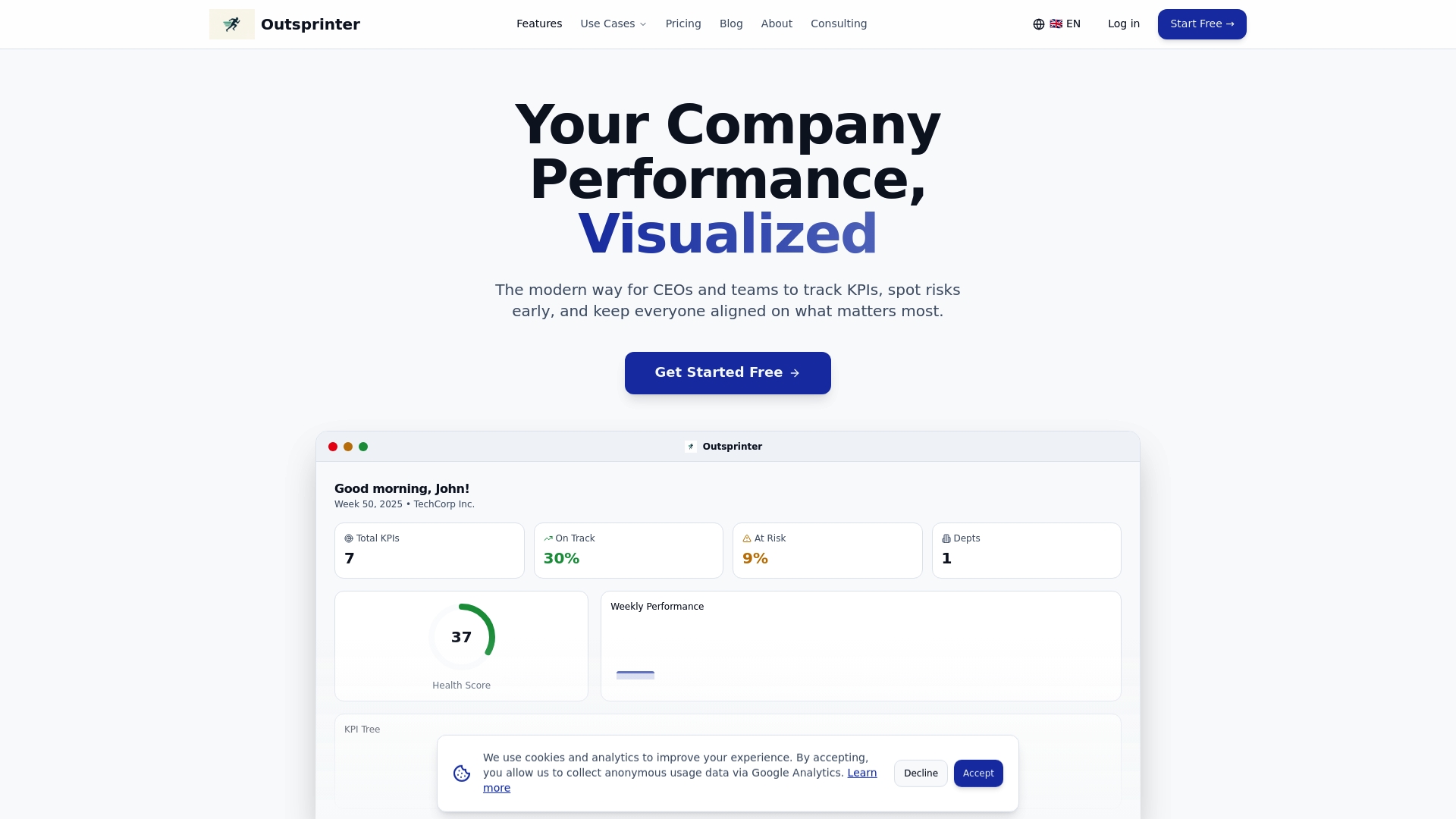
Outsprinter is built specifically for this challenge. The KPI management software lets you define, track, and visualize performance indicators across every team and department in real time. The project management platform connects task-level work to strategic goals so nothing falls through the cracks. From cascading objectives to automated review reminders, the Outsprinter platform gives your team the structure accountability requires without adding administrative burden. If you're ready to move from intention to measurable results, the tools are already there.
Frequently asked questions
What are some common KPIs for performance accountability?
Common KPIs include revenue growth, customer satisfaction scores, on-time delivery rates, and employee engagement scores. Selecting balanced KPIs across financial, customer, and operational dimensions ensures you're measuring what actually matters.
How do you avoid micromanagement when building accountability?
Set clear expectations upfront, use structured team check-ins focused on barriers rather than tasks, and measure outcomes instead of activity. Continuous feedback and coaching are the alternative to reactive oversight.
What are typical risks of performance accountability systems?
The most common risks are metric gaming, demotivation from imposed targets, and narrowing focus to only what's measured. Goodhart's Law and the performance paradox show why careful system design is essential from the start.
How does leadership affect accountability success?
Leadership behavior is the single biggest predictor of whether accountability systems take hold. Leadership modeling through transparency, candor, and consistent follow-through creates the culture that makes formal systems work.