
Leadership teams drive organizational success, yet many C-suite executives struggle to maximize their teams' productivity. Research shows that top-team health directly correlates with company performance, but diagnosing and addressing productivity gaps requires more than intuition. This article delivers five evidence-based strategies to enhance leadership team performance, from diagnostic frameworks and leadership style optimization to meeting structures and time management systems that high-performing CEOs use to achieve measurable results.
Table of Contents
- Key Takeaways
- Criteria for assessing leadership team productivity
- Leadership styles and their impact on team productivity
- Optimizing executive meetings for strategic productivity
- Leadership systems and time management for sustained productivity
- Boost your leadership team's productivity with Outsprinter
- Frequently asked questions
Key Takeaways
| Point | Details |
|---|---|
| Diagnostic tools | Use a structured diagnostic such as McKinsey Team Effectiveness Index to measure configuration alignment execution and renewal. |
| Benchmarking health | Benchmark your leadership team against industry averages to identify gaps in accountabilities priorities and feedback mechanisms. |
| Key performance drivers | Four drivers consistently predict performance including role definition unified purpose innovative thinking and communication effectiveness. |
| Adaptive leadership mix | The most effective leaders blend transformational democratic and coaching styles and tailor decisions to team maturity and situational needs while avoiding autocratic control. |
Criteria for assessing leadership team productivity
Before implementing productivity improvements, you need reliable metrics to diagnose your team's current health. CEOs must diagnose top-team health using tools like McKinsey's Team Effectiveness Index, which assesses 17 drivers across configuration, alignment, execution, and renewal. Four drivers consistently predict performance: role definition, unified purpose, innovative thinking, and communication effectiveness.
Start by benchmarking your leadership team against industry averages. Teams scoring in the top quartile on these health metrics deliver significantly better business outcomes than those in lower quartiles. The assessment reveals specific gaps in how your team operates, from unclear accountabilities to misaligned priorities or weak feedback mechanisms.
Focus your diagnostic efforts on these critical areas:
- Configuration: Do team members have clearly defined roles with minimal overlap or gaps in coverage?
- Alignment: Does everyone share a common understanding of strategic priorities and how success gets measured?
- Execution: Can the team make decisions efficiently and follow through with accountability?
- Renewal: Does the team regularly reflect on performance and adapt approaches based on learning?
Once you identify specific weaknesses, you can target interventions precisely rather than applying generic productivity advice. A team management checklist helps track improvement initiatives systematically. Understanding how high-performing leadership teams use KPIs differently provides additional benchmarks for measuring progress. Data-driven assessment transforms vague concerns about productivity into actionable improvement roadmaps.
Leadership styles and their impact on team productivity
Your leadership approach fundamentally shapes how your team performs. Research demonstrates that transformational, democratic, and transactional leadership positively impact employee productivity, while autocratic leadership harms morale and increases turnover. The differences aren't subtle. Autocratic approaches create short-term compliance but erode engagement and innovation over time.

Coaching leadership stands out for consistent results. Studies show coaching leadership links to the highest productivity scores, with departments regularly exceeding targets. This style focuses on developing team members' capabilities rather than simply directing tasks. You invest time in understanding individual strengths and growth areas, then provide guidance that builds competence and confidence.
Consider these leadership styles and their productivity effects:
- Transformational: Inspires teams through vision and purpose, driving innovation and commitment to ambitious goals
- Democratic: Involves team members in decisions, increasing buy-in and leveraging diverse perspectives
- Transactional: Clarifies expectations and rewards performance, providing structure and accountability
- Coaching: Develops individual capabilities through feedback and support, building long-term capacity
- Autocratic: Centralizes decision-making and control, reducing autonomy and damaging morale
The most effective executives don't rigidly adhere to one style. You adapt based on situational demands, team maturity, and strategic priorities. Crisis situations may require more directive approaches temporarily, while innovation initiatives benefit from democratic or transformational styles. A leadership performance review process helps you assess which styles you default to and where adaptation could improve outcomes.
Pro Tip: Conduct a leadership style audit by asking your team for anonymous feedback on how your approach affects their productivity and engagement. The gap between your self-perception and their experience often reveals valuable improvement opportunities.
Optimizing executive meetings for strategic productivity
Executive meetings consume significant leadership time yet often fail to drive proportional value. Effective executive meetings sharpen focus, surface truths, and generate momentum through structured agendas, feedback loops, and collaboration matrices. The difference between productive and wasteful meetings lies in intentional design and disciplined facilitation.
Start by preparing structured agendas that prioritize high-impact topics. Distribute materials in advance so participants arrive ready to discuss rather than absorb information. Allocate specific time blocks to each agenda item and enforce them rigorously. This prevents minor issues from consuming time better spent on strategic challenges.
Implement these meeting optimization practices:
- Open with a brief check-in to surface urgent issues or concerns that might otherwise distract participants
- Use collaboration matrices to clarify who owns each decision, who provides input, and who needs updates
- Build in feedback loops where team members explicitly share what's working and what needs adjustment
- Close with clear action items assigned to specific owners with defined deadlines and success criteria
- Limit total meeting time to maintain energy and focus, typically no more than 90 minutes for strategic sessions
Encourage open communication by explicitly inviting dissenting views and rewarding those who surface uncomfortable truths. Psychological safety enables your team to address real issues rather than maintaining polite fiction. Master team alignment processes extend meeting effectiveness into daily operations, ensuring decisions translate into coordinated action.
Pro Tip: Record decisions and rationale in a shared system accessible to the entire leadership team. This creates institutional memory and prevents rehashing settled issues in future meetings.
Leadership systems and time management for sustained productivity
Individual leadership capability matters less than the systems through which leaders operate. Leadership systems bottleneck productivity more than people, with common barriers including lack of time, short-term focus, and insufficient skills. This insight shifts improvement efforts from individual development to systemic redesign.
High-performing CEOs structure their time deliberately rather than reacting to demands. Research shows high-performing CEOs use time blocking, delegation, and energy audits, focusing 60% of their time on meetings that emphasize strategic planning and team building. They protect time for deep work on critical priorities and ruthlessly eliminate low-value activities.
Compare time allocation patterns between average and high-performing leadership teams:
| Activity category | Average teams | High-performing teams | Productivity impact |
|---|---|---|---|
| Strategic planning | 15% | 35% | High-performers spend 2.3x more time on strategy, enabling proactive rather than reactive leadership |
| Team development | 10% | 25% | Investing in capability building creates compounding returns through improved team performance |
| Operational firefighting | 45% | 20% | Better systems reduce crisis management, freeing time for higher-value activities |
| Administrative tasks | 20% | 10% | Effective delegation and automation minimize time spent on low-impact work |
| External stakeholder engagement | 10% | 10% | Both groups allocate similar time, but high-performers make these interactions more strategic |
Implement systems that align team workflows and objectives coherently. A performance alignment guide for B2B leaders provides frameworks for connecting individual work to strategic goals. Agile sprint management best practices offer structured approaches to maintain momentum and adaptability simultaneously.
Pro Tip: Conduct quarterly energy audits where you track which activities energize versus drain you. Delegate or redesign draining activities when possible, and structure your schedule to tackle high-cognitive-load work during your peak energy hours.
Boost your leadership team's productivity with Outsprinter
Translating productivity strategies into consistent execution requires the right tools. Outsprinter provides a team performance and sprint management platform designed specifically for leadership teams seeking measurable improvements. The platform integrates KPI tracking, goal planning, and real-time dashboards that keep strategic priorities visible and teams accountable.
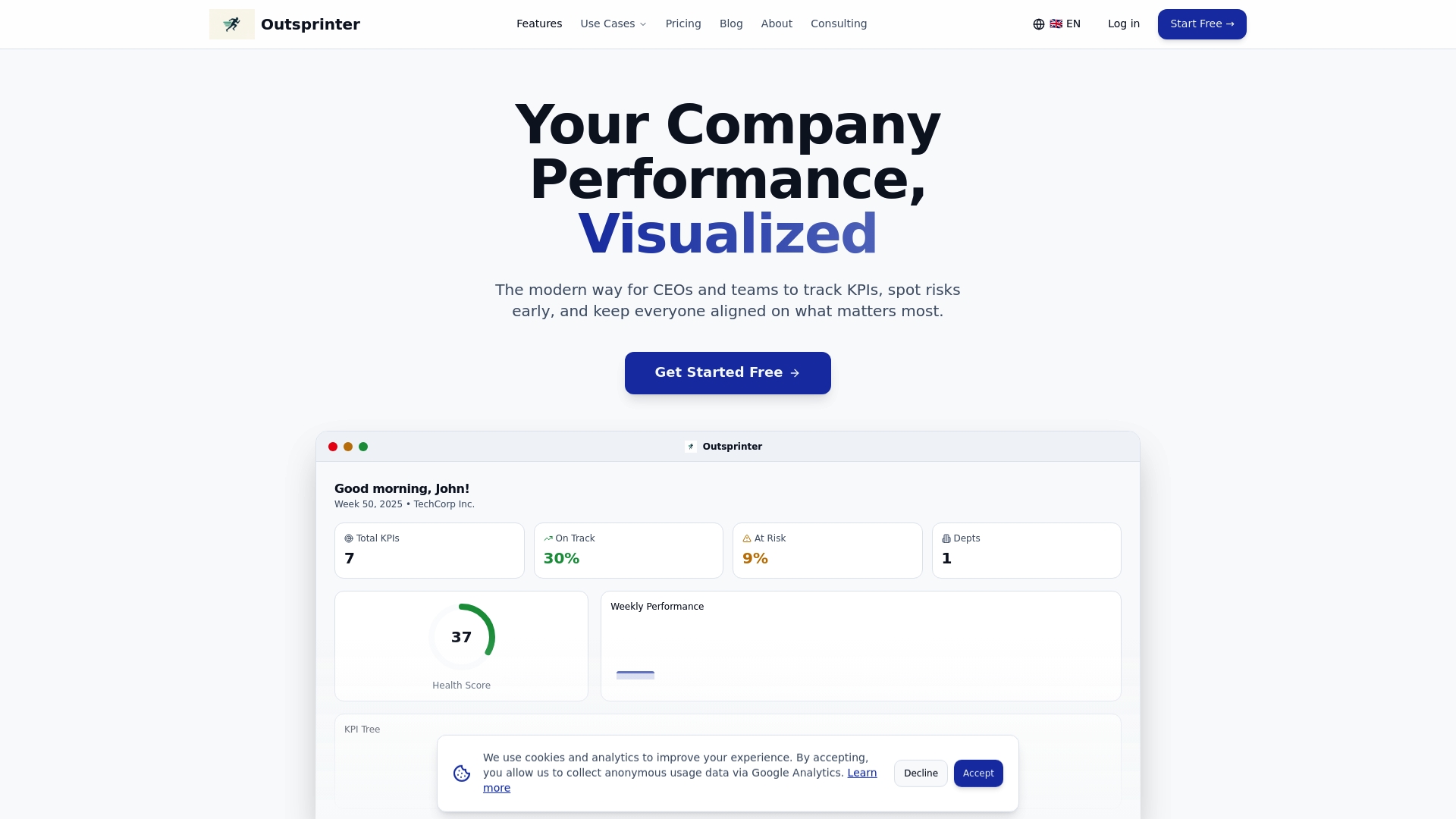
Executives use Outsprinter's management board use cases to maintain alignment across departments while tracking progress toward quarterly objectives. The platform's AI assistant helps leaders analyze performance data and identify bottlenecks before they escalate. Project management solutions connect strategic initiatives to daily execution, ensuring your team's efforts consistently advance organizational goals rather than drifting into reactive mode.
Frequently asked questions
What is the most effective leadership style for maximizing team productivity?
Coaching leadership consistently yields the highest productivity outcomes, with departments regularly exceeding targets through capability development and supportive feedback. Combining transformational and democratic styles also proves effective by boosting engagement through shared vision while leveraging diverse perspectives in decision-making. The optimal approach adapts to your team's maturity level and current strategic demands rather than rigidly applying one style.
How can CEOs diagnose the health of their leadership teams effectively?
Use diagnostic frameworks like McKinsey's Team Effectiveness Index to assess role clarity, communication effectiveness, and innovation capacity across 17 specific drivers. Regular KPI reviews and team management checklists provide ongoing health monitoring between formal assessments. Focus particularly on the four drivers that predict performance: role definition, unified purpose, innovative thinking, and communication quality.
What are common barriers to leadership team productivity and how can they be overcome?
The most frequent barriers include lack of time, short-term focus, and insufficient skills in critical areas like strategic thinking or change management. Overcome these by implementing structured leadership systems that allocate time to high-impact activities, establishing clear strategic frameworks that guide daily decisions, and investing in targeted capability development. Time blocking and delegation practices help leaders focus on activities only they can perform while building team capacity simultaneously.
How often should executive teams reassess their productivity and effectiveness?
Conduct comprehensive team health assessments quarterly to identify emerging issues before they become entrenched problems. Monthly reviews of key productivity metrics and goal progress maintain momentum between formal assessments. After major strategic shifts or team composition changes, run immediate diagnostics to recalibrate approaches and ensure alignment around new priorities.