
TL;DR:
- Effective leadership checklists must address clear operating rhythms and both structural and relational team dynamics.
- Implementing decision frameworks like RAPID clarifies authority, reduces delays, and improves decision speed.
- The best checklists are living tools that promote trust, accountability, and continuous refinement to deliver real results.
Most CEOs know their leadership team is capable of more. The problem is rarely talent. It's the absence of structure that transforms individual capability into collective, repeatable performance. Without a shared operating rhythm, even the best executive teams default to ad hoc discussions, unclear ownership, and slow decisions that quietly erode competitive advantage. Research confirms that team effectiveness depends on both structural and relational dimensions, yet most organizations treat neither with enough rigor. This article gives you research-backed checklists you can implement immediately to bring clarity, accountability, and momentum to your leadership team.
Table of Contents
- Criteria for effective leadership team checklists
- Weekly leadership team meeting checklist
- Monthly and quarterly leadership checklists
- Decision rights and escalation: the must-have RAPID checklist
- Culture and trust: the leadership team behaviors checklist
- What most leadership checklists get wrong (and how to fix it))
- Level up your leadership team with Outsprinter
- Frequently asked questions
Key Takeaways
| Point | Details |
|---|---|
| Checklists drive alignment | Structured checklists keep executive teams clear, accountable, and focused on results. |
| RAPID and RACI clarify authority | Decision frameworks reduce confusion by assigning clear roles and escalation paths. |
| Culture is non-negotiable | Effective checklists include trust-building and clear behavioral expectations. |
| Link to KPIs for impact | Tying checklist outcomes to specific KPIs ensures actions fuel measurable business results. |
Criteria for effective leadership team checklists
Not every checklist creates results. The ones that do share a set of non-negotiable characteristics that separate them from generic frameworks collecting dust in shared drives.
First, they define a clear operating cadence. According to proven leadership team models, teams should run structured weekly tactical meetings lasting 60 to 90 minutes covering scorecard review, goal review, and issue resolution, supported by monthly strategic sessions and quarterly off-site planning events. Without this rhythm, conversations repeat, decisions stall, and accountability evaporates.
Second, effective checklists address both structural and relational dimensions. Structural criteria include operating rhythm, role clarity, and goal alignment. Relational criteria include trust, productive conflict, and accountability. You need both. A checklist that only measures whether a meeting happened misses half the picture.
"Structure is not the enemy of creative leadership, it is the container that makes consistent, high-quality decisions possible at scale."
Third, the best checklists tie directly to how high-performing teams use KPIs. Every checklist item should connect to a leading indicator: decision speed, engagement score, initiative completion rate. If you can't measure it, you can't improve it.
Here are the core criteria your checklists should meet:
- Covers all three time horizons: weekly, monthly, quarterly
- Assigns a specific owner for each checklist item
- Includes both quantitative metrics and qualitative behaviors
- Is short enough to use in real time, not just in preparation
- Updated at least quarterly as the business context shifts
Pro Tip: Design one visual, one-page checklist for each meeting type. Color code it by category (performance, decisions, people) so facilitators can run through it without interrupting meeting flow. Teams that adopt visual formats use their checklists far more consistently than those relying on buried documents.
Weekly leadership team meeting checklist
Your weekly meeting is the engine room of executive team performance. It sets the week's priorities, surfaces problems before they escalate, and closes the accountability loop from the previous week. Done poorly, it wastes 90 minutes and frustrates your best leaders. Done well, it is the most valuable hour in your organization.
Weekly tactical meetings should run 60 to 90 minutes and consistently include scorecard review, goal progress, and structured issue resolution. The key is to separate tactical from strategic: weekly meetings are for current-week execution, not for re-litigating strategy.
Here is the step-by-step checklist your facilitator should run every week:
- Circulate the agenda and scorecard 24 hours in advance. Every participant reviews status before arriving. No surprises, no wasted time recapping.
- Confirm attendance and meeting roles (facilitator, timekeeper, note-taker). Small rituals signal that structure is taken seriously.
- Open with quick wins (5 minutes). Acknowledge progress publicly. This is not optional, it drives psychological momentum.
- Review the KPI scorecard (15 minutes). Each owner reports red, yellow, or green status. No lengthy explanations. Save the deep dives for issues time.
- Review progress against weekly goals (10 minutes). Are the priority initiatives on track? Who needs support?
- Tackle the top two to three issues (30 to 45 minutes). Each issue gets a defined time box. Use a clear format: state the problem, surface root causes, decide or escalate.
- Assign action owners with deadlines (10 minutes). Every action gets one owner, a deadline, and a verification method. Shared ownership means no ownership.
- Capture and distribute meeting notes within two hours. Digital capture ensures continuity. Anything not documented did not happen.
For weekly KPI tracking to be meaningful, the scorecard must be live and updated by owners before the meeting, not built on the spot. Teams that update KPIs in real time make decisions faster because the data argument is already settled.
Pro Tip: Start every weekly meeting with a silent 90-second status scan: each leader reads the scorecard independently before discussion begins. This forces individual accountability and eliminates the "I wasn't briefed" pattern that derails tactical meetings.
Monthly and quarterly leadership checklists
Beyond weekly rhythm, top teams implement robust monthly and quarterly checkpoints. Here's how to structure those sessions.
Monthly sessions shift the conversation from "are we executing?" to "are we executing the right things?" These two-hour strategic reviews demand a different mindset and a different checklist.
Monthly strategic review checklist:
- Review progress against 90-day priorities. What's on track, what's at risk, what needs a resource decision?
- Assess talent and capacity. Are the right people in the right seats? Any attrition risks that need proactive attention?
- Scan for emerging market and competitive signals. Dedicate 20 minutes to external intelligence, not just internal reporting.
- Review financial performance against forecast. Focus on variance explanations, not just the numbers.
- Identify the top two strategic risks for the next 30 days and assign owners.
- Update the leadership team on cross-functional blockers that weekly meetings couldn't resolve.
Quarterly off-sites operate on an entirely different level. These are your performance method for high-impact results: the sessions where you reset strategy, recalibrate culture, and stress-test your team's cohesion.
Quarterly off-site checklist:
- Review and reset OKRs (Objectives and Key Results). Which objectives need to be retired, modified, or doubled down on?
- Conduct a structured team effectiveness review. Use a survey instrument in advance, debrief results as a group.
- Identify top three strategic bets for the next quarter. Force prioritization: you cannot have ten strategic priorities.
- Assess culture signals. Review engagement data, exit interview themes, and any culture gaps surfaced during the quarter.
- Run a decision audit. Which decisions took too long? Which were escalated unnecessarily? Feed this into your decision rights framework.
- Plan the leadership team's own development. What skills, behaviors, or knowledge does the team need to build collectively?
| Component | Monthly session | Quarterly off-site |
|---|---|---|
| Duration | 2 hours | Full day or more |
| Focus | Strategic execution | Planning and team reset |
| Key output | Risk and opportunity log | Updated OKRs and culture commitments |
| KPI review | Variance analysis | Full-quarter performance debrief |
| Team health check | Quick pulse | Deep structured assessment |
| Facilitation | CEO or COO | External or CEO |
Decision rights and escalation: the must-have RAPID checklist
Alignment also means clear authority. Let's detail the decision checklists that separate high-functioning teams from the rest.
One of the most damaging patterns in executive teams is invisible: decisions made in meetings that get relitigated in the hallway, delayed because no one knows who has final authority, or made by the wrong person. The fix is a decision rights framework.
RAPID and RACI frameworks exist to clarify roles, reduce ambiguity, and define escalation paths with time-bound resolutions. RAPID stands for Recommend, Agree, Perform, Input, and Decide. Each decision in your organization maps to these roles.
Here is the decision rights checklist every leadership team should complete:
- Recommend: Who prepares the analysis and proposes a course of action? Document this role for every recurring decision type.
- Agree: Which domain experts (legal, finance, operations) must formally sign off? Keep this list short. Too many "Agree" roles create bottlenecks.
- Perform: Who is responsible for executing the decision once made?
- Input: Who should be consulted for their perspective but does not hold veto power?
- Decide: One person. Not a committee. Not "the leadership team." One accountable decision-maker per decision type.
"Disagree and commit is not a consolation prize. It is the mechanism that prevents post-decision sabotage and keeps organizations moving forward."
Common failure points and how to fix them:
- Too many "Agree" roles. Limit formal agreement authority to domain experts only. Every additional required approval adds days to your cycle time.
- No escalation trigger defined. Specify: if a decision is not made within X days, it escalates automatically to the next level.
- Shared "Decide" roles. Committees cannot decide. Assign one decider. Others can advise and input.
- No time-bound resolutions. Set explicit deadlines for decisions to be made. Open-ended decisions drift indefinitely.
For practical reference, see how leading organizations approach hiring remote leaders using structured decision frameworks to keep authority clear even across distributed teams.
KPI success strategies for CEOs consistently point to decision speed as a leading indicator of organizational health. Track it.
| Escalation trigger | Resolution time target | Escalation owner |
|---|---|---|
| Decision delayed beyond 5 business days | 48 hours from escalation | CEO or designated deputy |
| Cross-functional conflict, no resolution | 72 hours | Chief of Staff or COO |
| Risk exposure above defined threshold | 24 hours | CFO and CEO |
| Regulatory or legal implication identified | Immediate | General Counsel |
Culture and trust: the leadership team behaviors checklist
No checklist is complete without culture and trust. Here's how to codify these intangible drivers.
Structure will only take your team so far. The relational fabric underneath your checklists determines whether they produce real results or performative compliance. Psychological safety and constructive conflict are not soft concerns: Gallup data shows that fewer than 40% of leaders regularly reflect on team improvement, and only about half agree on what their coworkers are expected to deliver. That gap is where execution quietly fails.

New CEOs and seasoned executives alike benefit from codifying team behaviors, including clarifying roles, building trust deliberately, and upgrading talent when needed rather than hoping performance improves on its own.
Here is the leadership team behaviors checklist your team should review quarterly:
- Trust-building rituals are active. Does the team share vulnerabilities appropriately? Do members ask for help without fear?
- Expectation clarity is documented. Each leader can articulate what they owe the team and what the team owes them.
- Conflict norms are explicit. The team has agreed rules for productive disagreement: debate is encouraged, personal attacks are not.
- Accountability is peer-driven, not only top-down. Team members call each other on missed commitments, not just waiting for the CEO to notice.
- Recognition is specific and timely. Generic praise does not build culture. Specific acknowledgment of behaviors you want to see repeated does.
- Psychological safety is actively measured. You use a quarterly survey or structured conversation to gauge whether people feel safe raising problems and dissenting from majority views.
Pro Tip: Designate one quarterly meeting segment (30 minutes) as a "team health review" where the only agenda item is how the team is working together. Use three questions: What's working well? What's getting in the way? What one behavior change would make the biggest difference? The discipline of making this a recurring agenda item signals that relational performance is as important as financial performance.
Team best practices for peak performance consistently show that the highest-performing executive teams treat trust as an operational asset, not a by-product of good intentions.
What most leadership checklists get wrong (and how to fix it)
Having reviewed the essential checklists, it's worth asking: why do even well-designed tools often fail to deliver?
The most common failure is not poor design. It is that the checklist addresses process without addressing authority. Teams can follow a beautiful weekly meeting checklist and still leave every session with no clear decision made, because no one defined who has the final call. The single Decider rule is the most overlooked element in most executive operating models: one decision, one owner, a "disagree and commit" norm that prevents post-decision undermining.
The second failure is measuring structure while ignoring trust. You can track meeting attendance, action completion rates, and KPI review frequency. None of it matters if team members are filtering their real concerns through political lenses rather than voicing them directly. The checklist items that feel "soft" (psychological safety, conflict norms, peer accountability) are actually the hardest to get right and the most consequential when they break down.
Our perspective: the best checklists are living governance tools, not compliance artifacts. Assign a checklist observer at each session, someone whose job is to note where the checklist helped and where it was ignored. Review that feedback monthly. Checklists that don't get reviewed and refined become ritual without impact. Use them to drive high-impact results by treating them as dynamic instruments, not static documents.
Level up your leadership team with Outsprinter
Ready to put these insights into action? Here's how to make your new checklists effortless and repeatable.
Outsprinter is built for exactly this challenge. The Outsprinter platform lets you operationalize your leadership checklists directly inside your daily workflow, from running structured weekly meetings with live scorecard reviews to tracking OKRs and accountability across your entire executive team.
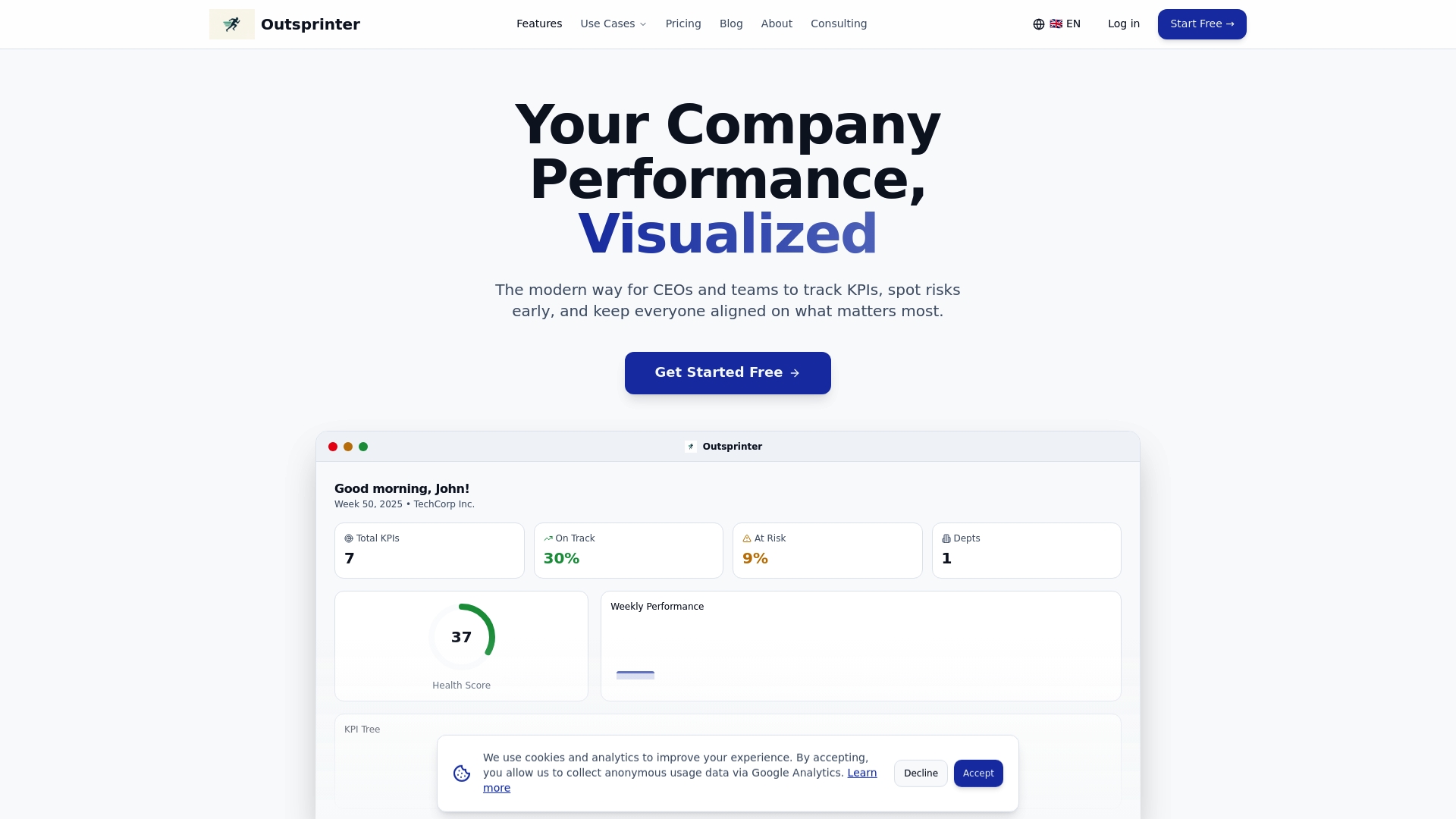
With real-time KPI tracking, your leadership team no longer debates the data — they debate what to do about it. The platform's Goal Planner breaks annual targets into weekly milestones, the AI Assistant surfaces performance insights before your meeting starts, and role-based access ensures every leader sees exactly what they need. Stop managing your checklists in documents. Start running them in a system designed to make your leadership team consistently excellent.
Frequently asked questions
What is the most important checklist for leadership teams?
A weekly team meeting checklist drives the most consistent accountability and decision-making because it formalizes scorecard reviews, goal tracking, and action assignments on a recurring basis, preventing issues from accumulating between sessions.
How does RAPID or RACI improve leadership team effectiveness?
These frameworks clarify decision authority by defining who recommends, who agrees, and who decides for each decision type, reducing confusion and establishing escalation paths with explicit time-bound resolutions.
How can CEOs measure leadership team effectiveness?
Measure both structural indicators like operating rhythm and role clarity and relational indicators like accountability and productive conflict, connecting them to KPIs such as decision speed and employee engagement scores.
Why do most executive checklists fail?
Most checklists fail because they focus on process steps while omitting single-point decision accountability and trust-building behaviors, leaving teams with a documented ritual that doesn't change how authority and conflict actually function in the room.