
TL;DR:
- Leaders often struggle with choosing the right metrics rather than collecting data.
- An effective metrics system aligns with strategic goals, uses SMART criteria, and includes clear ownership and action plans.
- Regular review, limiting metrics, and involving cross-functional teams are essential for turning data into actionable improvements.
Most leaders don't suffer from a lack of data. They suffer from too much of it. When every department tracks different numbers, and no one agrees on what actually matters, performance reviews become guesswork. The real challenge isn't collecting metrics; it's choosing the right ones. Measuring the wrong things wastes budget, demoralizes teams, and causes strategic drift that compounds quietly over months. This checklist gives executives and department managers a clear, repeatable process to identify, structure, and act on the performance metrics that genuinely move the needle for your organization.
Table of Contents
- How to choose impactful organizational metrics
- The essential checkpoints: Your performance metrics checklist
- Common performance metrics: What leaders track
- Avoiding pitfalls and maximizing impact
- Our perspective: Why your checklist matters more than you think
- Ready to level up your performance tracking?
- Frequently asked questions
Key Takeaways
| Point | Details |
|---|---|
| Align metrics with goals | Select metrics that directly support your organization's strategic objectives. |
| Use a structured checklist | A simple, actionable checklist ensures metrics are reviewed, owned, and improved regularly. |
| Avoid common pitfalls | Tracking too many or irrelevant metrics can dilute focus and reduce impact. |
| Prioritize actionable metrics | Metrics should lead to specific decisions and actions for tangible improvement. |
How to choose impactful organizational metrics
With a clear goal in mind, the next step is understanding what makes a metric impactful. Not all numbers are created equal. Some metrics feel satisfying to report but tell you nothing about whether your strategy is working. Others are harder to track but reveal exactly where performance is breaking down.
Before selecting any metric, start by anchoring your choices to your organization's strategic priorities. If your top goal is customer retention, a metric like "number of social media posts" is noise. Revenue per customer, churn rate, and net promoter score are signal. Strong performance alignment strategies always begin with this connection between strategy and measurement.
The most reliable framework for evaluating any metric is SMART: Specific, Measurable, Achievable, Relevant, and Time-bound. A metric that fails any one of these criteria is likely to create confusion rather than clarity. "Improve team morale" is not a metric. "Increase employee engagement score from 62% to 75% by Q3" is.
One of the most overlooked traps in metric selection is overreliance on vanity metrics. These are numbers that look impressive in a board presentation but don't correlate with outcomes. Page views, headcount growth, and training hours logged can all be vanity metrics if they aren't tied to results. Effective performance management strategies consistently distinguish between activity and impact.
Here's a simple selection process to follow:
- List your top three to five strategic priorities for the year.
- For each priority, identify one leading indicator (a metric that predicts future performance) and one lagging indicator (a metric that confirms past results).
- Apply the SMART test to every candidate metric.
- Remove any metric you cannot act on within a reasonable timeframe.
- Assign a clear owner to each metric before finalizing your list.
"What gets measured gets managed, but only if someone is accountable for the outcome."
Pro Tip: For each strategic priority, identify one leading and one lagging indicator. Leading indicators give you early warning; lagging indicators confirm whether your actions worked. Together, they create a complete picture. Organizations that track both are far better positioned to course-correct before problems become costly.
It's also worth noting that organizations spend a median $414 per FTE on learning and development, with 15% of HR budgets allocated there and 78% offering upskilling programs. If your organization invests at this level, you need metrics that show whether that investment is producing capability growth, not just participation rates.
The essential checkpoints: Your performance metrics checklist
Now that you know how to select impactful metrics, let's break down what your actual checklist should include. A well-structured checklist removes ambiguity and ensures every metric in your system has a clear purpose, owner, and review process.
Every metric on your list should pass these checkpoints:
- Strategic alignment: Does this metric directly connect to a stated organizational goal?
- Clear ownership: Is one specific person or team accountable for this number?
- Defined target: Is there a baseline and a specific improvement goal?
- Data source: Where does the data come from, and is it reliable and consistent?
- Review cadence: How often will this metric be reviewed, and by whom?
- Action trigger: What happens if the metric falls below the target threshold?
The action trigger is the checkpoint most organizations skip. Without it, a metric is just a number on a slide. With it, you have a system. For broader performance metric examples across different functions, it helps to see how other organizations structure ownership and review cycles.

Here's a sample checklist table to help you organize your metrics:
| Metric name | Description | Owner | Data source | Review cadence |
|---|---|---|---|---|
| Employee productivity index | Output per employee per quarter | HR Director | HRIS system | Quarterly |
| Customer satisfaction score | Average rating from post-interaction surveys | CX Manager | Survey platform | Monthly |
| Revenue growth rate | % increase in revenue vs. prior period | CFO | Finance system | Monthly |
| L&D ROI | Skill improvement vs. training spend | L&D Lead | LMS + performance data | Quarterly |
| Project delivery rate | % of projects completed on time | PMO Lead | Project management tool | Bi-weekly |
The median L&D spend of $414 per FTE is a useful benchmark when building your people metrics. If you're spending at or above this level, your checklist should include a metric that tracks the return on that investment, not just the spend itself. For a structured approach to KPI results strategies, connecting spend to outcomes is the critical link.
Pro Tip: Revisit your checklist every quarter with input from department heads. Metrics that made sense at the start of the year may become irrelevant as priorities shift. Stakeholder feedback keeps the checklist current and builds cross-functional buy-in.
Common performance metrics: What leaders track
With your checklist framework ready, it's time to explore the key types of metrics leaders most commonly use. Organizing metrics by category helps you spot gaps and avoid over-indexing on one area while neglecting another.
Financial metrics measure the economic health of the organization:
- Revenue growth rate
- Gross profit margin
- Operating expense ratio
- Return on investment (ROI)
Operational and process metrics measure how efficiently work gets done:
- On-time project delivery rate
- Cycle time per process
- Error or defect rate
- Capacity utilization
People and HR metrics measure workforce health and development:
- Employee engagement score
- Voluntary turnover rate
- Training completion and skill improvement rates
- Internal promotion rate
Customer and satisfaction metrics measure external perception and loyalty:
- Net Promoter Score (NPS)
- Customer retention rate
- Average resolution time
- Customer lifetime value
Understanding why tracking organizational performance improves decision-making at the executive level comes down to having the right mix across all four categories. Here's a quick comparison to help you prioritize:
| Organizational priority | Best metric category | Example metric |
|---|---|---|
| Scaling revenue | Financial | Revenue growth rate |
| Improving team efficiency | Operational | On-time delivery rate |
| Retaining top talent | People/HR | Voluntary turnover rate |
| Increasing customer loyalty | Customer | Net Promoter Score |
| Justifying L&D investment | People/HR | Skill improvement vs. spend |
On the people side, 78% of organizations now offer upskilling programs, which signals that workforce capability is a competitive differentiator. If your organization is in this majority, your HR metrics should go beyond headcount and track whether those programs are actually building the skills your strategy requires. Leveraging performance analytics for B2B contexts shows that people metrics are increasingly central to executive decision-making, not just HR reporting.
Avoiding pitfalls and maximizing impact
Knowing which metrics to choose isn't enough; leaders must ensure metrics drive real improvement. The most common failure isn't poor metric selection. It's poor follow-through after the metrics are in place.
Here are four ways to make your metrics actionable:
- Limit your total metric count. Tracking more than 10 to 15 metrics at the organizational level creates noise. Prioritize ruthlessly and let teams track their own operational metrics separately.
- Add context to every number. A 5% drop in customer satisfaction means something very different in January versus after a major product launch. Always review metrics alongside the conditions that shaped them.
- Build a response protocol. Define in advance what action will be taken if a metric misses its target. This removes the delay between insight and action.
- Schedule formal review cycles. Metrics reviewed ad hoc are rarely acted on. Monthly or quarterly reviews with a fixed agenda create the discipline that drives improvement.
"Misaligned metrics don't just waste time. They actively mislead leaders into optimizing for the wrong outcomes, creating the illusion of progress while the real problems go unaddressed."
A strong approach to scalable performance management always includes a feedback loop: measure, review, act, and adjust. Without the loop, metrics become historical records rather than management tools.
Note that 15% of HR budgets go toward L&D across leading organizations. When reviewing your metrics, ask whether your reinvestment decisions are informed by performance data or just habit. Using a team management checklist alongside your metrics framework helps ensure accountability is built into the process from the start.
Pro Tip: Involve department heads from finance, operations, HR, and customer success in your quarterly metric reviews. Cross-functional input catches blind spots and increases the likelihood that findings translate into real action.
Our perspective: Why your checklist matters more than you think
Most organizations we observe don't fail at measurement because they lack data or tools. They fail because they treat their metrics list as a one-time setup task rather than a living management discipline. The checklist gets built, shared in a kickoff meeting, and then quietly forgotten as day-to-day urgency takes over.
Here's the uncomfortable truth: a simple checklist with genuine accountability will outperform a sophisticated analytics platform that no one reviews consistently. Discipline beats sophistication every time. The organizations that improve fastest aren't the ones with the most metric examples or the most complex dashboards. They're the ones that pick fewer metrics, review them religiously, and act on what they find.
The checklist is not a bureaucratic formality. It is the structure that turns data into decisions. Without it, even the best performance data sits unused. With it, your organization builds the habit of improvement.
Ready to level up your performance tracking?
Putting a performance metrics checklist into practice is straightforward in theory but harder to sustain without the right infrastructure. Spreadsheets break down, ownership gets blurry, and review cycles slip.
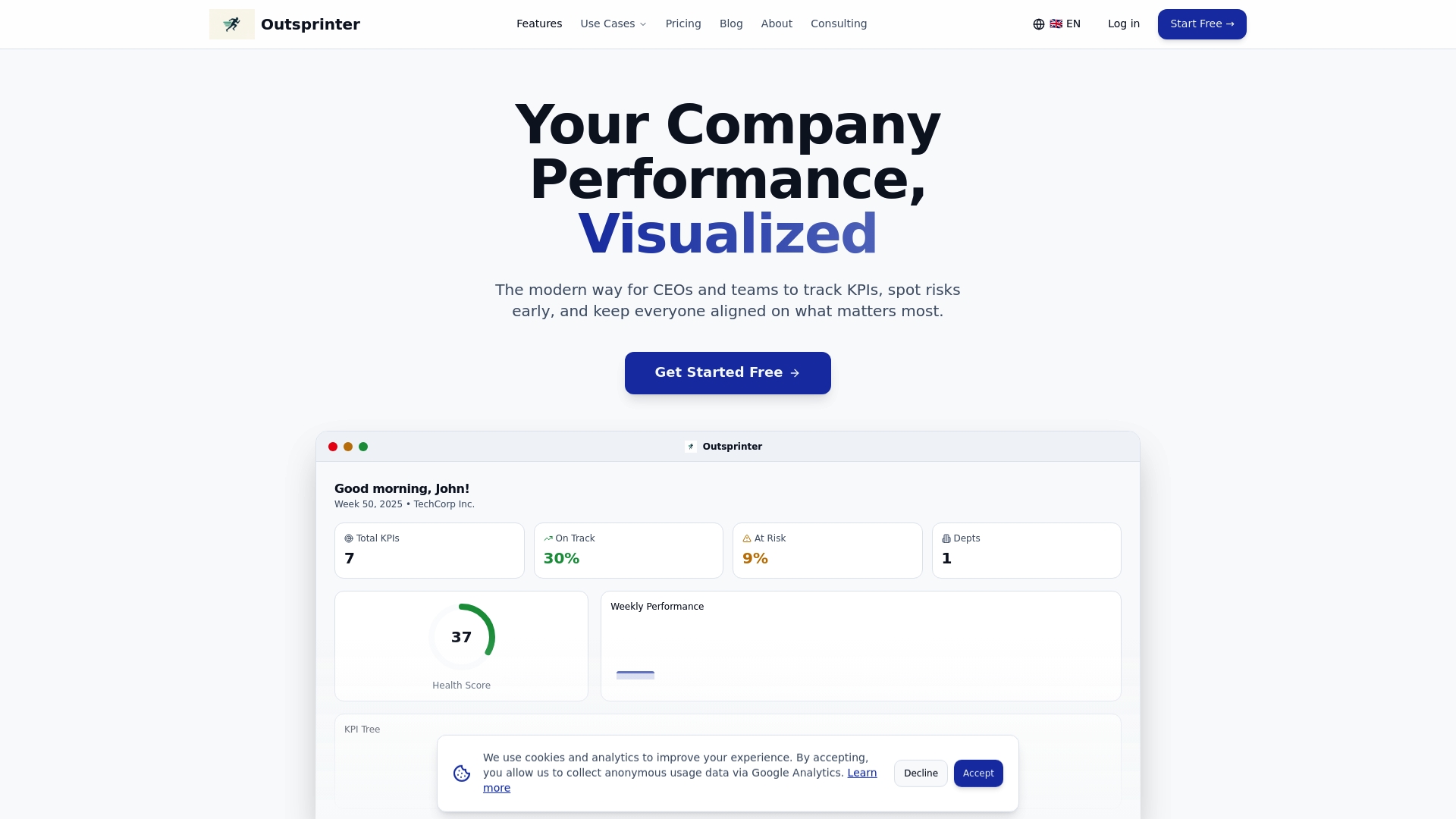
Outsprinter is built to operationalize exactly this kind of discipline. With the KPI management platform, you can define, assign, and visualize every metric on your checklist with real-time data updates. The project management tools connect task execution directly to your performance targets, so accountability is built into daily workflows. From goal setting to automated alerts, Outsprinter gives your team the structure to turn a checklist into a continuous improvement engine.
Frequently asked questions
What are the top 3 organizational performance metrics?
Common top metrics include employee productivity, customer satisfaction, and financial ROI, but the best metrics align with your specific organizational goals rather than a universal standard.
How often should organizational performance metrics be reviewed?
Most organizations review key metrics monthly or quarterly, which keeps leadership responsive to changes and ensures continuous improvement cycles stay on track.
Why do some metrics fail to drive improvement?
Metrics fail when they are disconnected from strategic action or reviewed without follow-up; accountability and alignment are the two factors that determine whether a metric produces change.
How much should organizations invest in learning and development metrics?
The median L&D spend is $414 per employee, with top organizations dedicating 15% of their HR budgets to it, making it a benchmark worth tracking in your people metrics category.