
Most leadership teams believe they are performing well. The problem is, they are usually wrong. Fortune 500 teams rate themselves 8.5/10 while direct reports score them just 4.2 out of 10, a gap wide enough to swallow entire strategic initiatives. That disconnect is not a minor calibration issue. It is a structural blind spot that quietly drains profitability, stalls innovation, and accelerates talent loss. This guide gives you a research-backed, step-by-step method to diagnose your leadership team's real effectiveness, execute targeted improvements, and verify measurable results over time.
Table of Contents
- Why leadership team performance matters
- Comparing leading frameworks: McKinsey TEI vs. Katzenbach-Smith
- Diagnosing your leadership team's true effectiveness
- Executing high-impact team improvements
- Verifying improvement: metrics, ROI, and continuous adjustment
- How Outsprinter elevates leadership team performance
- Frequently asked questions
Key Takeaways
| Point | Details |
|---|---|
| Business impact is huge | High-functioning leadership teams drive far greater profit, innovation, and talent retention. |
| Diagnostics reveal hidden gaps | Combining frameworks and multi-rater feedback exposes weaknesses leaders often miss on their own. |
| Continuous improvement wins | Ongoing measurement, feedback, and action keep teams aligned and performing at their best. |
| ROI is measurable | Evidence shows leadership team performance can yield 5.7x return on investment. |
Why leadership team performance matters
The performance gap between average and high-performing leadership teams is not marginal. It is transformational. Top teams deliver 21% higher profitability and 40% lower turnover, and organizations that invest in leadership development see a 5.7x return on that investment. These are not soft metrics. They show up directly in your income statement and your ability to retain the people who drive growth.
Diversity compounds the advantage further. Diverse leadership teams achieve 35% higher profitability, making team composition a strategic lever, not just a values statement. Yet most CEOs miss this opportunity because they rely on self-assessment rather than structured diagnostics.
"The best leadership teams are not the ones that feel the most aligned. They are the ones that measure alignment and act on the gaps."
Here is what organizations consistently gain when their leadership teams operate at peak levels:
- Faster and more confident strategic decision-making
- Higher employee engagement and reduced voluntary turnover
- Stronger cross-functional collaboration and accountability
- Greater capacity for innovation and market responsiveness
- Improved execution of team best practices across departments
Understanding measuring team performance is the foundation. With the business stakes established, it is vital to have a methodical approach to improving team performance.
Comparing leading frameworks: McKinsey TEI vs. Katzenbach-Smith
Two frameworks dominate serious leadership team development. Both are rigorous. Both are practical. And used together, they give you a complete picture of where your team stands and what to do about it.
McKinsey's Team Effectiveness Index (TEI) uses Net Effectiveness Scores to rate teams across four core factors: direction, leadership, environment, and dynamics. The average team scores just 44 out of 100 on this index, which means most leadership teams are operating at less than half their potential. The TEI is particularly powerful for diagnosing systemic issues and benchmarking against peer organizations.
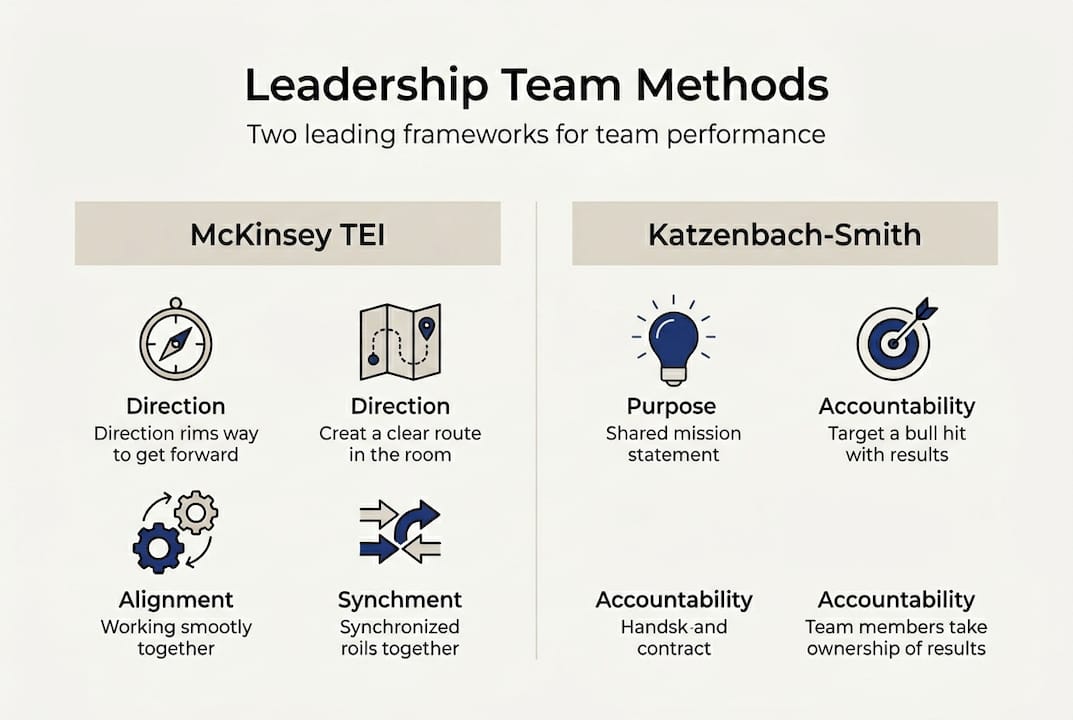
The Katzenbach-Smith framework takes a different angle. It defines high-performing teams by six essentials: small size, complementary skills, shared purpose, clear goals, common approach, and mutual accountability. The framework also maps teams along a performance curve, from working groups to true high-performance teams, helping you identify exactly where your team sits today.
| Framework | What it measures | Best used for | Key output |
|---|---|---|---|
| McKinsey TEI | Direction, leadership, environment, dynamics | Benchmarking and systemic diagnosis | Net Effectiveness Score |
| Katzenbach-Smith | Skills, accountability, purpose, goals | Team development and culture building | Performance curve position |
Both frameworks complement your performance review process and help you select the right performance metrics examples for your context.
"No single framework captures everything. The most effective CEOs use multiple lenses to see the full picture."
Pro Tip: Run the McKinsey TEI for a quantitative baseline, then use Katzenbach-Smith to guide the qualitative development work. Together, they cover both the diagnostic and the developmental dimensions of team health.
Understanding these frameworks is the first step. Here is how to apply them in practice for your leadership team.
Diagnosing your leadership team's true effectiveness
Diagnosis is where most executive teams skip ahead too quickly. They jump to solutions before they understand the actual problem. A structured diagnostic process changes that.

The gold standard is an annual 360-degree assessment. 360-degree assessments uncover perception gaps that self-reporting consistently misses. Combine that with multi-rater feedback, hard organizational KPIs, and a framework review, and you get a complete picture of team health rather than a flattering snapshot.
Best-in-class teams outperform on innovation and accountability precisely because they treat diagnosis as an ongoing discipline, not a one-time event. They use data to surface blind spots before those blind spots become strategic failures.
Here is a recommended diagnostic schedule:
| Tool | Frequency | Purpose |
|---|---|---|
| 360-degree survey | Annual | Full perception gap analysis |
| Pulse survey | Quarterly | Track sentiment and early warning signals |
| KPI review | Monthly | Hard performance data |
| Framework assessment (TEI or Katzenbach-Smith) | Annual | Structural team health |
Follow this diagnostic process step by step:
- Define the scope. Decide which team members, stakeholders, and direct reports will participate in the assessment.
- Select your tools. Choose a validated 360-degree instrument and align it with your chosen framework.
- Collect multi-source data. Gather input from peers, direct reports, and external stakeholders, not just self-assessments.
- Integrate hard metrics. Pull in KPI data for teams alongside qualitative feedback.
- Analyze perception gaps. Compare self-ratings against external ratings to identify the largest disconnects.
- Review blind spots with the full team. Use performance visualization techniques to make the data accessible and actionable.
- Document findings and prioritize gaps. Use a team management checklist to track what needs to change and by when.
Pro Tip: Bring in an outside facilitator for the blind spot review session. Internal facilitators often soften difficult findings to protect relationships. An external voice delivers the data without the politics.
Once you have diagnosed the gaps, shift focus to closing them with purposeful interventions.
Executing high-impact team improvements
Diagnosis without action is just expensive self-awareness. The real value comes from choosing the right interventions and executing them with discipline.
Your diagnostic results should directly inform your intervention priorities. If the data shows low trust, start there. If it reveals role ambiguity, clarify accountabilities before anything else. Trying to fix everything at once is a reliable way to fix nothing.
Effective transformation levers include role clarification, trust-building, and regular feedback loops, and the ROI shows up in measurable output improvement within one to two quarters. High-functioning teams manage conflict actively, provide structured feedback, and hold each other accountable as a standard operating practice, not as a crisis response.
Key improvement levers to prioritize based on your diagnostic findings:
- Role clarity: Eliminate overlap and ambiguity so every leader knows exactly what they own
- Trust architecture: Build psychological safety through structured vulnerability and consistent follow-through
- Feedback cadence: Install regular, structured feedback loops at both the team and individual level
- Skills diversity: Audit complementary skills and close gaps through hiring, development, or role redesign
- Conflict protocols: Create agreed-upon norms for surfacing and resolving disagreement productively
These levers connect directly to leadership productivity tips and your broader performance alignment guide for the organization.
"Resistance to change inside a leadership team is not a personality problem. It is data. It tells you exactly where the real work needs to happen."
Pro Tip: When team members push back on interventions, treat that resistance as strategic intelligence. It often reveals the exact pressure points where trust or clarity is weakest. Explore it rather than override it.
To ensure progress, you must track and verify improvement over time.
Verifying improvement: metrics, ROI, and continuous adjustment
Improvement without measurement is just hope. Verification closes the loop and turns your leadership development investment into a compounding advantage.
Leadership development initiatives deliver a 5.7x ROI, and firms with strong leadership pipelines generate 4.5x greater returns than their peers. Those numbers only materialize when you track the right metrics and adjust based on what the data tells you.
Follow this stepwise approach to verify improvement:
- Select your KPIs. Choose a mix of leading indicators (team trust scores, feedback frequency) and lagging indicators (profitability, retention, innovation output).
- Establish a baseline. Use your initial diagnostic data as the benchmark for all future comparisons.
- Review quarterly. Hold structured quarterly reviews to assess progress against each KPI.
- Adjust interventions. If a lever is not moving the needle after two quarters, replace or redesign it.
- Repeat the annual diagnostic. Run the full 360-degree assessment each year to reset the baseline and identify new gaps.
Tracking organizational performance at the leadership level gives you the early warning signals you need before small gaps become large failures.
| Focus area | Key metric | Review frequency |
|---|---|---|
| Profitability | Revenue per leader, margin trends | Quarterly |
| Retention | Voluntary turnover rate | Quarterly |
| Innovation | New initiatives launched, pipeline velocity | Bi-annual |
| Team health | NES score, pulse survey results | Quarterly |
| Accountability | KPI completion rate, milestone adherence | Monthly |
Leading indicators tell you where you are headed. Lagging indicators confirm whether you got there. Use both, and never rely on one data source alone.
How Outsprinter elevates leadership team performance
For teams ready to put this method to work, purpose-built technology can turn insight into ongoing results. Diagnosing gaps, tracking KPIs, and managing improvement initiatives across a leadership team requires more than spreadsheets and quarterly meetings.
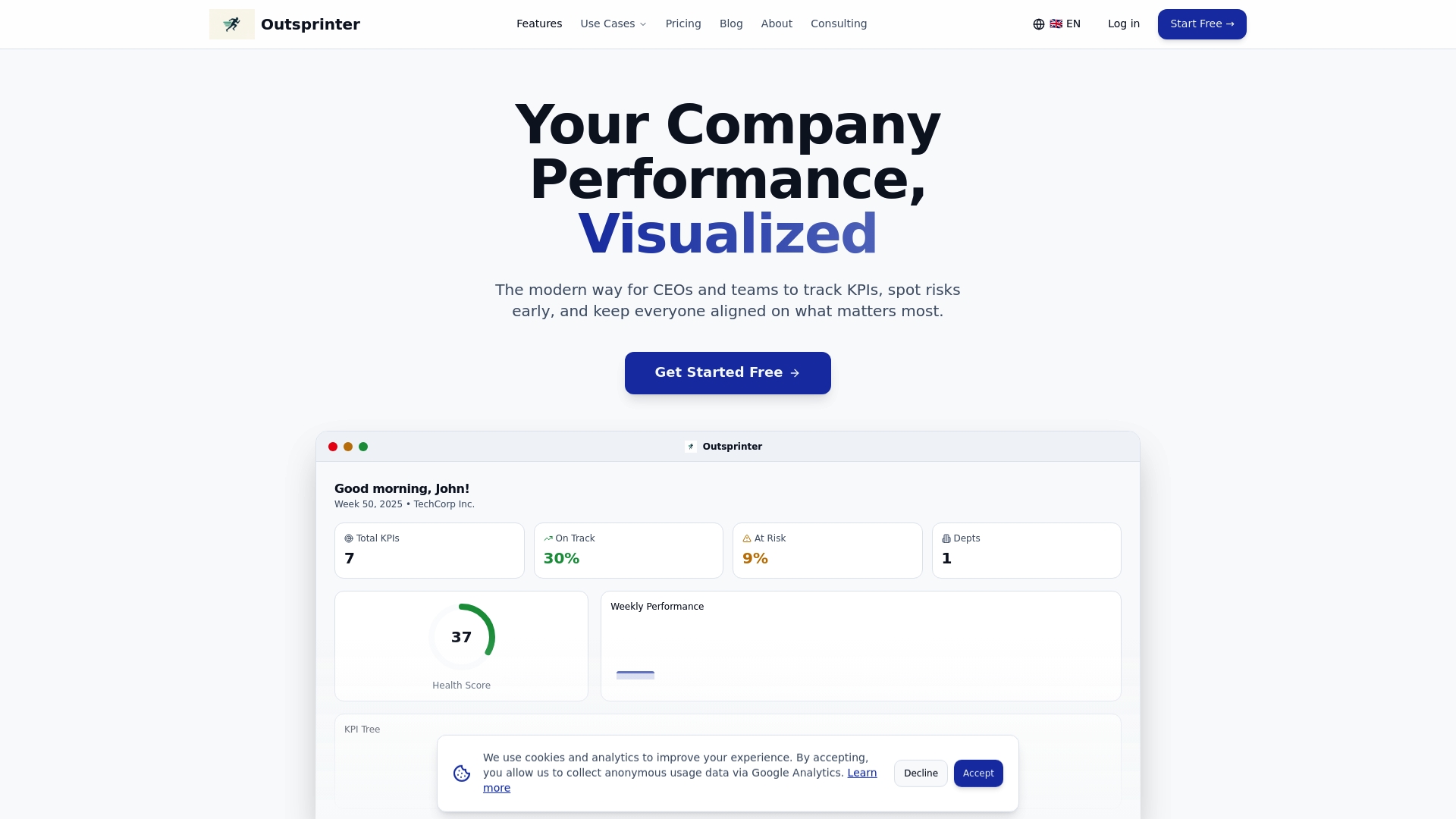
Outsprinter gives executive teams a single platform to operationalize every phase of this method. Use KPI tracking tools to define, visualize, and monitor leadership performance metrics in real time, with dashboards that update instantly as your team enters data. The Goal Planner breaks annual targets into weekly milestones so progress is visible and accountable at every level. Advanced task management keeps improvement initiatives on track with priorities, deadlines, and ownership clearly assigned. The AI Assistant helps you analyze performance data and surface actionable insights without waiting for a quarterly review cycle. When your method is this clear, the right tools make execution inevitable.
Frequently asked questions
What are the most important metrics for assessing leadership team performance?
Key metrics include innovation output, retention rates, accountability scores, profitability trends, and Net Effectiveness Scores from structured team assessments. Top teams deliver 21% higher profitability and 40% lower turnover compared to average teams.
How often should CEOs evaluate their leadership teams?
Best practice is an annual full 360-degree assessment combined with quarterly performance check-ins. Annual 360-degree surveys supplemented by quarterly pulses give you both depth and continuity.
Why do so many executive teams overestimate their effectiveness?
Self-perception gaps are the primary cause. Leaders consistently rate themselves far higher than their direct reports do, masking real issues in trust, accountability, and alignment. Fortune 500 teams self-rate at 8.5/10 while reports score them just 4.2 out of 10.
How does diversity impact leadership team performance?
Diversity is a direct performance driver, not just a cultural value. Diverse leadership teams achieve 35% higher profitability, making team composition one of the highest-leverage decisions a CEO can make.
Can digital platforms enhance leadership team performance methods?
Yes. Digital platforms streamline diagnostics, centralize KPI tracking, and create accountability structures that manual processes cannot sustain. They support continuous improvement by making performance data visible and actionable for the entire leadership team.