
Performance management is under more pressure than ever. HR teams in medium to large enterprises are navigating hybrid work, AI disruption, and rising employee expectations, all at once. The old annual review model simply cannot keep pace. Skills-based assessments are replacing traditional appraisals, with AI-driven gap identification reshaping how organizations develop talent. This guide breaks down five high-impact trends, gives you a side-by-side comparison, and offers practical recommendations so you can build a performance system that actually works in 2026.
Table of Contents
- How to evaluate performance management trends for 2026
- Trend #1: Skills-based assessments and talent marketplaces
- Trend #2: Continuous feedback and goal cascades
- Trend #3: AI augmentation and human-centric design
- Trend #4: Simplicity, calibration, and pay linkage
- Trend #5: Equity audits and inclusion focus
- Comparison table: 2026 performance management trends side by side
- Situational recommendations: Choosing the right trend for your enterprise
- Enhance your team's performance with Outsprinter
- Frequently asked questions
Key Takeaways
| Point | Details |
|---|---|
| Skills-based systems | Skills-based assessments and internal talent marketplaces increase agility and drive targeted development for modern teams. |
| Continuous feedback | Ongoing feedback and structured goal cascades are proven to boost effectiveness by 17 percent in performance management. |
| Human-centric AI | Balancing advanced AI tools with human judgment delivers 1.6 times better performance and less risk of underperformance. |
| Simple and calibrated processes | Simplification and calibration improve fairness, manager enablement, and create clear links between performance and compensation. |
| Equity and inclusion | Equity audits and inclusion-focused practices ensure unbiased, compliant performance management and greater employee trust. |
How to evaluate performance management trends for 2026
Before you adopt any new approach, you need a clear lens for evaluation. Not every trend fits every organization, and choosing the wrong one wastes time, budget, and trust. The right framework helps you cut through the noise.
When assessing any performance management (PM) trend, measure it against these four criteria:
- Agility and adaptability: Can the system respond quickly when business priorities shift?
- Skills-based focus: Does it assess competencies rather than just job titles or tenure?
- Technology integration: Does it leverage AI, data analytics, or talent marketplaces effectively?
- Human-centric execution: Does it keep people at the center, not just the platform?
Modern PM frameworks emphasize continuous, skills-based, AI-augmented, and equity-audited approaches as the new standard. Organizations that align their systems to these pillars consistently outperform those still running legacy processes. Use this performance alignment guide to map your current state before selecting a new direction.
Trend #1: Skills-based assessments and talent marketplaces
The shift from role-based to skills-based performance is one of the most significant changes in modern HR. Instead of evaluating employees by their job title, organizations now assess the specific competencies they bring and the gaps they need to close.

AI tools make this practical at scale. They scan performance data, project outcomes, and learning records to flag skill gaps in real time, before they become business problems. Enterprise talent marketplaces take it further by matching employees to internal projects based on their actual skills, not just their department.
Here is how leading organizations are making the transition:
- Audit your current appraisal criteria and identify which are role-based versus competency-based
- Map skills to business outcomes so assessments connect directly to organizational goals
- Pilot AI-driven gap detection in one division before scaling enterprise-wide
- Build internal talent marketplaces that allow flexible deployment across teams
Skills-based assessments paired with enterprise talent marketplaces are now central to high-performing PM systems. For a deeper look at how AI fits into this picture, the AI performance management guide is a strong starting point. You can also use a project management platform to track skill-based assignments and measure outcomes in real time.
Pro Tip: Use AI-generated skill gap reports to build personalized growth plans for each employee. When people see a clear path forward, engagement and retention both improve.
Trend #2: Continuous feedback and goal cascades
Annual reviews are a snapshot. Continuous feedback is a live feed. The difference in impact is enormous. When managers and employees exchange feedback regularly, course corrections happen faster and performance stays on track throughout the year.
Goal cascades add structure to this process. They align individual objectives to team targets, which connect to organizational strategy. Everyone knows what they are working toward and why it matters.
"91.6% of organizations now have formal PM processes, and those with structured goal cascades, calibrations, and pay linkage report 17% higher effectiveness than those without."
Key elements of a strong continuous feedback system include:
- Regular check-ins: Weekly or biweekly conversations replace the once-a-year review
- Structured goal cascades: Organizational targets broken into team and individual milestones
- Calibration sessions: Managers align on ratings to ensure consistency across departments
- Digital feedback loops: Platforms that capture, store, and surface feedback at the right moments
Pro Tip: Set up digital feedback checkpoints at the end of each project sprint. This keeps feedback timely and tied to real work, not vague impressions from months ago. A solid performance visualization guide can help you design dashboards that make feedback trends visible to both managers and employees. Understanding roles in performance management also clarifies who owns each part of the feedback cycle.
Trend #3: AI augmentation and human-centric design
AI is not replacing managers. It is making them better. The organizations seeing the strongest results are those that treat AI as a support layer, not a decision-maker. This is what human-centric AI design looks like in practice.
"Deloitte research shows that organizations using a human-centric AI approach are 1.6x less likely to underperform compared to those that prioritize technology over people."
That statistic should stop you in your tracks. Technology-first implementations often fail because they ignore the human dynamics that drive performance. The fix is designing for human-AI symbiosis from the start.
Here is what that looks like in practice:
- Manager enablement: Give managers AI tools that surface insights, but keep humans in the decision seat
- Transparent AI governance: Employees should understand how AI influences their performance data
- Hybrid support models: Combine automated feedback with human coaching for complex situations
- Continuous learning loops: Use AI to recommend development resources based on real performance patterns
To understand how this connects to broader productivity goals, explore why you should measure team productivity and review performance metrics examples that balance quantitative data with qualitative insight.
Trend #4: Simplicity, calibration, and pay linkage
Complex PM systems collapse under their own weight. When managers spend more time navigating the process than actually managing people, something has gone wrong. The 2026 trend is clear: simplify, calibrate, and connect performance to pay.
Ratings are used in 92.4% of organizations with formal PM processes, and the most effective systems keep the rating scale simple, the calibration process consistent, and the link to compensation transparent.
Here is a step-by-step approach to simplifying your PM system:
- Reduce rating scales to three to five levels with clear behavioral anchors
- Run calibration sessions quarterly, not just at year-end, to catch drift early
- Document pay linkage criteria so employees understand how ratings translate to compensation
- Train managers on calibration techniques to reduce bias and inconsistency
- Audit the process annually to remove steps that add friction without adding value
| Feature | Structured PM system | Unstructured PM system |
|---|---|---|
| Goal alignment | Clear cascades across all levels | Ad hoc, inconsistent |
| Calibration | Regular, documented sessions | Rare or absent |
| Pay linkage | Transparent and criteria-based | Subjective or unclear |
| Manager confidence | High, with training and tools | Low, with minimal support |
| Employee trust | Strong, due to consistency | Weak, due to perceived bias |
For HR teams managing large workforces, this kind of structured simplicity is not optional. It is the foundation of a fair and scalable system.
Trend #5: Equity audits and inclusion focus
An equity audit is a structured review of your PM data to identify patterns of bias or unfairness across demographic groups. It is not a compliance checkbox. It is a trust-building tool that protects your organization and your people.
Modern PM frameworks now treat equity-audited approaches as a baseline requirement, not an advanced feature. Organizations that skip this step risk perpetuating bias in ratings, promotions, and pay decisions.
Here is how to build equity audits into your PM cycle:
- Collect disaggregated data: Break down performance ratings by gender, ethnicity, tenure, and role level
- Identify patterns: Look for consistent gaps in ratings or promotion rates across groups
- Investigate root causes: Determine whether gaps reflect bias in the process or real skill differences
- Publish transparent metrics: Share findings with leadership and, where appropriate, with employees
- Iterate and improve: Use audit results to refine calibration criteria and manager training
Pro Tip: Use transparent reporting dashboards to share equity metrics with senior leadership on a quarterly basis. Visibility creates accountability, and accountability drives change. The KPI results guide offers a practical framework for tracking inclusion-related KPIs alongside traditional performance data.
Comparison table: 2026 performance management trends side by side
Use this table to evaluate which trends align best with your organization's current capabilities and goals.
| Trend | Implementation complexity | Business impact | Technology required | Inclusivity focus |
|---|---|---|---|---|
| Skills-based assessments | Medium | Very high | AI tools, talent marketplace | Medium |
| Continuous feedback and goal cascades | Low to medium | High | Feedback platforms, dashboards | Medium |
| AI augmentation and human-centric design | High | Very high | AI platforms, governance tools | High |
| Simplicity, calibration, and pay linkage | Low | High | Basic PM software | Medium |
| Equity audits and inclusion focus | Medium | High | Analytics and reporting tools | Very high |
This comparison is a starting point, not a final answer. Your organization's digital maturity, culture, and leadership readiness will shape which trends deliver the most value.
Situational recommendations: Choosing the right trend for your enterprise
Not every organization should chase every trend at once. The smartest approach is to match your PM investments to your current stage of development.
- If you are a medium to large enterprise with strong digital infrastructure: Prioritize AI augmentation and skills-based assessments. Invest in platforms that support hybrid AI governance and manager enablement to close execution gaps at scale.
- If you are scaling rapidly: Start with continuous feedback and goal cascades. These have the lowest implementation complexity and deliver fast, visible results.
- If you have low digital maturity: Focus on simplicity and calibration first. Get your rating and pay linkage processes clean before layering in technology.
- If trust and engagement are your biggest challenges: Lead with equity audits. Demonstrating fairness builds the psychological safety that makes every other PM initiative more effective.
- If you are ready for full transformation: Combine all five trends in a phased rollout, starting with the two that address your most urgent gaps.
The key is honest self-assessment. A trend that works brilliantly for a 5,000-person tech company may overwhelm a 300-person professional services firm still running spreadsheet-based reviews.
Enhance your team's performance with Outsprinter
Putting these trends into practice requires more than a strategy document. You need a platform that connects goal cascades, feedback loops, KPI tracking, and AI insights in one place.
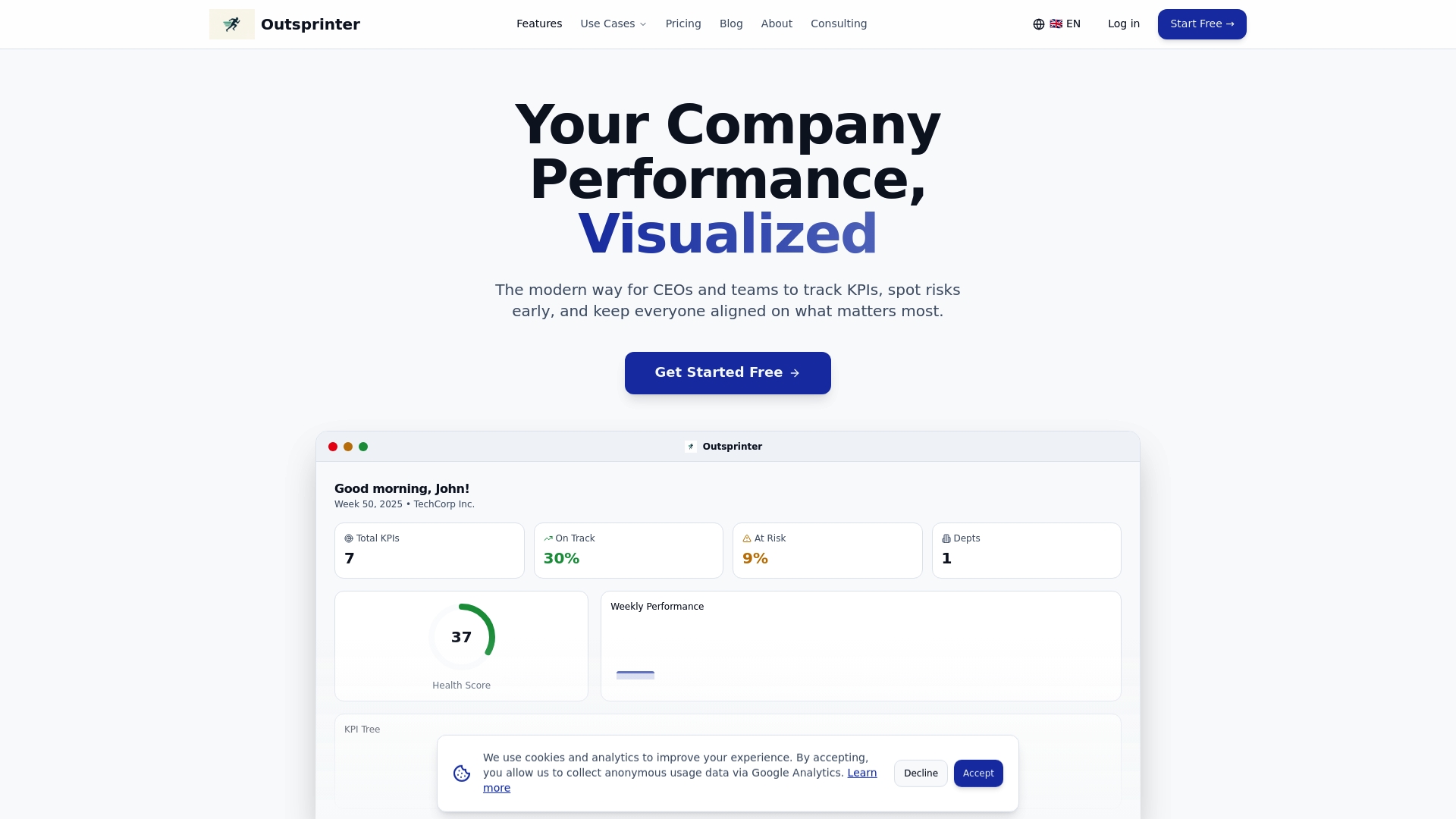
Outsprinter is built for exactly this. The KPI management software lets you define, track, and visualize performance indicators across your entire organization in real time. The task management software keeps individual and team work aligned to strategic goals with clear priorities and deadlines. And the AI Assistant helps HR leaders and managers analyze performance data, plan better KPIs, and surface actionable insights without needing a data science team. Whether you are rolling out skills-based assessments or building your first equity audit dashboard, the performance management platform gives you the infrastructure to move from trend awareness to measurable results.
Frequently asked questions
What is the most effective performance management trend in 2026?
Skills-based assessments and continuous feedback are the top performers, especially when combined with AI tools and structured goal cascades that align individual work to organizational strategy.
How does AI support performance management in modern enterprises?
AI-driven skill gap identification enables real-time detection of development needs, automates routine feedback tasks, and gives managers data-backed insights so they can coach more effectively and make fairer decisions.
Why are equity audits important in performance management?
Equity-audited PM frameworks prevent bias from compounding across ratings, promotions, and pay decisions, building the organizational trust that makes every other performance initiative more effective.
What is goal cascade in performance management?
Goal cascade is the process of breaking organizational objectives into aligned team and individual targets. Structured goal cascades correlate with significantly higher PM effectiveness across organizations of all sizes.
How do I choose the right PM trend for my team?
Match your choice to your team's size, digital maturity, and culture. Medium to large enterprises benefit most from investing in AI governance, hybrid support models, and manager enablement platforms that close execution gaps at scale.