
TL;DR:
- Effective performance management is an ongoing cycle of goal setting, feedback, and assessment, not just annual reviews.
- Combining methodologies like SMART goals, OKRs, and continuous feedback drives team success and alignment.
- Leveraging technology such as AI, real-time dashboards, and analytics enhances objectivity and early issue detection.
Most managers have a performance management system in place. They set goals, run reviews, and track metrics. Yet teams still miss targets, feedback feels hollow, and alignment with company objectives stays frustratingly out of reach. The problem isn't the absence of a process. It's that many managers treat performance management as a checkbox rather than a living system. This article walks you through proven strategies, core frameworks, and real-world solutions to help you build a performance management approach that actually moves the needle for your team.
Table of Contents
- What is performance management and why it matters
- Core methodologies: SMART goals, OKRs, and continuous feedback
- Leveraging technology: AI and analytics in performance management
- Navigating common challenges and edge cases
- A fresh perspective: What most managers overlook in performance management
- Next steps: Tools and resources to enhance your team's performance management
- Frequently asked questions
Key Takeaways
| Point | Details |
|---|---|
| Clear frameworks matter | Using proven methods like SMART and OKR ensures goals are clear and measurable. |
| Feedback drives growth | Continuous feedback and regular check-ins improve engagement and productivity. |
| Leverage technology | AI and analytics transform performance management by removing bias and providing actionable insights. |
| Address challenges early | Recognizing and resolving common issues quickly prevents productivity drops and misalignment. |
| Manager as coach | Training managers to coach and intervene early delivers better team outcomes than process alone. |
What is performance management and why it matters
Performance management is the ongoing process of setting clear goals, providing continuous feedback, and assessing progress to help individuals and teams perform at their best. It's not an annual review. It's not a single conversation. It's a cycle that runs all year long, connecting individual effort to organizational strategy.
When done well, performance management delivers real results:
- Higher team productivity through clear priorities and accountability
- Better employee development because gaps are identified early
- Stronger goal alignment between individuals, teams, and the business
- Reduced turnover, since employees feel supported rather than blindsided
- Faster course correction when performance dips
One of the biggest misconceptions managers carry is that having a framework automatically produces results. It doesn't. Performance management trends show that organizations are moving away from rigid annual cycles toward continuous, conversation-driven models because static processes fail to capture real-time performance shifts.
Another common failure is role confusion. Many managers don't fully understand their performance management roles versus HR's responsibilities, which creates gaps in accountability and follow-through.
"Key methodologies include SMART/OKR goal setting, continuous feedback via regular check-ins, 360-degree reviews, and data-driven assessments."
This quote captures what separates effective systems from ineffective ones. It's not one tool or one conversation. It's a combination of structured goal setting, regular dialogue, multi-source feedback, and objective data. When all four work together, performance management stops being a burden and starts being a genuine driver of team success.
The foundation matters because everything else builds on it. If your team doesn't understand what good performance looks like, no amount of technology or process will fix that.
Core methodologies: SMART goals, OKRs, and continuous feedback
Once you understand why performance management is essential, the next step is to master core methodologies for effective results.
SMART goals (Specific, Measurable, Achievable, Relevant, Time-bound) give employees a clear picture of what success looks like. Instead of "improve customer satisfaction," a SMART goal reads: "Increase customer satisfaction scores from 78% to 85% by Q3 2026 by reducing response time below 4 hours." The specificity removes ambiguity and makes progress trackable.
OKRs (Objectives and Key Results) work differently. They push teams toward ambitious, sometimes uncomfortable targets. The Objective is qualitative and inspiring. The Key Results are measurable and time-bound. OKRs are designed to stretch performance, not just maintain it.
| Framework | Best for | Time horizon | Stretch factor |
|---|---|---|---|
| SMART goals | Individual tasks and role clarity | Short to mid-term | Moderate |
| OKRs | Team and organizational ambition | Quarterly to annual | High |
Using goal-setting frameworks strategically means knowing when to use each. SMART goals work well for operational roles with defined outputs. OKRs shine when you need a team to innovate or shift direction.
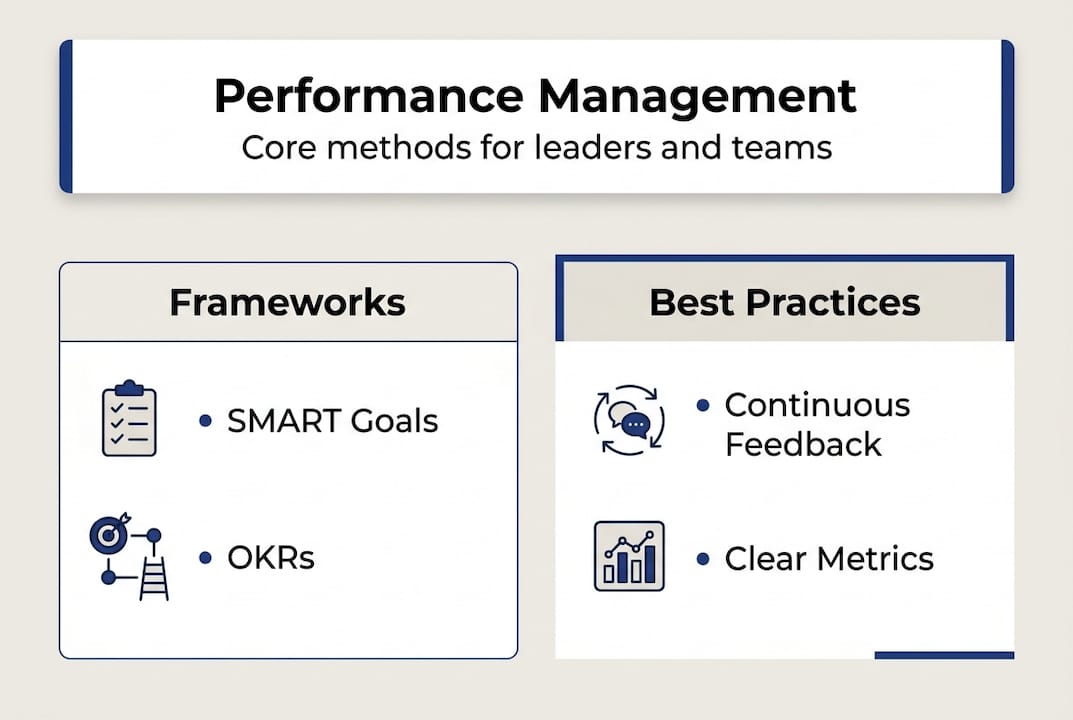
Continuous feedback is where most managers underinvest. Annual reviews capture a snapshot. Weekly or biweekly check-ins capture the full picture. Collaborative goal setting, regular check-ins, and real-time recognition are key practices that separate high-performing teams from average ones.
Here's a simple sequence to build continuous feedback into your routine:
- Set a standing 1:1 cadence with each direct report (30 minutes, weekly or biweekly)
- Open with progress on current goals, not status updates
- Ask one coaching question: "What's the biggest blocker you're facing right now?"
- Close with one clear action item per person
- Document notes and follow up at the next session
Pro Tip: Use your 1:1s specifically to surface blockers before they become performance issues. Most problems are visible weeks before they escalate. A 10-minute conversation early saves hours of performance management later.
Leveraging technology: AI and analytics in performance management
After setting up core methodologies, it's crucial to leverage technology to maximize their impact and minimize bias.
Modern performance management systems go far beyond spreadsheets and email threads. Today's tools include real-time dashboards, automated KPI tracking, AI-powered analytics, and integrated feedback platforms. Each one addresses a specific weakness in traditional approaches.

Big data and AI enhance PMS effectiveness, and research shows they are positively associated with top management support and employee empowerment. In plain terms, when leaders use data well, teams feel more fairly evaluated and more motivated to perform.
Here's how common analytics tools add value:
| Tool type | Primary benefit | Manager use case |
|---|---|---|
| Real-time dashboards | Instant visibility into team output | Spot performance dips before reviews |
| AI feedback analyzers | Reduce recency and halo bias | More accurate mid-year assessments |
| KPI tracking software | Objective, data-backed goal progress | Replace gut-feel with evidence |
| Pulse survey tools | Capture team sentiment continuously | Identify engagement risks early |
The advantages of adopting a tech-driven approach are significant:
- Bias reduction through pattern recognition across large data sets
- Faster identification of high performers and those needing support
- Consistent evaluation criteria applied across the whole team
- Time savings on manual reporting and data collection
- Better conversations because managers arrive with facts, not impressions
Exploring AI in performance management reveals that the biggest wins come not from replacing human judgment but from informing it. AI flags anomalies. You decide what to do about them.
Reviewing performance metrics examples helps you choose the right indicators for your team's specific function, whether that's sales conversion rates, project delivery speed, or customer retention scores.
Navigating common challenges and edge cases
Even with methodologies and technology, managers face real-world challenges. Here's how to tackle them effectively.
The most common challenges in performance management include bias in evaluations, unclear expectations, and infrequent feedback. These aren't rare edge cases. They're the default state for most teams that haven't deliberately built better habits.
Here's a breakdown of frequent obstacles and practical fixes:
- Recency bias: Managers overweight the last few weeks before a review. Fix this by keeping running notes on performance throughout the cycle.
- Unclear goals: Employees don't know what "good" looks like. Fix this by co-creating goals so employees own them.
- Feedback gaps: Feedback only flows downward and annually. Fix this by building 360-degree input into your regular rhythm.
- Misaligned priorities: Teams work hard on the wrong things. Fix this by connecting individual tasks to team OKRs visibly.
Edge cases in performance management include high-stakes roles where mistakes are costly, timing issues where performance dips coincide with personal challenges, and behavioral problems that don't show up in metrics. Solutions involve coaching conversations, holistic assessment of the full performance picture, and incremental testing in lower-stakes situations before escalating.
For example, if a senior engineer is struggling with delivery timelines, don't jump to a formal performance improvement plan. Start with a coaching conversation to understand root causes. Is it unclear requirements? Workload overload? A skill gap? The answer shapes your response entirely.
Pro Tip: Intervene early. Most managers wait until a problem is undeniable before acting. By then, the employee is demoralized and the team is affected. A single honest conversation at the first sign of struggle is far more effective than a formal process six months later.
Building strong leadership team performance habits means treating early intervention as a core management skill, not an uncomfortable exception.
A fresh perspective: What most managers overlook in performance management
Here's the uncomfortable truth most performance management articles skip: process alone doesn't fix a performance problem. Judgment does.
The key failure point in performance management is judgment in ambiguous work situations. When output is hard to measure, managers default to activity metrics or gut feel, both of which are unreliable. The fix isn't more process. It's clearer standards and earlier intervention.
Most managers are promoted for technical skill, not coaching ability. Then they're handed a performance management system and expected to use it well. That gap is enormous. For mid-level managers, prioritizing manager training as coaches and reducing bias are the highest-leverage investments an organization can make.
We've seen teams transform not by adopting new software but by shifting the manager's mindset from evaluator to coach. When you approach performance conversations with curiosity instead of judgment, employees open up, problems surface earlier, and solutions emerge faster. Secure performance management isn't about rigid control. It's about creating the psychological safety where honest performance dialogue can happen.
Next steps: Tools and resources to enhance your team's performance management
For those ready to optimize their systems and apply these insights, the right tools can make all the difference.
Implementing everything covered here manually is possible, but it's slow and error-prone. A dedicated platform removes friction and keeps your team focused on performance rather than administration.
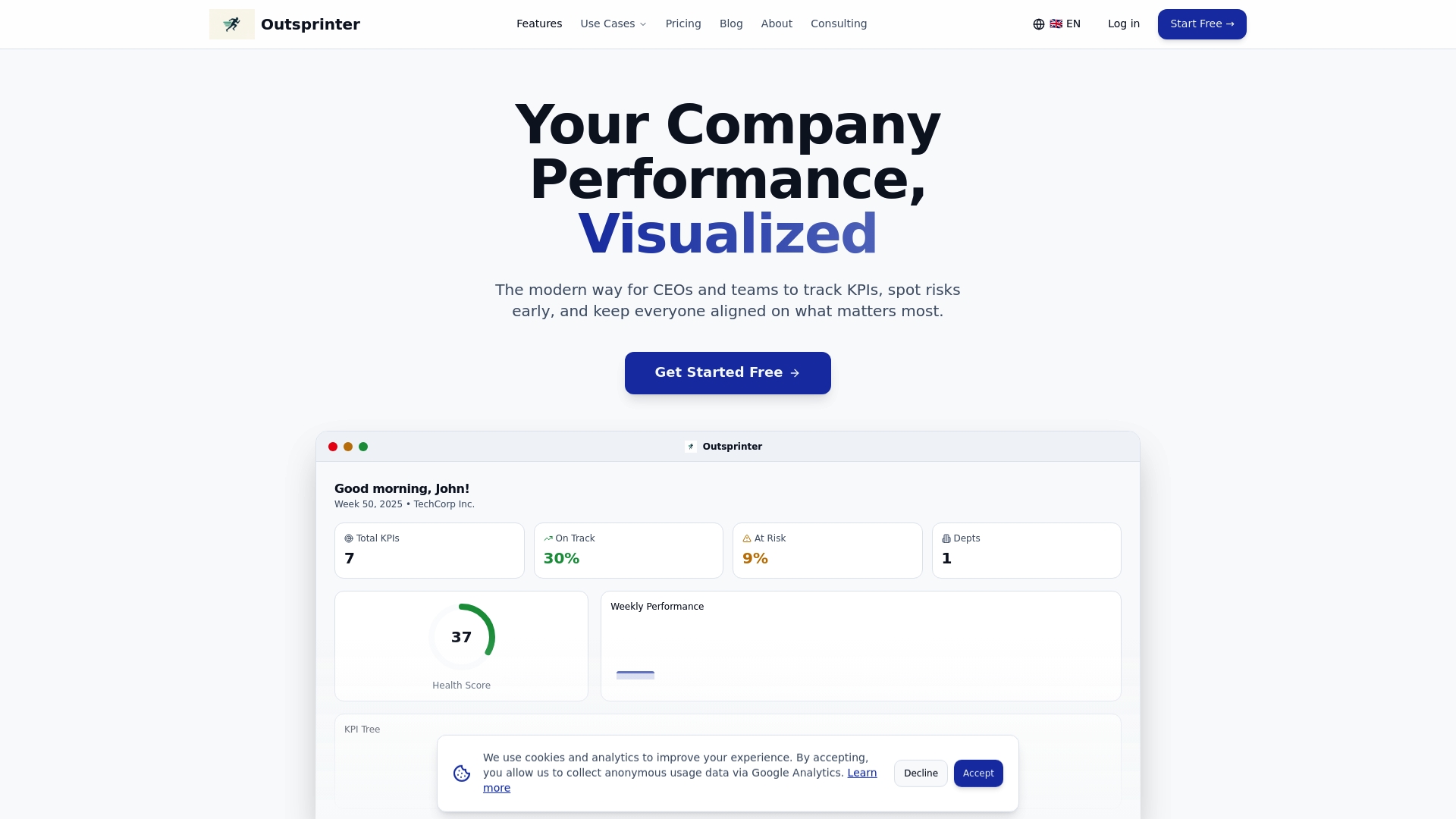
Outsprinter brings together task management software, KPI tracking software, and goal planning into one connected workspace. You can set goals, track progress in real time, run check-ins with full context, and let the AI Assistant surface insights you'd otherwise miss. If you're ready to move from reactive performance conversations to proactive performance leadership, explore the full team performance platform and see how it fits your team's workflow.
Frequently asked questions
What is the main purpose of performance management?
The main purpose is to align individual and team goals with organizational objectives while boosting productivity and development. Performance management entails collaborative goal setting and ongoing feedback to keep everyone moving in the same direction.
How do SMART goals differ from OKRs?
SMART goals focus on specific, measurable outcomes tied to defined roles, while OKRs emphasize ambitious objectives paired with key results tracked over time. SMART and OKR frameworks serve different purposes and work best when used together strategically.
How does AI reduce bias in performance evaluations?
AI identifies patterns and inconsistencies across data automatically, helping managers reduce recency and halo bias in assessments. Big data and AI enhance PMS effectiveness by making evaluation criteria more consistent and objective across the entire team.
What are the signs that a performance management system isn't working?
Common signs include unclear expectations, infrequent feedback, biased reviews, and team misalignment with business goals. Unclear expectations and infrequent feedback are the two most common indicators that a system needs a serious reset.