
TL;DR:
- Most teams believe their dashboards provide real-time insights, but they often display snapshots of past data. True real-time analytics delivers continuous data freshness, enabling instant decision-making at critical moments. Implementing genuine real-time systems requires careful planning, clear ownership, and processes that can act swiftly on live insights.
Most teams believe their dashboards are giving them a live picture of performance. They're not. If your analytics platform refreshes every five or ten minutes, you're making decisions based on a snapshot of the past, not the present. Data freshness and actionable monitoring matter far more than a faster refresh cycle when the stakes are high. In this article, you'll learn what true real-time analytics actually means, why organizations are racing to adopt it, where it delivers the most impact, and how to avoid the implementation traps that catch even experienced teams off guard.
Table of Contents
- What really is real-time analytics?
- Why teams and organizations are adopting real-time analytics
- Where real-time analytics makes the biggest impact
- Operational intelligence: Closing the gap between data and action
- Potential pitfalls and what to watch for
- Why real-time analytics is only as valuable as your agility
- Unlock real-time insights with Outsprinter
- Frequently asked questions
Key Takeaways
| Point | Details |
|---|---|
| Continuous insights | True real-time analytics delivers up-to-the-minute information, reducing decision blind spots and lag. |
| Faster, better decisions | Decision-makers act quicker and more confidently with live data and immediate alerts. |
| Maximize impact by acting | The value of real-time analytics depends on your organization's agility in acting on new insights. |
| Watch for hidden pitfalls | Not all 'real-time' platforms are equal—scrutinize update intervals and data integration. |
What really is real-time analytics?
The term "real-time" gets thrown around loosely. Some vendors label their product real-time when it simply refreshes every 60 seconds instead of every 24 hours. That's not real-time. It's faster batch processing, and the distinction matters enormously in high-stakes environments.
True real-time analytics delivers insights the moment data is generated. There's no scheduled job, no waiting period, no "data as of 10:47 AM" footnote in the corner of your dashboard. Continuous freshness means your charts and KPIs reflect what's happening right now, not what happened a few minutes ago.
To understand the gap, it helps to see these systems side by side:
| Type | Update method | Latency | Best for |
|---|---|---|---|
| Batch analytics | Scheduled jobs (hourly, daily) | Minutes to hours | Historical reporting, trends |
| Near-real-time analytics | Micro-batch or fast refresh | Seconds to minutes | Operational dashboards, alerts |
| Real-time analytics | Continuous stream processing | Milliseconds to seconds | Live monitoring, instant decisions |
"Real-time analytics commonly supports decision-makers by focusing on continuous data freshness and actionable monitoring rather than fixed refresh cycles, which create blind spots."
The common pitfall is assuming that "near-real-time" satisfies real-time requirements. In a logistics operation tracking shipment status, a two-minute lag might mean a missed rerouting window. In a manufacturing line, a 30-second delay before detecting a quality defect could mean hundreds of faulty units. The cost of lag compounds fast.
This is where AI-powered insights in management are changing the game. Modern platforms don't just surface data continuously — they apply intelligent analysis on top of live streams, flagging anomalies and generating recommendations the moment the data arrives.
Why teams and organizations are adopting real-time analytics
With a solid grasp on what real-time analytics truly means, it's clear why organizations are rapidly embracing these platforms. The motivations go beyond curiosity about new technology. They're rooted in competitive pressure, operational necessity, and the hard lessons of reactive management.
Here are the primary drivers behind widespread adoption:
- Faster decisions. When your team sees a KPI drop in the moment it happens, they can investigate and respond before it becomes a crisis. Waiting for tomorrow's report means acting on yesterday's problem.
- Reduced decision latency. There's a measurable gap between when something happens and when your team knows about it. Real-time analytics collapses that gap to near zero.
- Actionable visibility. Knowing that sales conversion dropped 8% last week is interesting. Knowing it dropped 8% in the last 30 minutes, correlated with a specific campaign change, is actionable.
- Unified data pipelines. Siloed tools and disconnected data sources are among the biggest drags on organizational agility. Unified platforms reducing latency across ingestion, transformation, and analytics is a recognized shift in enterprise data architecture, with industry analysts noting it as a leading capability in modern streaming platforms.
- Proactive issue response. Instead of discovering problems during weekly reviews, real-time alerts notify the right people the moment a threshold is crossed.
Teams that invest in tracking team performance with real-time tools consistently report higher productivity and better alignment on organizational goals. And organizations using performance analytics in B2B contexts find that continuous visibility is often the factor that separates proactive growth from reactive firefighting.
Pro Tip: Audit your current data stack for hidden latency. Even if your dashboard looks live, trace the data back to its source. You may find batch jobs running hourly that no one has questioned in years. Eliminating those silent delays often unlocks the biggest performance gains.
Where real-time analytics makes the biggest impact
Understanding the motivational drivers is only part of the story. Let's see where real-time analytics actually delivers game-changing advantages in day-to-day operations.
Some of the strongest returns come from latency-sensitive use cases where analytics happens at or near the data source, commonly called edge analytics. These environments share a common characteristic: a delay of even a few seconds changes the outcome.

| Use case | Core benefit | Latency requirement |
|---|---|---|
| Manufacturing quality control | Catch defects before they multiply | Under 500ms |
| Logistics route optimization | Reroute in response to live traffic or delays | Under 5 seconds |
| Retail personalization | Serve relevant offers during the shopping session | Under 2 seconds |
| Team KPI monitoring | Alert managers to underperformance while correction is still possible | Under 60 seconds |
| Financial fraud detection | Block suspicious transactions before they clear | Under 200ms |
Here's how real-time analytics creates better outcomes, step by step:
- Data is generated at the source (a machine sensor, a completed task, a sales transaction).
- The analytics engine processes it continuously, without waiting for a scheduled refresh.
- Thresholds or rules trigger an alert the moment a metric crosses a defined boundary.
- The right person receives a notification with enough context to act immediately.
- The response is logged, creating a feedback loop that improves future thresholds and decision quality.
This five-step cycle is what separates reactive organizations from genuinely agile ones. For team management specifically, steps three and four are the most valuable. A manager who gets an alert that sprint velocity has dropped 20% in the first two days of a cycle can intervene before the team falls behind, not after the missed deadline.
Putting performance improvement tips into practice becomes far more effective when you have live feedback, rather than waiting to review what went wrong after the fact.
Operational intelligence: Closing the gap between data and action
Now that we've seen where these systems shine, let's explore how real-time analytics bridges the gap between data and immediate business action.
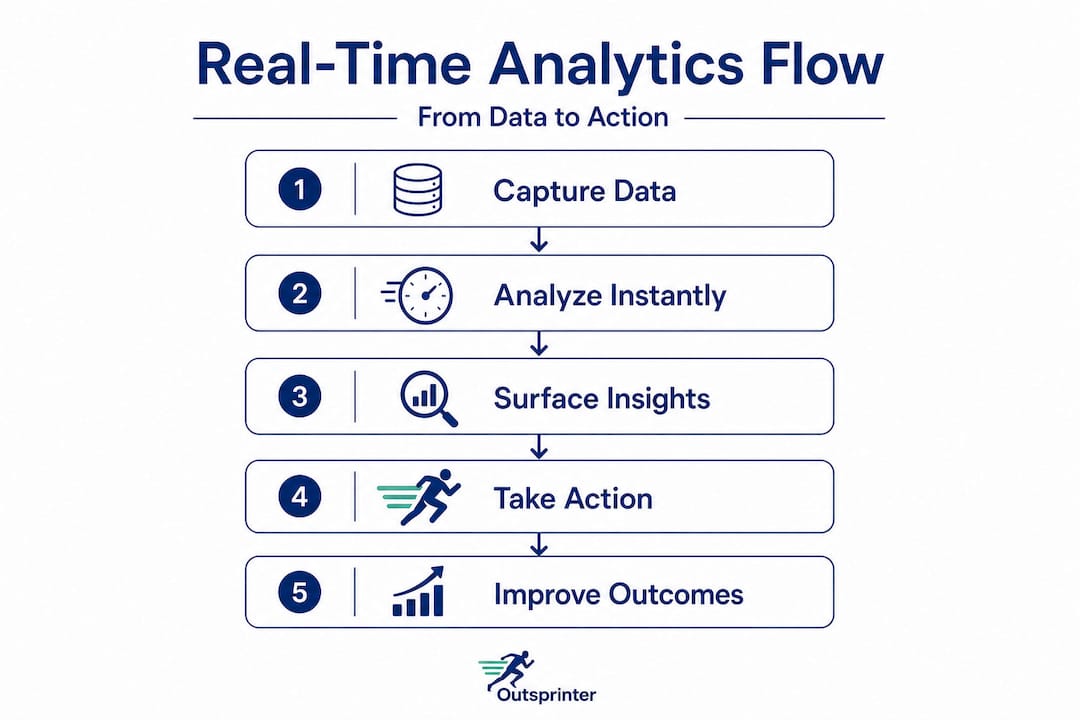
The concept connecting these dots is operational intelligence, which refers to using embedded analytics and AI to steer business processes in the moment, rather than informing decisions after the fact. Operational intelligence is no longer considered optional according to leading industry analysts, driven by the need to reduce the delay between data generation and insight in transactional environments.
What does this look like in practice? Consider a few concrete scenarios:
- A fulfillment center uses real-time inventory analytics to automatically trigger restock orders when stock falls below a threshold, without waiting for a nightly report.
- A customer success team uses live ticket volume data to reroute cases to available agents the moment a queue exceeds a defined limit.
- A project management platform alerts a team lead the moment a critical task deadline is at risk, based on live completion rate data.
Each of these examples shares a defining feature: the analytics is embedded in the workflow. It doesn't sit in a separate reporting system that someone has to check. It comes to the people who need to act.
Real-time analytics combined with AI in performance management takes this further. AI doesn't just surface live data — it interprets it, surfaces patterns that would take hours to find manually, and suggests corrective actions in plain language. For HR leaders and department managers, this means performance gaps get flagged weeks earlier, and coaching conversations are grounded in current data rather than anecdotal impressions.
Pro Tip: When evaluating platforms for operational intelligence, ask specifically how the AI generates recommendations. Is it pattern matching on historical data? Is it analyzing the live stream? The answer tells you whether the platform is truly real-time or dressing up historical analysis in modern packaging.
Potential pitfalls and what to watch for
Finally, before you jump into implementation, it's critical to avoid the pitfalls that can undermine the promise of real-time analytics.
The most common trap is definitional. Vendors frequently describe systems as "real-time" when they mean faster-than-daily batch. A dashboard that refreshes every 15 minutes is not real-time by any rigorous standard. Calling a system real-time based solely on faster-than-daily batch processing can mask significant blind spots, particularly when you need immediate alerting or continuous data availability for decision-critical processes.
Watch for these specific warning signs:
- No clear latency SLA. A legitimate real-time platform can tell you exactly how long it takes from data entry to dashboard update. If a vendor can't give you a number in milliseconds or seconds, ask why.
- Alerts that lag behind the data. Some platforms update the dashboard in near-real-time but only send alerts based on scheduled scans. The visual looks live; the notifications arrive late.
- Integration bottlenecks. Real-time data flow requires every step in the pipeline to support it. A single integration that writes to a flat file and uploads once per hour breaks the entire chain.
- Data quality shortcuts. Speed without accuracy is dangerous. Prioritizing freshness at the cost of validation can mean your team is acting on bad data instantly rather than good data slowly.
The hidden cost of not tracking KPIs weekly is real, but moving to real-time without fixing underlying data quality issues simply accelerates the cost of bad information. Sustainable adoption requires both speed and integrity.
Pro Tip: Before committing to any real-time analytics platform, ask for a proof-of-concept with your actual data sources. Measure the end-to-end latency yourself, from data entry to dashboard update to alert delivery. Don't take marketing materials as the baseline. Your task management platform should be able to demonstrate this transparently.
Why real-time analytics is only as valuable as your agility
Here's the uncomfortable truth that most technology discussions skip: installing a real-time analytics platform does not make your organization faster. Your people and your processes determine that.
We've seen this pattern repeatedly. A team invests in a sophisticated real-time dashboard. The data flows instantly. The alerts fire accurately. And then? Nothing changes. The manager checks the dashboard once a day during their morning standup. The alerts land in a shared inbox that no one owns. The KPI changes, but the response time doesn't.
Real-time analytics reveals problems in the moment. Acting on them in the moment requires something technology cannot provide: a culture and structure built for rapid response. That means clear ownership over metrics, defined response playbooks for common alert scenarios, and empowered team members who can make decisions without waiting for approval chains to process.
The teams that get the most value from real-time analytics invest just as much in their response workflows as they do in the technology itself. They ask: "If this metric crosses this threshold, who exactly decides what happens next, and how quickly?" If the answer is vague, the real-time data becomes theater.
Using improvement tips for agile teams in combination with real-time visibility creates a compounding advantage. The data tells you what changed. A responsive team structure determines what you do about it. Neither is enough on its own.
The teams that win aren't just the ones with the fastest data. They're the ones where the data and the decision-making process are aligned. Build that alignment first, then scale the technology on top of it.
Unlock real-time insights with Outsprinter
If the gap between data and action is something you're ready to close, Outsprinter gives your team the infrastructure to do it without months of complex setup.
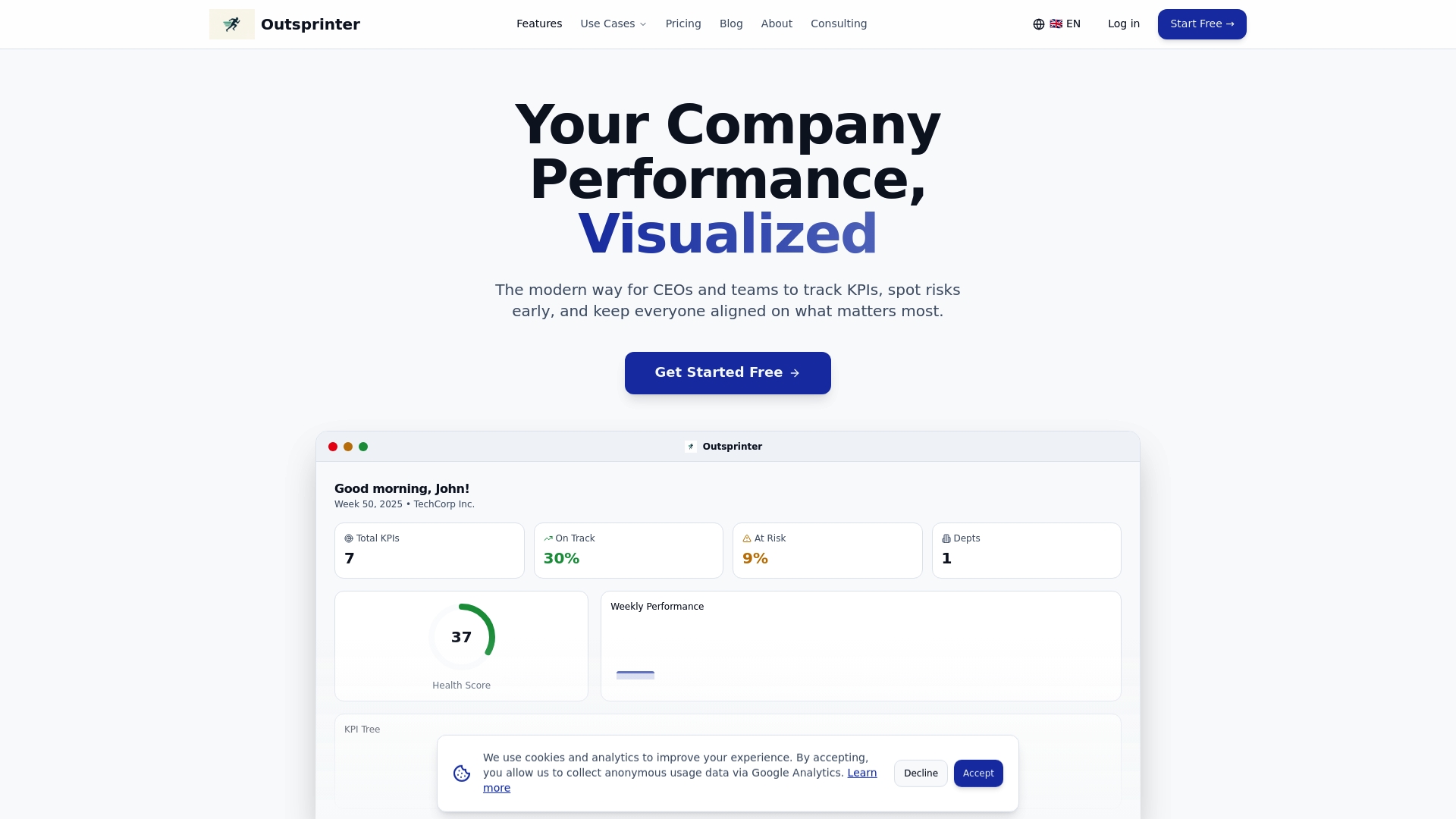
Outsprinter's platform brings real-time KPI tracking and live dashboards together so every team member sees performance the moment data is entered, not the next time someone runs a report. Alerts fire automatically when metrics move outside defined thresholds, so your managers spend time responding rather than searching. The project management tools layer workload analysis and health metrics directly on top of live task data, giving leaders the full operational picture they need to course-correct in real time. From goal planning to AI-powered insights, Outsprinter is built specifically for teams that are serious about turning data into decisions fast.
Frequently asked questions
What is the main difference between real-time and batch analytics?
Real-time analytics updates and delivers insights continuously as data is generated, while batch analytics processes data at scheduled intervals, creating windows where your visibility is incomplete or outdated based on fixed refresh cycles.
Which industries benefit most from real-time analytics?
Manufacturing, logistics, and retail see some of the strongest returns because those environments require immediate data processing to act on conditions as they change, with edge analytics use cases in those sectors often demanding latency under a few seconds.
Are real-time analytics platforms harder to implement than traditional BI tools?
They can require more architectural planning to ensure continuous data flow, but unified platforms that handle ingestion, transformation, and analytics in a single environment have significantly reduced the implementation complexity for most organizations.
What's a common mistake businesses make with real-time analytics?
The most frequent error is accepting a vendor's claim of "real-time" without verification. Calling a system real-time based only on faster-than-daily batch processing masks meaningful blind spots that only surface when you need instant alerting or continuous data availability.