
TL;DR:
- AI-driven insights automate routine management tasks, freeing time for strategic judgment and coaching.
- Scaling AI in organizations requires clear KPIs, phased implementation, and strong executive sponsorship.
- Effective AI management enhances forecasting, pattern detection, and workflow redesign, transforming management practices.
Most executives assume AI-driven efficiency gains belong to Amazon or Google. They don't. AI automation reclaims up to 25% of team time, and researchers project that 80% of project management tasks will run on AI by 2030. These numbers are already within reach for mid-sized organizations willing to build the right management foundation. This guide breaks down what AI-powered insights actually mean in practice, how they reshape management roles, and how your organization can scale these advantages without losing the human judgment that still matters most.
Table of Contents
- What are AI-powered insights and why they matter
- How AI is reshaping management: Automation, forecasting, and workflow redesign
- Managers in the era of AI: Enhanced roles and new challenges
- Scaling AI-powered management practices for organizational impact
- Our take: What most management guides miss about AI-powered insights
- Explore AI-powered tools for actionable management insights
- Frequently asked questions
Key Takeaways
| Point | Details |
|---|---|
| AI accelerates management | AI-powered tools transform routine tasks and forecasting, reclaiming up to 25% of team time. |
| Managers evolve roles | With AI, managers shift toward higher-value activities like exception handling and coaching. |
| Scaling requires leaders | Clear KPIs, roadmaps, and executive buy-in are essential for successful AI management adoption. |
| Tech complements, not replaces | AI multiplies management impact but demands strong human leadership and judgment. |
What are AI-powered insights and why they matter
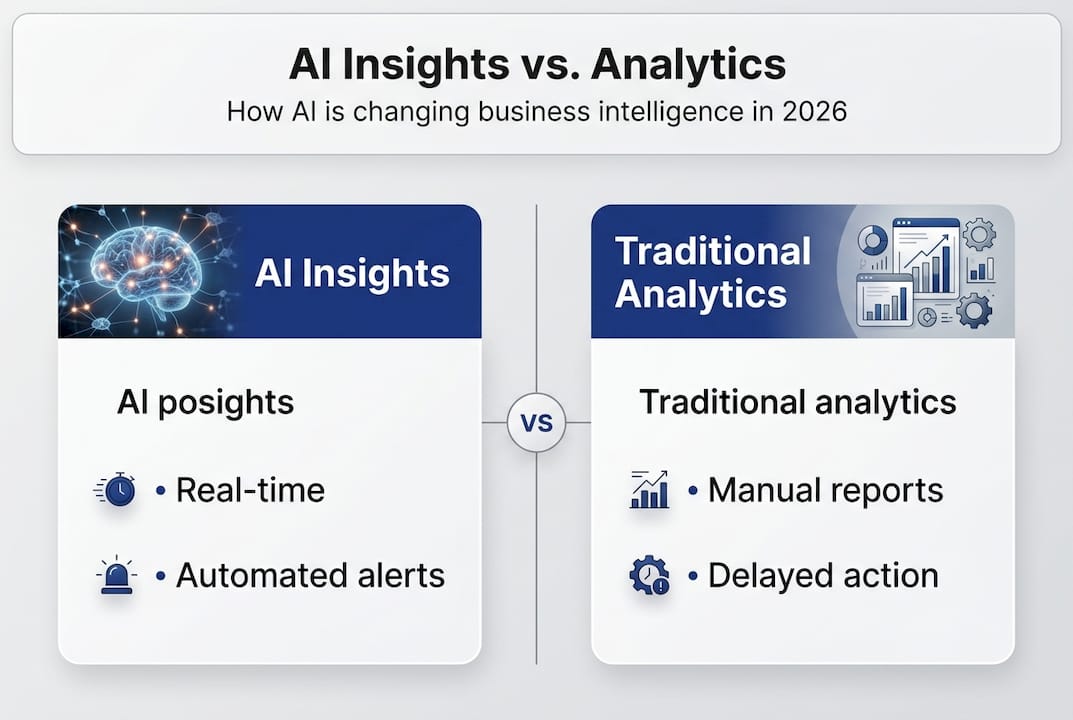
AI-powered insights are conclusions drawn automatically from your organization's data, delivered in time to act on them. That's the key distinction from traditional analytics. A classic dashboard tells you what happened last quarter. An AI-powered system tells you what is likely to happen next week and recommends specific actions to change the outcome.
Traditional analytics relies on a human analyst pulling data, building a report, and presenting findings in a meeting. By the time decisions get made, the moment has often passed. AI-powered insights compress that cycle from days to minutes. They monitor data continuously, detect patterns that humans would miss in large datasets, and surface exceptions that need attention before they become problems.
For managers, this shift is significant. You stop spending cognitive energy on data gathering and start spending it on interpretation and action. That's a fundamentally different job, and a more valuable one.
Here's what AI-powered insights actually do for management teams:
- Forecasting: Predict project completion dates, resource gaps, and budget overruns before they materialize
- Automation: Handle routine reporting, status updates, and task assignments without manual input
- Pattern detection: Identify which teams, processes, or workflows are underperforming and why
- Exception handling: Flag the 5% of situations that need human attention instead of forcing managers to review everything
78% of organizations now use AI for workflow redesign, and that redesign consistently delivers the greatest measurable improvement to earnings before interest and taxes. The organizations seeing the biggest returns aren't just automating tasks. They're rebuilding how work flows through their teams.
The practical implication for executives is that AI in performance management is no longer an experimental investment. It's a structural advantage. Organizations that integrate AI insights into daily management cycles are compressing decision timelines and catching performance issues earlier than competitors who rely on weekly or monthly reporting cycles.
How AI is reshaping management: Automation, forecasting, and workflow redesign
The numbers from real deployments are striking. One large-scale implementation showed an 80% reduction in inspection scoping time, 44% faster pull request merge time, 39% less time spent in meetings, and 37.5% shorter onboarding periods. These aren't projections. They're measured outcomes from organizations that redesigned workflows around AI capabilities.
The table below shows what those benchmarks look like in practical terms:
| Process area | Improvement | What changed |
|---|---|---|
| Inspection scoping | 80% faster | AI pre-analyzes asset data before human review |
| Code review (PR merge) | 44% faster | Automated checks reduce manual review load |
| Meeting time | 39% reduction | AI-generated summaries replace status meetings |
| Employee onboarding | 37.5% shorter | Personalized learning paths replace fixed schedules |
Automation is the most immediate win. Routine tasks like status reporting, task assignment based on workload, and deadline reminders consume a disproportionate share of management time. AI handles these without error and without fatigue. The time reclaimed goes directly to higher-value work.
Forecasting is the second major shift. AI's impact on management roles is most visible in planning cycles. Sprint reliability in software teams, for example, can reach 90% accuracy when AI models are trained on historical velocity data. That kind of predictability changes how executives commit to stakeholders.
Here's a practical sequence for redesigning workflows with AI:
- Map your current workflow to identify where time is lost and where errors occur most frequently
- Prioritize high-volume, repetitive processes for automation first, since these yield the fastest measurable ROI
- Integrate AI tools into your existing project management tools rather than building parallel systems
- Set baseline metrics before deployment so you can measure actual improvement
- Review exceptions weekly and use manager judgment to handle what AI flags as anomalies
- Expand gradually using results from the first process to build internal confidence and adoption
Pro Tip: Don't start with the most complex process in your organization. Start with the one that has the highest volume of routine decisions. That's where automation delivers the fastest time savings and where your team can boost collaboration with task tools most visibly.
Managers in the era of AI: Enhanced roles and new challenges
Here's the uncomfortable truth most management guides avoid: AI doesn't just automate tasks. It exposes which management activities were low-value to begin with. When a machine can generate a weekly status report in seconds, the manager who spent three hours compiling it manually has to ask what else they should have been doing with that time.

The answer is judgment, coaching, and strategic oversight. These are the areas where AI augments not replaces managers, elevating roles toward insight and decision-making while repricing the lower-value coordination layers of management.
In practical terms, the manager's job in an AI-powered environment looks like this:
- Reading exceptions: Reviewing the situations AI flagged as unusual and deciding how to respond
- Coaching individuals: Using AI-generated performance data to have more specific, evidence-based development conversations
- Strategic oversight: Interpreting trend data to make resource allocation and priority decisions
- Culture stewardship: Maintaining team motivation, trust, and values that no algorithm can sustain
- Cross-functional coordination: Connecting insights from AI systems across departments where data alone doesn't tell the full story
Here's how the role shift looks in practice:
| Traditional management task | AI-augmented equivalent |
|---|---|
| Compiling weekly status reports | Reviewing AI-generated summaries |
| Manually tracking KPI performance | Monitoring real-time alerts and dashboards |
| Scheduling and running status meetings | Responding to exception flags and coaching sessions |
| Onboarding new hires with fixed programs | Overseeing personalized AI-driven learning paths |
| Estimating project timelines manually | Validating AI forecast models with contextual judgment |
The most significant shift isn't in what managers do. It's in what they're paid to know. AI in project management research consistently shows that organizations moving fastest are those where managers treat AI output as a starting point for judgment, not a final answer.
For executives building scalable performance management systems, the implication is clear. Invest in developing your managers' ability to interpret AI outputs, not just use the tools. The organizations that do this well will consistently outperform those that treat AI as a replacement for management skill. Understanding why tracking team performance matters is the foundation before any AI layer can add value.
Scaling AI-powered management practices for organizational impact
Piloting AI in one team is relatively easy. Scaling it across a 500-person organization without losing momentum is where most initiatives stall. Scaling best practices consistently point to five factors: clear KPIs, phased roadmaps, senior buy-in, agile delivery teams, and continuous impact monitoring. Larger firms are currently leading in successful scaling, partly because they have dedicated resources, but mostly because they treat AI adoption as a change management challenge, not a technology installation.
Here's a sequence that works for organizations at most stages of AI maturity:
- Define your management KPIs first. AI can only optimize what you measure. Establish clear metrics for team performance, project health, and decision speed before selecting tools.
- Build a phased roadmap. Sequence deployments by impact and complexity. Start simple, prove value, then expand.
- Secure executive sponsorship. Scaling fails without visible senior support. Leaders need to model the behavior they want to see, including using AI tools themselves.
- Form agile delivery teams. Cross-functional groups that can iterate quickly on AI implementations outperform large, slow rollout committees.
- Monitor and share results. Measure impact at each phase and broadcast wins internally. This builds the credibility needed for the next expansion.
The statistic worth noting: larger organizations that follow structured scaling approaches are seeing measurably better adoption rates and faster ROI than those that deploy AI tools without a governance framework.
Pro Tip: Run your first AI pilot in a department where the manager is already data-oriented and the processes are well-documented. Early wins in these conditions are easier to achieve and easier to communicate to skeptical stakeholders. Then use those results to guide performance management trends conversations at the executive level.
A team management checklist approach works well here. Treat each phase of AI scaling as a checklist item with a clear owner, a measurable outcome, and a defined review date. This keeps momentum without letting the initiative drift into vague "transformation" language that loses executive attention.
Our take: What most management guides miss about AI-powered insights
Most articles about AI in management focus on the technology. They list tools, cite adoption statistics, and describe features. What they skip is the harder truth: AI amplifies whatever management system already exists in your organization. If your KPIs are vague, AI will optimize for the wrong things faster. If your managers lack coaching skills, AI-generated performance data will sit unused in dashboards nobody checks.
The organizations seeing real step-change improvements are the ones that used AI as a mirror first. They let the data expose where their management routines were inconsistent, where accountability was unclear, and where decisions were being made on habit rather than evidence. Then they fixed those things before scaling the technology.
Over-relying on AI for judgment is a real risk. The tool is excellent at pattern recognition and prediction. It is not equipped to read the room in a difficult team conversation or decide when a high-performer needs space rather than a performance improvement plan. Those calls still require a human with context.
Pro Tip: Use AI outputs to prepare for management conversations, not to replace them. When scaling performance management across your organization, the managers who improve fastest are those who treat AI data as conversation fuel, not as verdicts.
Explore AI-powered tools for actionable management insights
Understanding AI-powered management is one thing. Putting it to work for your team is another. The gap between theory and measurable results usually comes down to having the right platform in place.
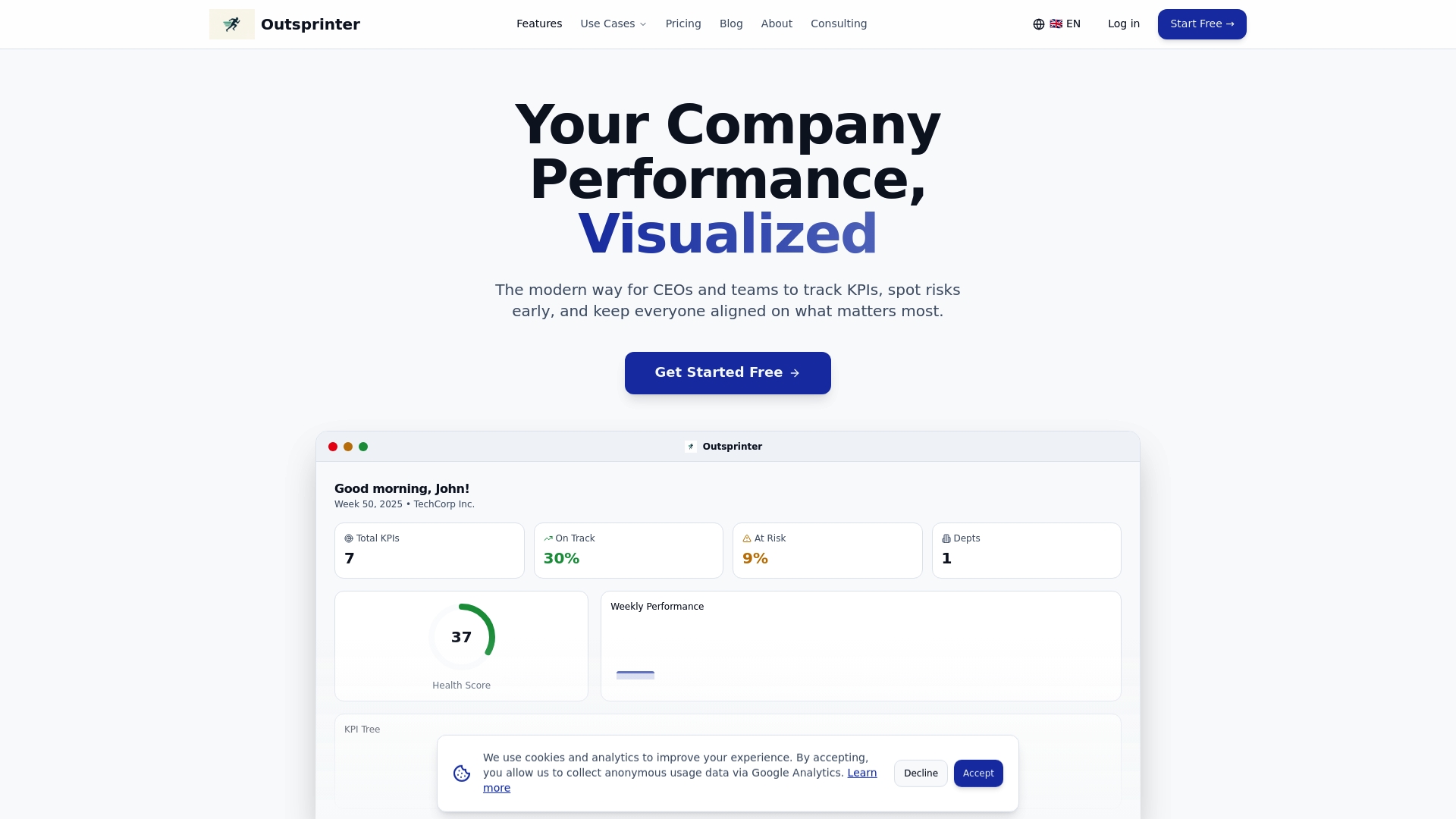
Outsprinter's team performance platform gives executives and managers real-time visibility into KPIs, project health, and team workload, all updating instantly as data comes in. The project management platform organizes work with health metrics and progress tracking built in, while the task management software handles assignment, prioritization, and recurring workflows automatically. If you're ready to move from reading about AI-powered insights to acting on them, these are the tools designed to make that transition practical and measurable for your organization.
Frequently asked questions
How do AI-powered insights help managers make better decisions?
AI-powered insights automate analysis, surface patterns, and improve forecasting accuracy, enabling managers to act on real data rather than intuition. AI automation reclaims up to 25% of team time, freeing managers for higher-value judgment work.
Can AI fully replace management roles?
AI enhances but does not fully replace managers. It automates routine tasks so managers can focus on coaching, exception handling, and strategic decisions. AI augments managers by elevating their roles toward insight and judgment rather than coordination.
What are common pitfalls when adopting AI for management?
The most common pitfalls are poorly defined KPIs, missing executive buy-in, and treating AI as a substitute for sound management judgment. Scaling best practices require roadmaps, agile delivery, and clear metrics from the start.
How can organizations scale AI-powered management effectively?
Effective scaling requires clear KPIs defined before tool selection, a phased rollout roadmap, and strong leadership sponsorship at every stage. Structured scaling approaches consistently outperform ad-hoc deployments in both adoption speed and measurable ROI.