
TL;DR:
- Clear goals and continuous feedback are essential for high team performance.
- Agile methods like Scrum and Kanban optimize workflow based on team needs.
- AI and data-driven tools enhance real-time insights and decision-making accuracy.
Essential performance improvement tips for high-impact teams
Most managers know their teams could perform better. The real struggle is translating that feeling into a concrete plan that actually moves the needle. Many improvement efforts stall because they rely on vague directives instead of structured frameworks that teams can act on immediately. This article walks you through four evidence-based strategies: goal-setting, Agile workflow methods, AI-powered analytics, and culture-building practices. Each section gives you practical tools you can deploy right away, along with the benchmarks to know whether they're working.
Table of Contents
- Clarify expectations with SMART goals and continuous feedback
- Adopt Agile methods for workflow optimization
- Harness AI and data-driven insights for smarter performance management
- Build a culture of accountability, psychological safety, and recognition
- Why focusing on real-time feedback and team ownership outpaces traditional reviews
- Accelerate team performance with Outsprinter's platform
- Frequently asked questions
Key Takeaways
| Point | Details |
|---|---|
| Set clear, measurable goals | SMART goals and continuous feedback drive lasting performance gains. |
| Choose Agile workflow | Scrum and Kanban improve collaboration and adaptability in projects. |
| Leverage AI for results | Data-driven tools and analytics can massively boost efficiency and revenue. |
| Prioritize team culture | Recognition, accountability, and psychological safety multiply team motivation and outcomes. |
| Update review methods | Real-time feedback and team ownership outperform annual review cycles. |
Clarify expectations with SMART goals and continuous feedback
Every high-performing team traces its results back to one thing: clarity. When people know exactly what they're working toward and receive consistent feedback on progress, they move faster and make smarter decisions. Without that clarity, even talented individuals drift.

SMART goals provide the structure your team needs. The acronym stands for Specific, Measurable, Achievable, Relevant, and Time-bound. Each element removes a common source of confusion. "Improve customer satisfaction" is a wish. "Increase customer satisfaction scores by 10% within Q2 by resolving tickets within 24 hours" is a SMART goal. The difference is night and day when it comes to execution. For performance management strategies to work, goals must be unambiguous enough that every team member knows whether they've hit the mark.
Feedback is where most organizations fall short. Annual performance reviews are too slow for modern project cycles. By the time a formal review surfaces a problem, weeks or months of productivity have already been lost. The smarter approach is the SBI feedback model, which stands for Situation, Behavior, and Impact. Instead of vague praise or criticism, you describe the exact situation, the specific behavior you observed, and the impact that behavior had. Using SMART goals and SBI feedback together creates a performance improvement system that is both structured and human.
Consistent feedback loops also signal respect. When employees receive timely input, they feel seen and supported, not just evaluated. Research-backed team performance assessment guidance recommends scheduling these check-ins at predictable intervals so teams can prepare and reflect, rather than feeling ambushed.
For project-focused teams, the PMBOK 8 framework reinforces this point by embedding performance assessment throughout project phases rather than saving it for retrospectives. That shift from periodic to continuous review aligns perfectly with fast-moving project environments. Explore team improvement steps that pair this approach with structured milestone tracking.
Here's a practical process you can start this week:
- Write SMART goals for each major project phase, not just at kickoff. Goals should evolve as your project does.
- Schedule weekly 15-minute SBI check-ins with direct reports. Focus on one behavior per session to keep it manageable.
- Document feedback in a shared system so both manager and employee can track patterns over time.
- Review goal relevance monthly to ensure targets still align with shifting business priorities.
- Celebrate small milestones visibly to reinforce positive behaviors and maintain momentum between major reviews.
Pro Tip: Pair micro-goals with weekly check-ins. For fast-moving teams, a 90-day goal with weekly checkpoints outperforms an annual target reviewed quarterly. It keeps everyone aligned and enables step-by-step team management adjustments before small problems become large ones.
Adopt Agile methods for workflow optimization
With goals and feedback systems in place, optimizing workflow is the next essential step for sustained performance gains. Agile methodology is not just a software development philosophy. It's a practical operating model for any team managing complex, evolving work.
The two most widely adopted Agile frameworks are Scrum and Kanban. Understanding which fits your team's context is more important than picking the most popular one. Agile methodologies like Scrum and Kanban serve fundamentally different workflow needs, and choosing the wrong one creates friction rather than flow.
| Feature | Scrum | Kanban |
|---|---|---|
| Work structure | Fixed sprints (1-4 weeks) | Continuous flow |
| Roles | Defined (Scrum Master, Product Owner) | Flexible |
| WIP limits | Per sprint scope | Explicit WIP caps |
| Best for | New product development | Ongoing support/operations |
| Cadence | Sprint ceremonies (standups, retros) | As-needed meetings |
| Adaptability | Moderate (changes per sprint) | High (changes anytime) |
Scrum works best for teams with high collaboration needs, defined deliverables, and project phases that benefit from structured reflection. Sprint reviews and retrospectives build a cadence of learning that compounds over time. Kanban suits teams handling variable workload, like IT support or content production, where work arrives unpredictably and needs to keep moving without ceremony overhead.
Benefits of Scrum:
- Creates a predictable delivery rhythm
- Builds team accountability through shared sprint goals
- Retrospectives drive continuous process improvement
Drawbacks of Scrum:
- Rigid sprint structure can feel constraining for fast-changing priorities
- Requires commitment to roles and ceremonies that some teams resist
Benefits of Kanban:
- Highly visual and easy to understand at a glance
- WIP limits prevent team overload and improve focus
- Low ceremony overhead makes it easy to adopt
Drawbacks of Kanban:
- Lacks built-in planning structure, which can lead to scope drift
- Without discipline, WIP limits get ignored
For teams running projects with significant uncertainty, such as market launches or product pivots, Agile sprint best practices recommend starting with Scrum to build team rhythm, then transitioning to Kanban once workflows stabilize. Use a team building checklist to ensure your team has the foundational skills and structure before introducing either framework.
The real power of Agile is not in the tools or ceremonies. It's in the mindset shift: from "deliver once and evaluate later" to "deliver continuously and adapt constantly."
Harness AI and data-driven insights for smarter performance management
Once your workflow is optimized, technology can supercharge your team's ability to track and boost performance. AI-driven platforms are no longer a luxury for enterprise teams. They're becoming a baseline expectation for competitive organizations.
The data is striking. AI-augmented sales reps achieve 41% higher revenue per rep, generating $1.75M compared to $1.24M for non-AI-assisted reps, while completing 18% fewer activities across a study of 938 companies. That's not a marginal improvement. It's a structural advantage. The same research highlights that DevOps teams with high collaboration outperform peers in deployment frequency and incident resolution, proving that AI works best when paired with strong team culture.
Here's how AI delivers these results in practice:
| Performance area | Traditional approach | AI-augmented approach |
|---|---|---|
| Feedback generation | Manual, periodic | Automated, real-time |
| Performance gap detection | Reactive (after issues arise) | Predictive (before problems escalate) |
| Metric reporting | Static dashboards | Dynamic, context-aware alerts |
| Workload balancing | Manager-driven estimates | Data-driven capacity modeling |
For your team, the highest-value AI applications typically fall into three categories. First, automated performance summaries that surface patterns a manager would never spot manually across dozens of tasks and contributors. Second, predictive risk alerts that flag when a project trajectory suggests a deadline miss before it becomes critical. Third, AI-assisted KPI benchmarking that compares your team's output against historical baselines, so you know whether performance is genuinely improving or just stable.
An AI performance management guide built for HR leaders reinforces that AI works best as an augmentation layer, not a replacement for human judgment. The goal is faster, sharper decision-making, not automated management.
For practical performance metrics examples that pair well with AI tools, focus on output quality, cycle time, and goal attainment rates rather than vanity metrics like hours logged.
Pro Tip: Start with one AI experiment in your workflow before rolling out broadly. A good starting point is automating weekly status report generation from task data. It saves time, reduces reporting fatigue, and surfaces patterns faster. Combine this with proven workflow optimization strategies to maximize impact without overwhelming your team.
Build a culture of accountability, psychological safety, and recognition
Technical improvements need complementary culture upgrades to unlock their full impact. You can install the best tools and processes available, but if your team culture rewards silence over honesty, performance will plateau.
Psychological safety, defined as the belief that one can speak up without fear of punishment, is the single most powerful predictor of high team performance, according to Google's internal research. But psychological safety without accountability becomes an environment where anything goes. The balance is what separates average teams from exceptional ones.
Google's Project Oxygen identifies 10 behaviors that distinguish great managers:
"Be a good coach, empower the team without micromanaging, create an inclusive environment, be results-oriented, be a good communicator, support career development, have a clear vision, demonstrate relevant technical skills, collaborate across teams, and be a strong decision-maker."
This list is worth printing and putting on your wall. Notice what it does not say. It does not prioritize individual technical output or tenure. The emphasis is squarely on enabling others.
Recognition is the often-overlooked accelerant in this equation. Great Place to Work research shows that effective leaders listen, thank, develop, celebrate, and inspire, using tools like 360 feedback and engagement surveys to systematically identify recognition gaps. Informal recognition, a direct message, a public callout in a team meeting, has an outsized impact relative to the time it costs.
Here are proven best practices for building this kind of culture:
- Define accountability at the team level, not just individually. When teams own outcomes together, peer accountability naturally strengthens.
- Run brief retrospectives after each project phase to normalize reflection and continuous improvement.
- Acknowledge failure constructively. When mistakes happen, focus on systemic causes, not individual blame.
- Rotate leadership roles on projects to develop ownership skills across all team levels.
- Use 360 feedback tools to gather input from peers, not just managers, giving people a richer picture of their impact.
- Celebrate milestones visibly, including small wins. This is particularly important for remote or hybrid teams where informal recognition is harder to observe.
Managers who commit to 2026 team management trends are finding that recognition programs linked directly to goal achievement drive the strongest engagement. Pair this with insights from high performance team science to understand the neurological and psychological underpinnings of what makes recognition so effective. And when building new teams, apply risk reduction in team building frameworks to reduce the time it takes for psychological safety to develop.
Why focusing on real-time feedback and team ownership outpaces traditional reviews
Here's a perspective you probably won't find in most management guides: the annual performance review is not just ineffective, it's actively harmful. When feedback arrives once a year, it distorts memory, inflates conflict, and guarantees that correctable problems fester for months. Managers spend hours documenting issues that could have been resolved with a two-minute conversation in week three.
The real accelerator for team performance is distributed ownership. When every team member feels personally accountable for outcomes, not just tasks, performance becomes self-sustaining. Managers shouldn't need to chase results; the team's ownership structure does that work automatically. This is why Agile sprint ownership practices matter so much. They formalize accountability at the team level rather than concentrating it in a single manager.
There's also a promotion problem worth naming. Many organizations still promote their best individual performers into management roles. This creates a structural mismatch. Great individual contributors are rewarded for personal output. Great managers are rewarded for enabling others' output. These are different skills, and confusing them produces poor leaders and loses great individual contributors simultaneously.
The leaders who drive the most lasting performance improvements are those who build systems that work without them, not those who personally drive every result.
Accelerate team performance with Outsprinter's platform
For leaders ready to scale these approaches, integrated technology makes adoption seamless rather than theoretical.
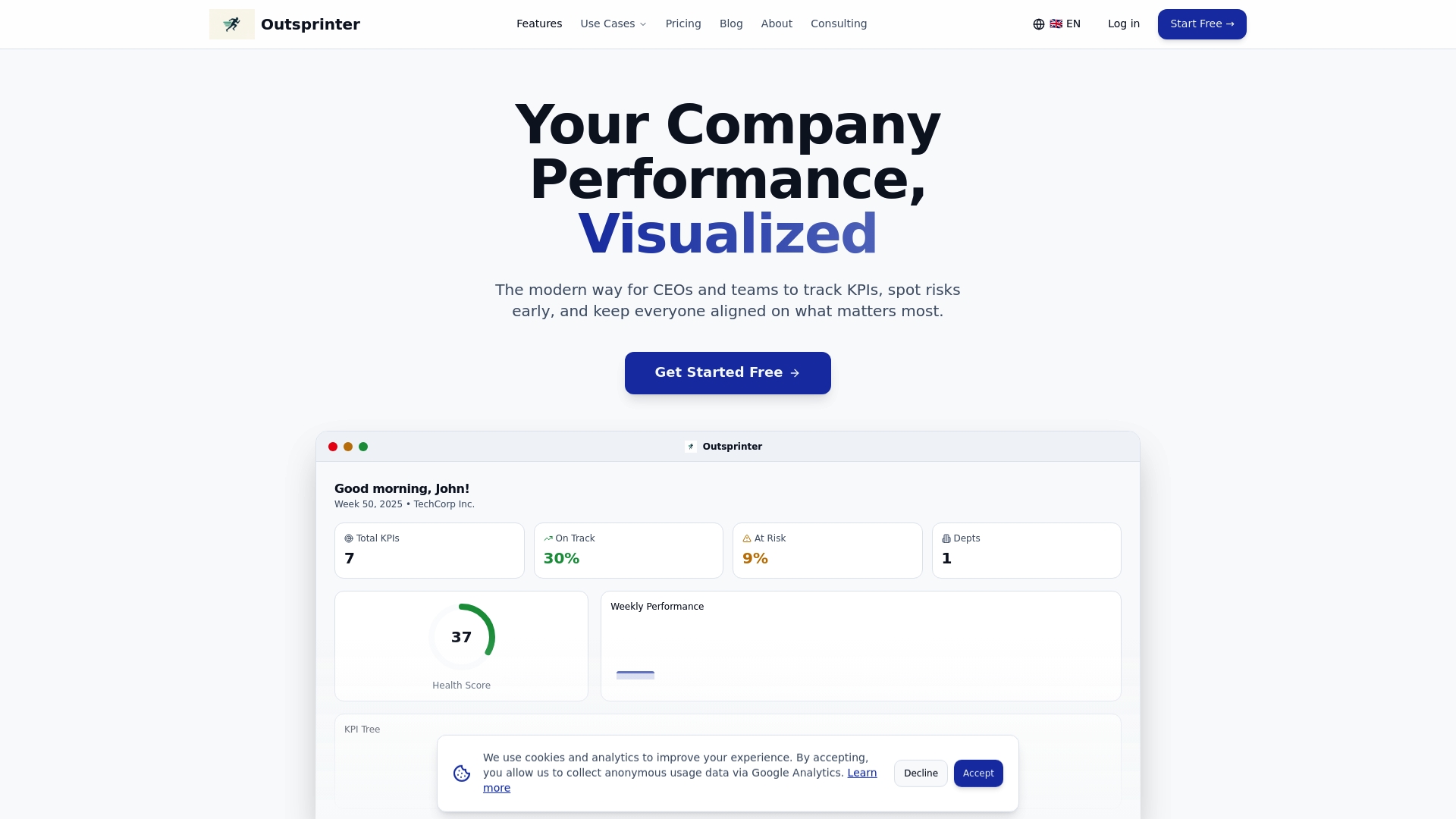
Outsprinter gives you the infrastructure to run everything covered in this article from one place. Set and track SMART goals through the Goal Planner, monitor KPIs in real time with the KPI tracking platform, and manage every project milestone through the task management software. The AI Assistant helps you analyze performance data and generate actionable recommendations without needing a dedicated analytics team. Real-time dashboards mean you spot issues the moment they surface, not weeks later in a review meeting. If you're serious about building a high-performance team, Outsprinter gives you the tools to make it happen at scale.
Frequently asked questions
What is the best way to set team performance goals?
The SMART goal framework is the most effective structure, ensuring each goal is Specific, Measurable, Achievable, Relevant, and Time-bound to drive team clarity and accountability.
How does Agile methodology improve project outcomes?
Agile frameworks like Scrum and Kanban enable teams to adapt to project uncertainty, accelerate delivery cycles, and strengthen collaboration through structured feedback loops.
What are the key behaviors of effective managers?
According to Google's Project Oxygen, effective managers coach, empower, communicate clearly, and celebrate team successes rather than focusing solely on individual output metrics.
Does using AI really boost sales team performance?
Yes. AI-augmented sales reps achieve up to 41% higher revenue per rep with 18% fewer activities, based on large-scale empirical research across 938 companies.