
Managing complex operations across departments demands more than strategic vision. COOs who master task management unlock operational clarity that transforms scattered efforts into coordinated execution. While many leaders focus on high-level strategy, the real competitive advantage lies in how effectively you coordinate daily tasks across teams. This guide reveals practical task management strategies that drive measurable productivity gains and streamline operations for COOs leading mid to large organizations in 2026.
Table of Contents
- Understanding the COO's role in task management
- Core elements of effective task management for COOs
- Comparing task management strategies for operational excellence
- Implementing task management to drive COO success in 2026
- Enhance your task management with Outsprinter
- Frequently asked questions about the role of task management for COOs
Key takeaways
| Point | Details |
|---|---|
| Task management bridges strategy and execution | Effective coordination transforms strategic plans into daily operational reality for teams |
| Digital platforms centralize operational visibility | Real-time tracking tools give COOs instant insight into progress and bottlenecks |
| Prioritization frameworks enhance leadership impact | Structured approaches to delegation multiply your effectiveness across departments |
| Continuous refinement maintains agility | Regular process reviews keep operations responsive to changing business needs |
Understanding the COO's role in task management
As a COO, you occupy the critical space between strategic vision and operational reality. Your role demands translating executive objectives into coordinated team actions that deliver results. Operations teams require precise task coordination to execute complex workflows successfully. Task management serves as your primary tool for maintaining visibility, ensuring accountability, and driving execution across every department.
Without robust task frameworks, COOs face predictable challenges. Missed deadlines cascade through projects, creating bottlenecks that slow entire operations. Duplicate efforts waste resources when teams lack visibility into each other's work. Low transparency leaves you blind to problems until they become crises. These operational friction points compound quickly in organizations managing multiple simultaneous initiatives.
Effective task management transforms these challenges into competitive advantages. When you implement standardized systems, communication flows smoothly across departments. Teams understand priorities clearly, reducing confusion and rework. You gain real-time visibility into progress, enabling proactive problem-solving before small issues escalate.
Key COO task management responsibilities include:
- Aligning cross-functional teams around shared operational objectives
- Delegating work efficiently based on team capacity and skill sets
- Monitoring progress through transparent tracking systems
- Ensuring accountability with clear ownership and deadlines
- Adjusting priorities dynamically as business needs evolve
Pro Tip: Implement a standardized team management checklist that unifies communication protocols across all departments. This single framework eliminates confusion caused by different teams using incompatible systems, reducing operational silos that fragment your organization.
Your effectiveness as a COO multiplies when task management becomes a core operational competency rather than an administrative afterthought. The frameworks you establish today determine whether your organization executes with precision or struggles with chronic coordination problems.
Core elements of effective task management for COOs
Building operational excellence requires mastering fundamental task management components that create structure without stifling agility. Start with clear task creation protocols that capture essential details: specific deliverables, responsible owners, realistic deadlines, and success criteria. Vague tasks generate confusion, while overly detailed ones create administrative burden. Strike the balance by defining what matters for accountability.
Prioritization separates high-performing operations from chaotic ones. Establish transparent criteria for ranking tasks by business impact, urgency, and resource requirements. When everyone understands priority logic, teams make better independent decisions without constant escalation. Assignment clarity prevents the diffusion of responsibility that plagues many organizations. Every task needs a single owner accountable for completion, even when multiple people contribute.
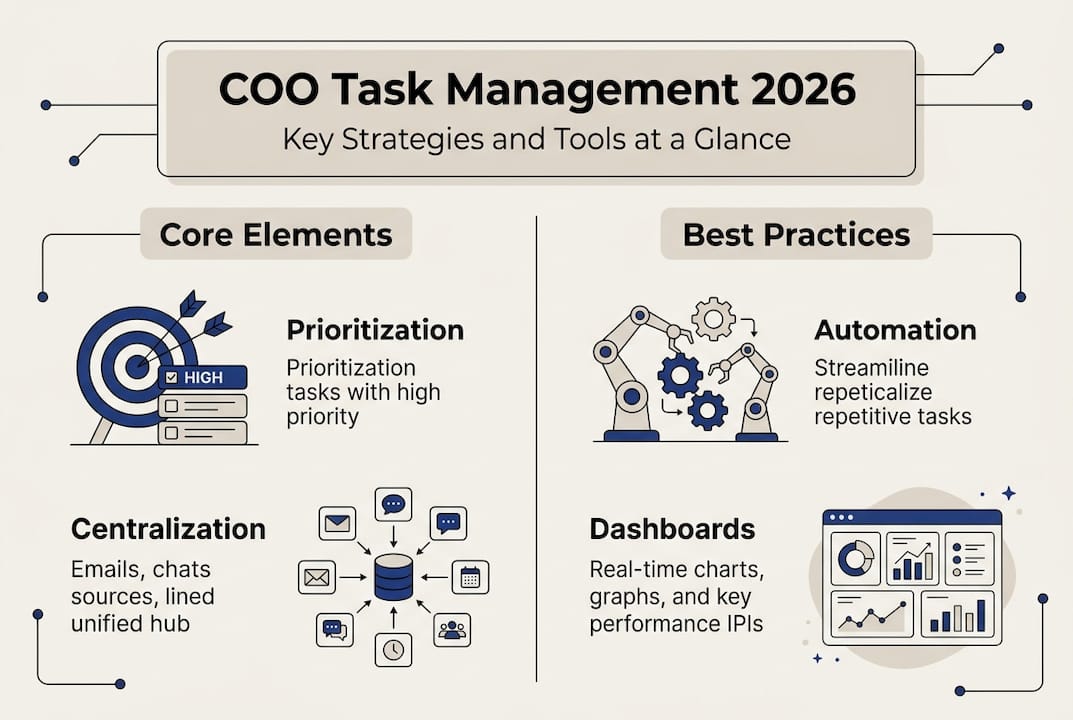
Digital platforms centralizing task tracking improve monitoring and collaboration for operational teams. Modern tools provide the visibility COOs need without requiring manual status meetings that drain productivity. Real-time dashboards show you exactly where work stands across all departments simultaneously.

| Task Management Feature | Operational Value | Implementation Priority |
|---|---|---|
| Transparent ownership | Eliminates accountability gaps | Critical |
| Deadline tracking | Prevents cascading delays | Critical |
| Progress visibility | Enables proactive problem solving | High |
| Workflow automation | Reduces manual coordination overhead | High |
| Cross-platform integration | Unifies fragmented tool ecosystems | Medium |
| Customizable reporting | Delivers insights tailored to leadership needs | Medium |
Key practices that elevate task management effectiveness:
- Establish clear ownership for every task to prevent responsibility diffusion
- Enforce deadline discipline while building realistic buffer time into schedules
- Require regular status updates that surface blockers before they become crises
- Build contingency plans for high-impact tasks vulnerable to disruption
- Standardize communication channels to reduce information scatter
Pro Tip: Automate recurring task creation and reminder notifications to eliminate oversight risks. Manual tracking fails eventually because humans forget. Automation ensures critical operational tasks never slip through cracks, freeing your mental energy for strategic decisions that require human judgment.
Transparent dashboards transform how you lead operations. Instead of relying on filtered reports that arrive days late, you access current reality instantly. This visibility enables rapid response when priorities shift or problems emerge. You spot patterns across teams that reveal systemic issues requiring process improvements. The right task management tools become your operational nervous system, delivering the information you need exactly when decisions matter most.
Comparing task management strategies for operational excellence
Choosing the right task management approach dramatically impacts operational effectiveness. Different methodologies offer varied benefits impacting team productivity and adaptability. Understanding how popular frameworks compare helps you select approaches aligned with your organizational context and operational challenges.
Agile sprints organize work into short, focused cycles with regular review points. This methodology excels when priorities shift frequently or projects involve significant uncertainty. Teams deliver incremental value quickly while maintaining flexibility to adjust direction. Kanban boards visualize workflow stages, making bottlenecks immediately obvious. This approach works well for operations with continuous work streams rather than discrete projects. Waterfall task flows follow sequential phases with defined handoffs between stages. This structure suits operations with regulatory requirements or projects where later stages genuinely depend on earlier completion. Hybrid models blend elements from multiple frameworks, customizing approaches to specific operational needs.
| Strategy | Transparency | Scalability | Flexibility | Best For |
|---|---|---|---|---|
| Agile Sprints | High | Medium | Very High | Dynamic environments with evolving priorities |
| Kanban Boards | Very High | High | High | Continuous workflow operations |
| Waterfall Flows | Medium | Very High | Low | Sequential processes with compliance needs |
| Hybrid Models | High | High | High | Complex organizations with diverse team needs |
Pros and cons for COO consideration:
- Agile sprints provide rapid adaptation but require significant team coordination overhead
- Kanban offers excellent visibility but can lack structure for complex project dependencies
- Waterfall delivers predictability but struggles when requirements change mid-stream
- Hybrid approaches maximize fit but demand more sophisticated implementation expertise
Industry context matters significantly when selecting strategies. Manufacturing operations often favor waterfall approaches due to physical production constraints and regulatory compliance requirements. Technology companies typically embrace agile methodologies that match rapid market evolution and iterative product development. Professional services firms frequently adopt Kanban systems that visualize client work flowing through delivery stages. Financial institutions commonly implement hybrid models that balance regulatory structure with operational agility.
Company size influences strategy selection too. Smaller organizations benefit from simpler frameworks with lower coordination overhead. Larger enterprises need scalable approaches that maintain consistency across numerous teams while allowing departmental customization. Mid-sized companies occupy a sweet spot where they can implement sophisticated systems without the complexity challenges facing massive organizations.
Your selection process should start with honest assessment of organizational culture and change capacity. The theoretically optimal framework fails if your teams resist adoption or lack skills for execution. Choose task management software that supports your selected methodology while remaining flexible enough to evolve as your operational needs mature. The best strategy is the one your organization will actually use consistently, not the one that looks most impressive in consultant presentations.
Implementing task management to drive COO success in 2026
Successful implementation requires systematic rollout that builds adoption momentum while minimizing disruption to ongoing operations. Follow this proven sequence:
- Assess current state by documenting existing task management practices, pain points, and gaps across departments
- Define requirements based on operational priorities, team workflows, and integration needs with existing systems
- Select platforms that match your strategy, scale to organizational size, and offer intuitive interfaces teams will embrace
- Design workflows that balance standardization for consistency with flexibility for departmental differences
- Pilot with one high-visibility team to validate approach and identify refinements before broader rollout
- Train systematically across all teams with hands-on practice, clear documentation, and accessible support resources
- Monitor adoption through usage metrics, gathering feedback to address resistance and optimize processes
- Optimize continuously based on performance data, evolving business needs, and emerging best practices
Cultural change management determines whether new systems deliver value or become shelf-ware. Teams resist changes that feel imposed without input or understanding. Involve representatives from each department in design decisions to build ownership. Communicate clearly why changes matter, connecting task management improvements to tangible benefits teams care about like reduced confusion and fewer last-minute crises.
Accountability mechanisms ensure sustained adoption after initial enthusiasm fades. Establish expectations that task updates happen consistently, not sporadically when someone remembers. Recognize teams demonstrating excellent task management practices to reinforce desired behaviors. Address persistent non-compliance directly, because allowing exceptions undermines system credibility.
Pro Tip: Define measurable KPIs directly linked to task completion rates and operational milestone achievement. Track metrics like on-time task completion percentage, average task cycle time, and percentage of tasks blocked by dependencies. These numbers reveal whether your task management system drives real operational improvement or just creates administrative theater.
Continuous feedback loops between you and frontline teams keep systems relevant as operations evolve. Schedule regular reviews where teams share what works well and what creates friction. Regularly reviewing progress and adjusting priorities is essential for agile operational management. Your willingness to refine processes based on user experience signals that systems serve teams rather than the reverse.
Integration with broader operational tools multiplies task management value. Connect task systems with project management platforms to maintain alignment between daily execution and strategic initiatives. Link performance management systems so individual contributions visible in task completion inform development conversations. Integrate communication tools to reduce context switching that fragments attention and slows progress. The goal is creating a unified operational ecosystem where information flows seamlessly rather than trapped in disconnected silos.
Enhance your task management with Outsprinter
Transforming task management from operational challenge to competitive advantage requires the right platform foundation. Outsprinter delivers centralized task and sprint management designed specifically for operational leaders managing complex team coordination. Create, assign, and track tasks with priorities, deadlines, subtasks, and recurring rules that match how your operations actually work.
Real-time dashboards provide the visibility COOs need to maintain control without micromanaging. Performance charts update instantly as teams enter data, giving you current operational reality rather than stale reports. Track progress across projects with health metrics and workload analysis that surface problems before they escalate.
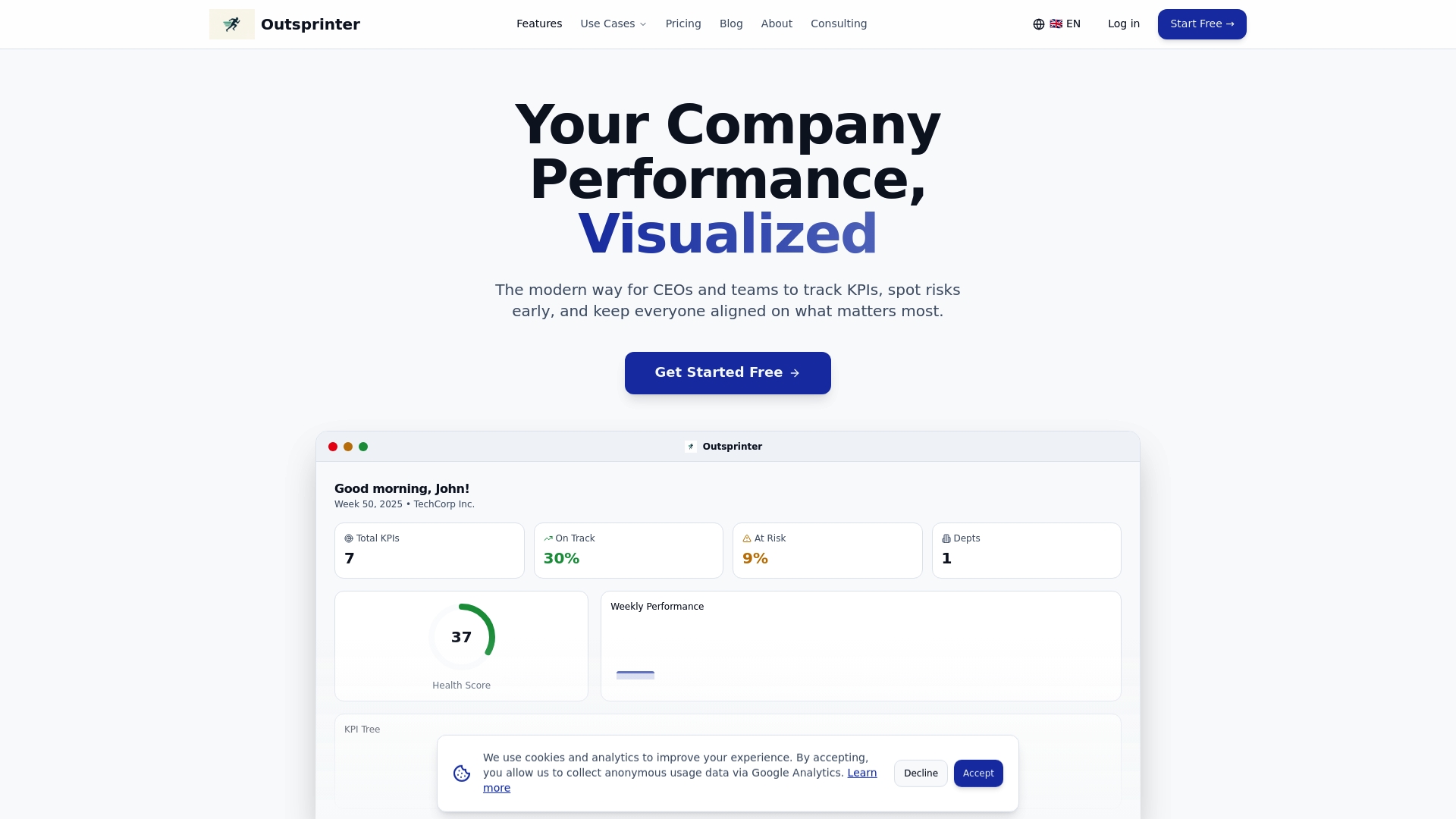
The platform unifies task execution with broader operational management through integrated KPI tracking, goal planning, and team management capabilities. Management board solutions give you the strategic overview while maintaining connection to daily execution details. Project management approaches organize work with the structure large teams need and the flexibility dynamic operations require. Explore how Outsprinter helps COOs like you boost transparency, ensure accountability, and execute with precision in 2026.
Frequently asked questions about the role of task management for COOs
What are the biggest challenges COOs face with task management?
COOs typically struggle with visibility gaps across departments, inconsistent task tracking practices, and difficulty prioritizing among competing demands. Coordination overhead increases exponentially as organizations grow, making manual approaches unsustainable. The challenge lies in maintaining operational control without creating bureaucratic bottlenecks that slow execution.
How can COOs select the right task management software for their teams?
Start by defining must-have features based on your operational workflows and team size. Evaluate platforms on ease of use, integration capabilities, scalability, and reporting functionality. Involve team representatives in selection to ensure the chosen task management tools match how people actually work. Prioritize platforms offering trial periods so you can validate fit before committing.
What metrics should COOs track to measure task management success?
Focus on on-time completion rates, average task cycle time, percentage of tasks blocked by dependencies, and team utilization rates. Track operational outcomes like project delivery predictability and cross-department coordination effectiveness. Monitor adoption metrics to ensure teams actually use systems consistently rather than reverting to informal methods.
How often should COOs review and update task management processes?
Conduct lightweight reviews monthly to address immediate friction points and gather team feedback. Perform comprehensive process evaluations quarterly to assess whether systems still align with evolving operational needs. Major updates should happen annually or when significant organizational changes like restructuring or new strategic initiatives require different coordination approaches.
Can task management improve cross-department collaboration effectively?
Absolutely. Transparent task systems give teams visibility into each other's work, reducing duplicate efforts and enabling proactive coordination. Shared platforms create common language and workflows that break down silos. Clear task dependencies make handoffs explicit, preventing the coordination failures that plague organizations where departments operate as isolated kingdoms.
What role does automation play in COO task management?
Automation eliminates manual coordination overhead that doesn't add strategic value. Automated task creation for recurring workflows ensures nothing falls through cracks. Notification systems keep teams informed without requiring constant status meetings. Workflow automation moves tasks through approval processes without human intervention for routine decisions. This frees your time and team capacity for high-value work requiring human judgment and creativity.