
TL;DR:
- Traditional annual reviews are outdated; continuous, real-time performance management improves agility.
- Implementing frameworks like OKRs and regular feedback cycles boosts productivity and strategic alignment.
- Successful scaling requires addressing manager behavior, cultural readiness, and integrating automation tools.
Annual performance reviews made sense when business moved slowly. Today, they're a liability. Organizations clinging to once-a-year cycles are watching competitors lap them while their own teams drift without clear direction. Scalable performance management, meaning systems that adapt continuously as your organization grows, changes that equation entirely. Companies with effective systems can outperform peers by 2.5x and generate 316% ROI. This guide covers the core methodologies, the real pitfalls most leaders overlook, and the practical steps to build a system that actually scales.
Table of Contents
- Defining scalable performance management
- Core frameworks and methodologies
- Navigating challenges: Edge cases and pitfalls
- Practical steps to implement scalable performance management
- Our take: What most leaders miss when scaling performance management
- Scale smarter: Unlock next-level team performance with Outsprinter
- Frequently asked questions
Key Takeaways
| Point | Details |
|---|---|
| Scalable systems boost productivity | Organizations see up to 30% higher engagement and 316% ROI by scaling performance management. |
| OKRs and feedback drive results | Combining OKR frameworks with continuous feedback cycles aligns teams and metrics to business goals. |
| Anticipate challenges and audit bias | Leaders must address silos, tool sprawl, and feedback bias with iterative audits and hybrid oversight. |
| Pilot implementation is essential | Launching pilots in high-growth teams validates ROI and smooths cultural transition to scalable models. |
Defining scalable performance management
Scalable performance management is not just a bigger version of what you already do. It is a fundamentally different operating model, one built to grow with your teams rather than buckle under their weight.
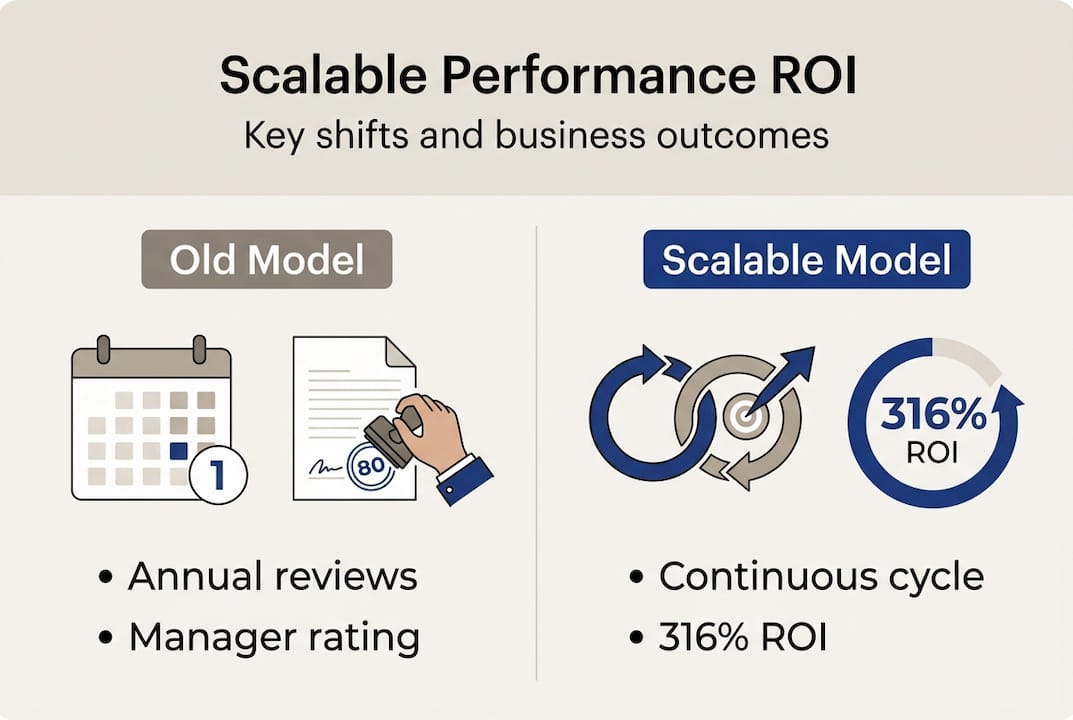
Traditional performance management runs on annual or semi-annual review cycles. Managers fill out forms, employees receive ratings, and everyone moves on until next year. The problem is that feedback arrives months after the moment it was relevant. Goals set in January are obsolete by March. That model worked when markets were stable and headcount was predictable. Neither is true anymore.
Scalable systems replace that static cycle with continuous loops. Continuous performance cycles include regular planning sessions, frequent check-ins, and structured reviews that happen on a rolling basis rather than once a year. Alongside these cycles, scalable systems use OKR frameworks (Objectives and Key Results) for goal cascading across departments, 360-degree feedback that gathers input from peers and direct reports, competency-based evaluations tied to role expectations, and HR tech integration that automates workflows and surfaces analytics.
The contrast between the two models is significant:
| Dimension | Traditional model | Scalable model |
|---|---|---|
| Review frequency | Annual or semi-annual | Continuous, rolling cycles |
| Goal setting | Top-down, static | Cascaded OKRs, dynamic |
| Feedback source | Manager only | 360-degree, multi-source |
| Data visibility | Lagging indicators | Real-time dashboards |
| Adaptability | Low | High |
The benefits are not theoretical. 30% higher productivity and engagement are documented outcomes in organizations that make this shift. That gap compounds over time. A team running at 30% higher productivity for two years does not just outperform, it laps the competition.
Why does scalability matter specifically for team alignment? Because misalignment is expensive. When individual contributors do not understand how their work connects to organizational goals, effort scatters. Scalable systems solve this by keeping performance management trends tied directly to strategy, so every team member can see the line from their daily tasks to the company's top priorities. The result is less wasted effort and faster course correction when priorities shift. To see how this connects to measurable outcomes, explore how to boost KPI results across your organization.
Core frameworks and methodologies
Frameworks are the architecture that makes scalability possible. Without them, you are just adding more meetings and hoping for better results.
OKRs (Objectives and Key Results) are the most widely adopted framework for scalable goal setting. The OKR framework works by setting ambitious objectives at the company level, then cascading them into department and individual key results. Every person on your team can trace their work back to a strategic priority. This is goal alignment at scale, and it removes the ambiguity that kills productivity in growing organizations.
Continuous performance cycles replace the annual review with a rhythm of shorter, more frequent interactions. These include weekly or biweekly check-ins, monthly progress reviews, and quarterly recalibrations. The cadence keeps feedback timely and goals relevant. Continuous performance cycles also reduce the anxiety employees feel around high-stakes annual reviews, which tends to improve candor and participation.
360-degree feedback and competency grids add depth to performance data. Instead of one manager's perspective, you gather input from peers, direct reports, and cross-functional partners. Competency grids map specific behaviors to role levels, making evaluations more objective and less subject to personal bias. Nine-box talent mapping, a tool that plots performance against potential, helps leaders make succession and development decisions with clearer evidence.
Here is how the major frameworks compare on key dimensions:
| Framework | Primary use | Best for |
|---|---|---|
| OKRs | Goal alignment | All team sizes |
| Continuous cycles | Feedback cadence | Fast-growing teams |
| 360-degree feedback | Evaluation depth | Mid to large orgs |
| Competency grids | Role clarity | Structured orgs |
The ROI case for adopting these frameworks is strong. High-growth implementations have demonstrated 316% ROI and a 21.4% increase in operational equipment effectiveness (OEE), a measure of how efficiently production assets are used. Those numbers come from organizations that committed to the full system, not just one piece of it.

Pro Tip: Do not try to roll out every framework at once. Start with OKRs and a basic check-in cadence in your highest-growth team. Validate the process, collect feedback, and then expand. This pilot approach reduces resistance and gives you real data before you scale organization-wide. For a deeper look at how AI in performance management can enhance these frameworks, the tools available in 2026 are worth exploring. You can also review how secure performance management practices protect your data as you scale.
Navigating challenges: Edge cases and pitfalls
Frameworks do not implement themselves. The gap between a well-designed system and one that actually works is filled with predictable, avoidable problems.
Scaling reveals several recurring failure points: siloed teams that do not share performance data, unclear expectations that make evaluations feel arbitrary, tool sprawl where multiple disconnected platforms create more friction than insight, manager judgment gaps where leaders lack the skill or confidence to have meaningful performance conversations, and bias in feedback that skews evaluations based on factors unrelated to actual performance.
Here are the most common pitfalls and how to address them:
- Treating it as a checkbox exercise. When performance management becomes a compliance activity rather than a genuine development tool, participation drops and data quality suffers. Leaders must model engagement, not just mandate it.
- Tool sprawl. Adding a new platform every time a problem surfaces creates fragmentation. Consolidate around a core system that handles goal tracking, feedback, and analytics in one place.
- Feedback bias. Recency bias, affinity bias, and halo effects all distort performance data. Regular bias audits, where you review rating distributions across demographic groups, catch these patterns before they calcify.
- Cultural resistance. Moving from annual to continuous feedback feels threatening to managers who are used to controlling the narrative. Change management is not optional; it is part of the implementation.
"The organizations that scale performance management successfully are the ones that treat bias and cultural readiness as first-class problems, not afterthoughts." — Gartner performance management best practices
Pro Tip: Run a bias audit on your first quarter of performance data after any new system launch. Look at rating distributions by department, tenure, and role level. Patterns that look wrong usually are. Catching them early builds credibility for the entire program.
Hybrid human-AI oversight is emerging as a practical solution for reducing bias at scale. AI flags statistical anomalies in ratings while managers retain final judgment. This combination is more reliable than either approach alone. Explore how HR team solutions can support this kind of oversight, and review performance visualization best practices to make sure your data tells the right story.
Practical steps to implement scalable performance management
Knowing the frameworks and pitfalls is useful. Having a step-by-step path forward is what actually moves organizations.
- Set SMART goals at every level. Before any system goes live, define what success looks like. SMART goals (Specific, Measurable, Achievable, Relevant, Time-bound) give managers and employees a shared language. Use OKR implementation tips to cascade these from company strategy down to individual contributors.
- Pilot in a high-growth team. Choose a team that is already motivated to improve and has clear, measurable output. Run the full cycle, check-ins, feedback, reviews, for one quarter. Collect data on what worked and what created friction.
- Train managers first. Technology does not replace manager skill. Invest in training that covers how to give specific feedback, how to run a productive check-in, and how to handle difficult performance conversations. This is the step most organizations skip, and it is why most rollouts stall.
- Integrate your tech stack. Automation handles the administrative load so managers can focus on conversations. Look for platforms that connect goal tracking, feedback collection, and analytics without requiring manual data entry.
- Measure benchmarks and ROI. Establish baseline metrics before launch: productivity rates, engagement scores, goal completion percentages. Then track against them. Companies with effective systems see 2.5x outperformance and 316% ROI, but you need your own baseline to know where you stand.
- Iterate continuously. Treat the system itself as a product. Run quarterly retrospectives on the process, not just performance. What feedback loops are working? Where are managers disengaged? Adjust accordingly.
Pro Tip: Connect performance management explicitly to your employee value proposition (EVP). When employees see that the system is designed to help them grow, not just evaluate them, adoption rates climb and retention improves. Review the performance alignment playbook and leadership review steps to sharpen your rollout strategy.
Our take: What most leaders miss when scaling performance management
Here is the uncomfortable truth: most performance management rollouts fail not because of bad frameworks or weak technology. They fail because leaders underestimate how much manager behavior needs to change.
Every article on this topic covers OKRs and continuous cycles. Far fewer address the reality that a manager who is uncomfortable with feedback will undermine any system you put in place. Technology surfaces the data. Managers determine whether that data leads to real conversations or gets quietly ignored.
We have seen organizations invest heavily in platforms and training materials, then watch adoption plateau because no one addressed the cultural readiness gap. The managers who struggled with annual reviews do not automatically improve when you switch to monthly check-ins. They need coaching, accountability, and in some cases, a reassessment of whether they are the right people for people management roles.
AI-driven judgment tools can help flag where manager engagement is dropping, but they cannot replace the leadership decision to prioritize this. The organizations that scale performance management well treat it as a leadership capability investment, not a software deployment.
Scale smarter: Unlock next-level team performance with Outsprinter
If you are ready to move beyond theory and build a performance management system that actually scales, the right platform makes a measurable difference.
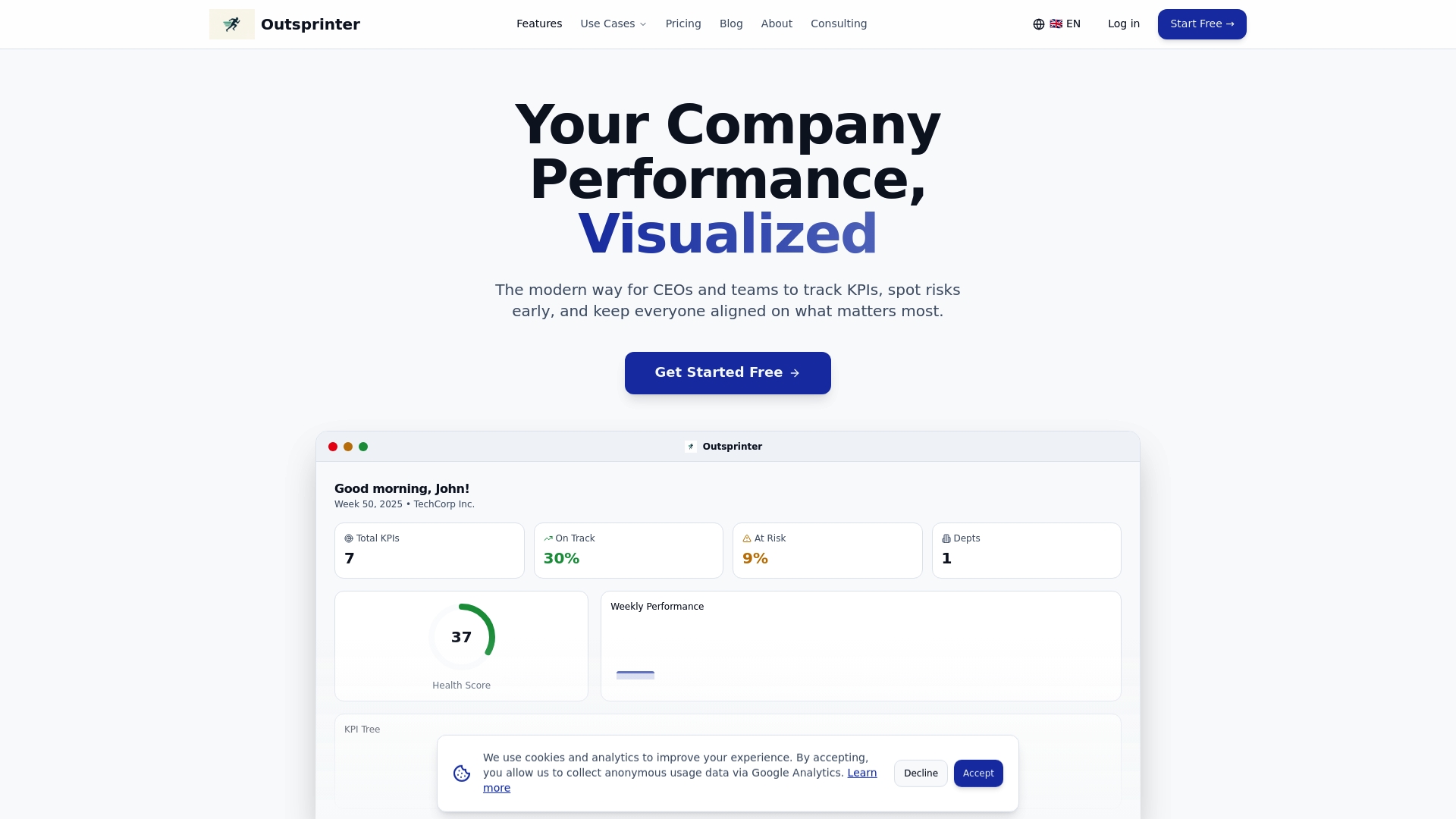
Outsprinter is built for exactly this challenge. The Outsprinter platform gives you real-time dashboards, goal tracking, and team alignment tools in one place. With KPI management software, you can define, track, and visualize performance indicators across every department, so nothing falls through the cracks. The task management tools keep daily work connected to strategic priorities, giving managers and contributors a shared view of progress. Whether you are piloting with one team or rolling out across the organization, Outsprinter scales with you.
Frequently asked questions
What makes a performance management system scalable?
A scalable system adapts to growth through continuous cycles, robust frameworks like OKRs, integration with automation tools, and frequent feedback across teams. The key is that the system improves as the organization grows rather than creating more administrative burden.
What ROI can business leaders expect from scalable performance management?
Productivity increases of 30%, 2.5x outperformance versus peers, and 316% ROI are documented outcomes from organizations with effective scalable systems. Results depend on implementation quality and manager engagement.
How do leaders overcome cultural and organizational resistance when scaling?
Start with pilot programs in motivated teams, pair tech rollout with manager training, run bias audits on early data, and use iterative feedback to refine the process before expanding organization-wide.
Do small organizations need scalable performance management?
Yes. OKRs and continuous cycles can be sized for small startups and growing teams. Building scalable habits early means the system supports growth rather than becoming a bottleneck when headcount increases.