
TL;DR:
- Many executives mistakenly believe irregular LinkedIn activity ensures visibility, but deliberate, multi-channel strategies shape influence. Authenticity, strategic channel use, and linking activities to measurable business outcomes are essential for sustainable executive presence and credibility. Focusing on genuine opinions and internal engagement builds lasting impact and organizational trust.
Most executives assume that showing up on LinkedIn a few times a month counts as executive visibility. It does not. Real visibility is a deliberate, multi-channel strategy that shapes how your board, your team, your peers, and your market think about your leadership. When done right, it directly influences strategic decisions, accelerates team alignment, and builds the kind of credibility that opens doors no job title can. This guide unpacks the full picture, from defining the concept clearly to linking it with measurable business outcomes.
Table of Contents
- Defining executive visibility: More than just presence
- Core strategies to build authentic executive visibility
- Linking executive visibility to business outcomes
- Measuring, refining, and sustaining executive visibility
- What most executive visibility advice gets wrong
- Build lasting executive impact with Outsprinter
- Frequently asked questions
Key Takeaways
| Point | Details |
|---|---|
| Visibility is strategic | True executive visibility goes beyond posting online and integrates authenticity, thought leadership, and cultural alignment. |
| Multi-channel beats single-channel | Leaders see greater results by using a mix of public and internal platforms, not just LinkedIn. |
| Link visibility to outcomes | Use metrics tied to engagement, cultural buy-in, and business goals rather than focusing on likes or vanity stats. |
| Refine and sustain | Regularly assess visibility efforts using analytics and adapt based on feedback for long-term influence. |
Defining executive visibility: More than just presence
Executive visibility is a term that gets used loosely, and that vagueness is exactly what causes most leaders to misapply it. A clear working definition is the starting point for everything else.
Notice what that definition actually covers: it is not just about being seen. It involves reputation, credibility, and value creation. There is a meaningful difference between a leader who posts quarterly updates and a leader who shapes industry conversations, aligns internal teams around a shared vision, and earns consistent trust from stakeholders.
For organizations, executive visibility delivers three core advantages. First, it builds trust at scale. When employees and customers can see and hear from leadership directly, confidence in the organization's direction increases. Second, it improves strategic alignment. Visible leaders communicate priorities clearly, which means less guesswork at every level. Third, it directly influences decision-making. A well-positioned executive carries more weight in boardrooms, partnerships, and media coverage.
The key dimensions of executive visibility include:
- Public-facing presence: Industry articles, conference keynotes, podcasts, and media interviews
- Internal presence: Town halls, written updates, video messages, and cross-functional communication
- Thought leadership: Publishing original perspectives on trends, challenges, and innovations
- Digital footprint: LinkedIn profiles, company blogs, and social media engagement
- Relationship networks: Peer connections, industry associations, and community involvement
Authenticity ties all of these together. Leaders who adopt visibility as a performance rather than a genuine expression of their thinking quickly lose credibility. Building high-impact team performance depends on teams believing in and trusting their leaders, and that trust is earned through consistent, authentic communication over time. The same principle applies when reviewing leadership team best practices: visibility is a leadership behavior, not a marketing tactic.
Core strategies to build authentic executive visibility
Once you understand what executive visibility actually means, the next question is: where do you start? The honest answer is that most leaders pick one channel, post inconsistently, and wonder why nothing moves. The research paints a different picture.
Effective visibility mechanics include LinkedIn optimization with forward-looking insights, consistent posting at least once per week, thought leadership articles, speaking at conferences, media relationships, video content, podcasts, and analytics for ongoing measurement. That is a wide-ranging toolkit, and the best leaders treat it strategically rather than haphazardly.
Here is where the single-channel versus multi-channel comparison becomes critical:
| Dimension | Single-channel visibility | Multi-channel visibility |
|---|---|---|
| Reach | Limited to one audience segment | Reaches diverse stakeholders simultaneously |
| Credibility | Perceived as self-promotional | Builds authority across contexts |
| Sustainability | Vulnerable to algorithm changes | Resilient and adaptable |
| Engagement depth | Surface-level interactions | Deeper, more varied relationship building |
| Business impact | Minimal and hard to measure | Directly tied to leads, trust, and alignment |
The data reinforces this clearly. Treating visibility as self-promotion or limiting it to a single platform significantly reduces impact. Multi-channel approaches combining podcasts, publications, speaking, and peer networks consistently outperform single-channel strategies on every dimension.
Here are the core tactics to build authentic visibility, ranked by strategic importance:
- Optimize your LinkedIn profile and post consistently: Use your profile headline to communicate your vision, not just your title. Post at least once a week with insights that reflect where your industry is heading, not just where it has been.
- Speak at industry events: Nothing replaces standing on a stage in front of your peers. Conference appearances signal credibility and create network effects that digital content alone cannot replicate.
- Write thought leadership articles: Long-form pieces in trade publications, industry blogs, or your company's own channels establish depth of expertise. Aim for one per month.
- Pursue podcast and media opportunities: Being interviewed by others validates your perspective in a way self-publishing cannot. Start small with niche podcasts in your sector and build from there.
- Build intentional media relationships: Journalists and editors are always looking for credible sources. Being known as a reliable, insightful voice in your field puts you in their contact list.
- Network with purpose: Not every connection adds value. Strategic networking means building relationships with peers who challenge your thinking and open strategic doors.
Pro Tip: Resist the urge to treat each channel separately. The leaders with the strongest visibility build one coherent narrative across all platforms. Your LinkedIn post, your conference talk, and your podcast appearance should all reinforce the same core ideas and values.
Connecting this to business performance matters. When executives are consistently visible in the right ways, it supports driving KPI success by keeping teams focused on what leadership prioritizes. You can also use executive team checklists to make sure visibility activities stay aligned with organizational goals rather than drifting into noise.

Linking executive visibility to business outcomes
Visibility for its own sake is not worth your time. What matters is what it produces. The strongest case for investing in executive visibility is the direct link between visible leadership and measurable business outcomes.
| Visibility action | Business outcome |
|---|---|
| Regular thought leadership content | Increased brand equity and inbound opportunities |
| Internal communication and town halls | Higher employee engagement and retention |
| Conference speaking and media presence | Stronger talent attraction and investor confidence |
| Peer networking and industry involvement | Faster access to strategic partnerships |
| Consistent social media presence | Greater market awareness and customer trust |
Visible CEOs and senior leaders consistently produce stronger organizational results in practice. Consider a few concrete examples:
- Organizations where the CEO actively communicates vision and progress see measurably higher employee engagement scores. Teams that understand where they are going are more motivated and more focused.
- Leaders who publish regularly on industry trends attract inbound interest from potential partners, media, and top-tier talent who want to work with forward-thinking executives.
- When leadership is visible during periods of change or uncertainty, culture buy-in accelerates. Employees do not fill the information vacuum with fear; they rally around a clear, credible voice.
- Visible executives drive better KPI attainment because teams can see the connection between their daily work and the broader mission. Leadership visibility creates a line of sight that vague internal memos never achieve.
Strategic executives who commit to continuous learning, use digital tools like Google Alerts to monitor their presence, and build a culture of innovation sustain visibility in ways that are both authentic and data-driven. Refinement over time, not perfection from day one, is the operating model.
Pro Tip: Stop measuring your visibility success by likes and follower counts. Instead, track business-relevant outcomes: inbound partnership inquiries, quality of talent applying to open roles, employee engagement survey responses, and media coverage in target publications. These metrics tell you whether your visibility is actually creating value.
Linking visibility to outcomes requires tracking organizational performance rigorously. Without clear performance data, it is nearly impossible to know whether your visibility efforts are moving the needle. Platforms that support management board strategies make this connection explicit by keeping leadership accountable to the results their visibility is meant to drive.
Measuring, refining, and sustaining executive visibility
Most leaders who invest in executive visibility start strong and then lose momentum within three to six months. The reason is almost always the same: they have no measurement system, so they cannot tell if it is working, and eventually they stop.
Building a sustainable visibility practice requires a clear, step-by-step measurement and refinement process:
- Set specific goals before you start: Are you trying to attract talent, increase brand awareness, build investor confidence, or improve internal alignment? Different goals require different channels and metrics.
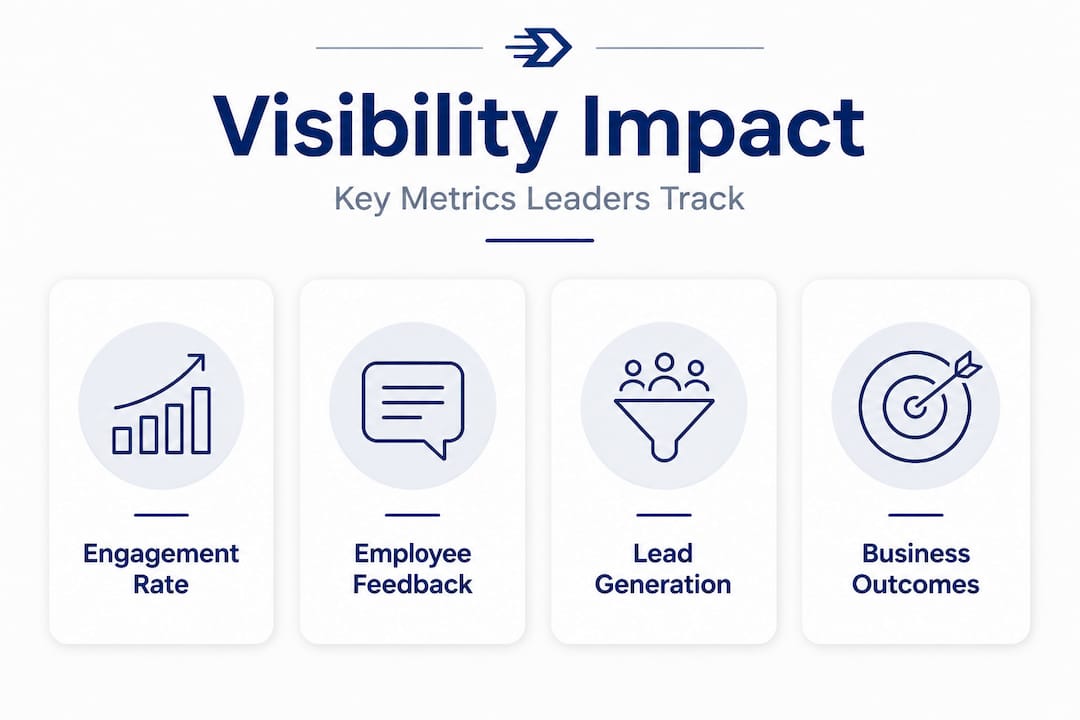
- Choose meaningful metrics over vanity metrics: Follower counts feel good but rarely correlate with business outcomes. Instead, track engagement rate, content shares, media mentions, inbound inquiries, and internal survey feedback on leadership communication.
- Use monitoring tools consistently: Google Alerts for your name and key topics, LinkedIn analytics for content performance, and media tracking tools for press mentions all give you a real-time picture of your visibility footprint.
- Review and adjust quarterly: Schedule a quarterly review of your visibility activities. What generated the most meaningful engagement? What fell flat? Which channels are producing business outcomes and which are just consuming time?
- Document your narrative evolution: Your core message will sharpen over time. Keep a record of your key themes and how your positioning evolves so your visibility stays coherent and forward-looking.
Avoiding common pitfalls is just as important as building good habits. Leaders who focus only on vanity metrics get trapped chasing engagement that does not convert to business value. Those who come across as overly self-promotional lose the trust of peers and employees quickly. And those who treat visibility as a one-time campaign rather than an ongoing practice find their credibility erodes the moment they go quiet.
Analytics for engagement and lead measurement provide the data layer that turns visibility from guesswork into a manageable leadership discipline. Use them consistently, not just when you want to report good numbers to your board.
Pro Tip: Once every quarter, ask two or three trusted peers or direct reports this simple question: "How would you describe my leadership perspective to someone who doesn't know me?" Their answer tells you exactly how your visibility is landing, not how you intend it to land. That gap is your most valuable feedback.
Tying visibility metrics to broader leadership lessons from KPI tracking creates the kind of integrated leadership practice that sustains momentum and builds long-term credibility.
What most executive visibility advice gets wrong
Here is the uncomfortable truth: most executive visibility advice focuses on tactics when the real problem is mindset.
Leaders come to visibility coaching or read articles like this one, and they immediately want to know what to post, how often, and on which platform. Those are the wrong first questions. The first question should be: "What do I genuinely believe that is worth saying out loud?" Without a clear, honest answer to that, all the tactics in the world produce what we call visibility theater. It looks like leadership presence, but it lacks the substance that creates real influence.
The executives who build lasting visibility are not the ones with the slickest content strategy. They are the ones who have formed genuine opinions about their industry, who have learned hard lessons they are willing to share openly, and who prioritize being useful to their audience over being impressive.
There is also a common trap around scale. Many leaders think they need to be everywhere at once to matter. This leads to shallow presence on five platforms instead of meaningful engagement on two. Being meaningfully present in the right places consistently beats broadcasting everywhere sporadically. Your team, your board, and your market do not need more noise. They need your clearest thinking.
Finally, internal visibility is chronically undervalued. Many executives focus entirely on external presence while their own teams feel disconnected from leadership's thinking. The highest-return visibility investment for most leaders is often better, more frequent internal communication. Culture buy-in, team productivity, and strategic alignment all improve dramatically when employees can see, hear, and genuinely connect with their leaders.
If you want to build the kind of presence that actually moves organizations, focus less on being everywhere and more on being meaningfully present where it matters. Review C-suite team productivity as a complement to visibility strategy, because the two reinforce each other more than most leaders realize.
Build lasting executive impact with Outsprinter
Knowing what executive visibility requires is one thing. Having the systems to track whether your leadership is actually producing results is another.
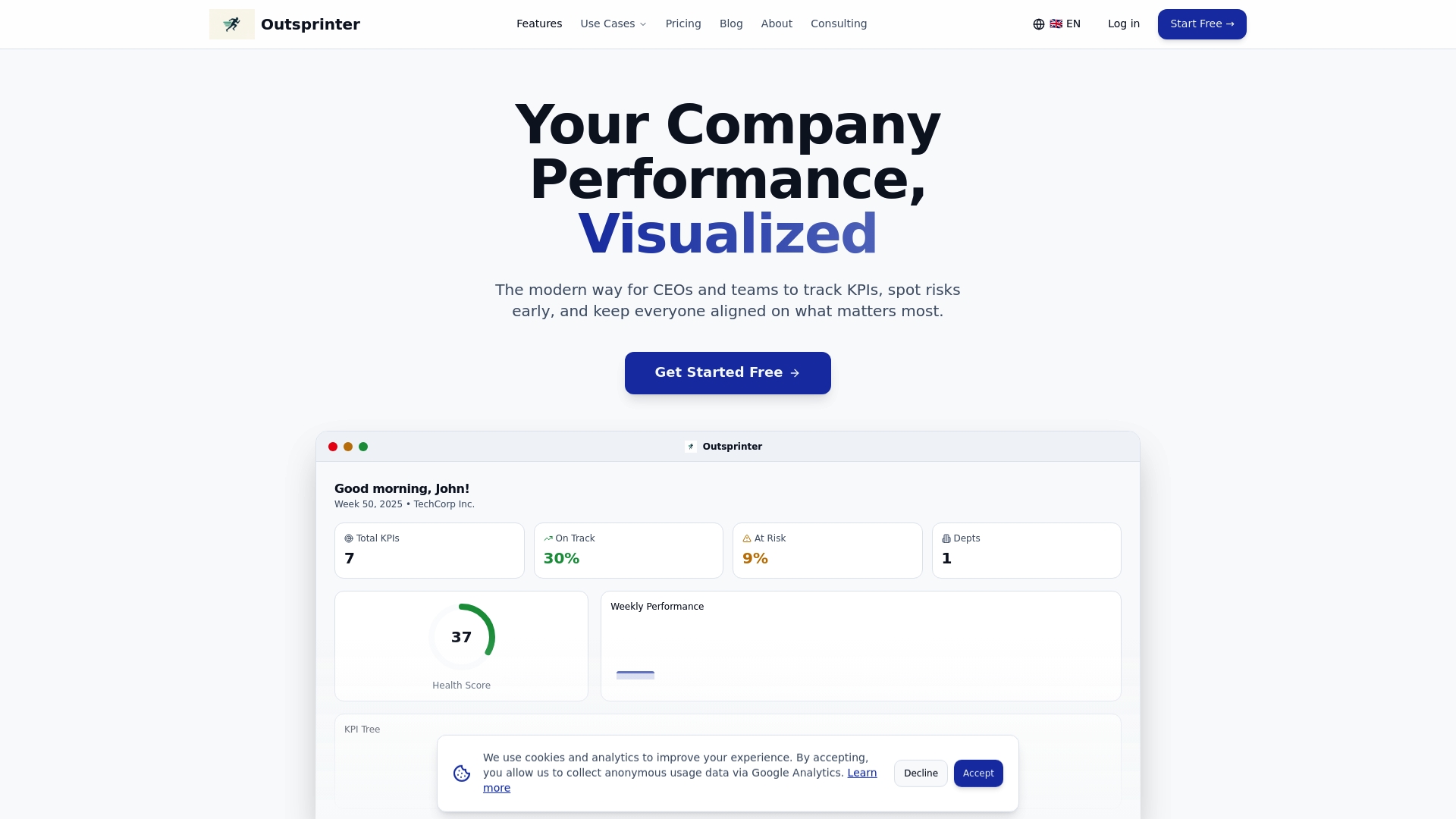
Outsprinter gives executive teams the infrastructure to connect visibility efforts with real organizational performance. With real-time KPI tracking, you can measure exactly how leadership actions translate into business outcomes, from employee engagement scores to strategic goal attainment. The platform's advanced task management keeps visibility-related activities accountable within the broader rhythm of leadership priorities. Whether you are aligning a C-suite team around a shared narrative or tracking quarterly goals with your board, Outsprinter brings the data layer that transforms good leadership intentions into measurable, reportable impact.
Frequently asked questions
What are the best channels for executive visibility in 2026?
The most effective approach combines LinkedIn, public speaking, thought leadership articles, podcasts, and media interviews, since effective visibility requires multiple channels working together rather than relying on any single platform.
How do executives measure the impact of their visibility efforts?
Beyond follower counts, meaningful measurement includes engagement and lead analytics, employee feedback, inbound partnership inquiries, and concrete business outcomes like improved team alignment or increased brand recognition.
Is executive visibility only important for CEOs?
All senior leaders benefit from building visibility, since executive visibility applies to any leader who influences strategic direction, manages teams, or represents the organization in public or internal contexts.
What are common mistakes to avoid in executive visibility campaigns?
The biggest pitfall is treating visibility as self-promotion or limiting efforts to a single platform, because success requires multi-channel approaches combined with authentic storytelling and consistent, value-driven engagement.