
TL;DR:
- Most CEOs mistake activity for strategic execution, which actually requires continuous learning and adaptation.
- Effective execution involves a closed-loop management system with clear priorities, ownership, resource allocation, and feedback.
- Tools like strategy maps and balanced scorecards operationalize strategy, reinforced by disciplined cadences and leadership control levers.
Most CEOs believe they understand strategic execution. They set goals, hold quarterly reviews, and build slide decks full of KPIs. But that activity is not execution. It is performance theater. The real system of strategic execution is a closed-loop management discipline that links vision to daily action through continuous learning, ownership, and adaptation. Research from Kaplan and Norton defines it as the set of leadership practices and management systems that translate strategy into action, and most executive teams are only practicing a fraction of it.
Table of Contents
- Defining strategic execution: More than planning
- The mechanics: Strategy maps and balanced scorecards
- Leadership levers: Inspiring, monitoring, and adapting
- Execution cadence: Organizational rhythms for results
- From confusion to clarity: Applying strategic execution in your organization
- Why most CEOs underestimate strategic execution (and what actually works))
- Take strategic execution further with Outsprinter tools
- Frequently asked questions
Key Takeaways
| Point | Details |
|---|---|
| Execution is a system | Strategic execution is an ongoing process—not just a plan or a meeting. |
| Frameworks drive action | Tools like strategy maps and balanced scorecards link vision to outcomes for leadership. |
| Leadership levers matter | CEOs must balance monitoring, boundaries, and adaptability to ensure execution. |
| Cadence sustains results | Regular review cycles and feedback loops prevent misalignment and fuel performance. |
| Technology optimizes execution | Software platforms streamline KPI tracking, task management, and team alignment. |
Defining strategic execution: More than planning
Strategic execution is frequently mistaken for strategic planning, and that confusion is costly. Planning sets direction. Execution delivers results. The gap between them is where most organizations fail, not because their strategy is wrong, but because the system designed to carry it out is incomplete.
"Strategic execution is the set of leadership practices and management systems that translate strategy into action — clarifying priorities, assigning ownership, allocating resources, and running review/learning loops so teams can adjust as conditions change." — Kaplan and Norton
Execution is a closed-loop management system. That means it does not end when plans are written or even when goals are assigned. It runs continuously, cycling through planning, action, monitoring, learning, and strategy updates. The loop never closes permanently — it keeps turning as the environment changes.
The core elements of a functioning execution system include:
- Priority clarification: Leaders must translate broad strategy into specific, ranked priorities so teams know where to focus first.
- Ownership assignment: Every objective needs a named owner accountable for outcomes, not just activities.
- Resource allocation: Time, budget, and talent must be deliberately matched to strategic priorities, not distributed by default.
- Feedback loops: Regular review and learning cycles allow teams to course-correct before small misalignments become major failures.
A common mistake is treating execution as a one-time rollout event. Leadership announces the strategy, managers cascade it down, and then everyone waits for the annual review to see what happened. That is static execution, and it does not work. Learning about strategy execution principles reveals why dynamic, adaptive systems consistently outperform static planning approaches.
The mechanics: Strategy maps and balanced scorecards
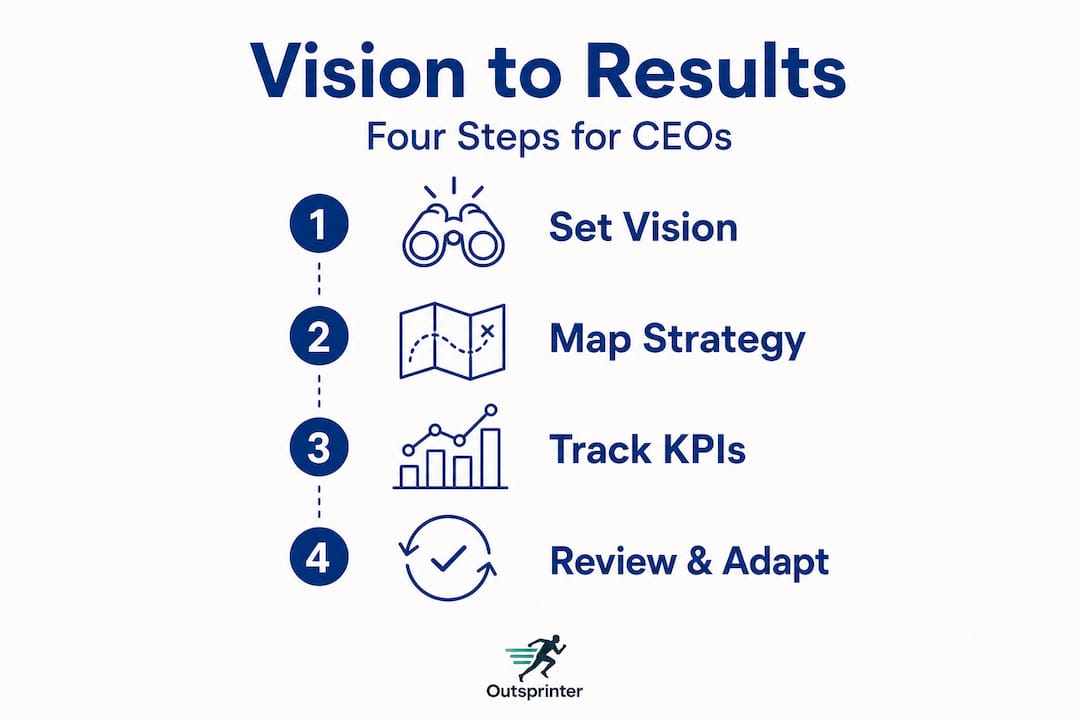
With a clear understanding of what strategic execution involves, the next question is practical: what tools do CEOs use to make it operational? Two frameworks dominate here: the strategy map and the balanced scorecard. Together, they form a powerful pair.
A strategy map + balanced scorecard approach converts vision into linked objectives and performance measures across four perspectives: financial, customer, internal process, and learning and growth. It then connects those measures to initiatives and budgets, and installs governance and review cycles so leadership can track progress and adapt.
| Tool | Primary function | Key output |
|---|---|---|
| Strategy map | Visualizes cause-and-effect links between objectives | Aligned objective hierarchy |
| Balanced scorecard | Tracks measurable progress against each objective | KPIs and initiative status |
| Governance cycle | Reviews progress and triggers adaptation | Decision and adjustment log |
Here is how these tools work together in practice for an executive team:
- Build the strategy map. Group strategic objectives by perspective (financial, customer, process, learning). Draw arrows showing how achieving one objective drives another. For example, investing in employee training (learning) improves process quality (internal), which raises customer satisfaction (customer), which drives revenue (financial).
- Define measures and targets. For each objective on the map, assign one or two KPIs with clear numerical targets and deadlines.
- Link to initiatives and budgets. Every KPI should connect to at least one funded initiative. If there is no budget behind a measure, it will not move.
- Set the review cadence. Monthly operational reviews and quarterly strategic reviews keep the system alive and responsive.
Pro Tip: Do not build a balanced scorecard with more than 25 to 30 KPIs total. Organizations that track too many measures dilute leadership attention and reduce the accountability that makes the scorecard powerful. Fewer, better measures beat a crowded dashboard every time.
Understanding the mechanics of turning strategy into action through these frameworks gives leadership teams a concrete operating model, not just a conceptual one.
Leadership levers: Inspiring, monitoring, and adapting
Frameworks are structural tools. But execution also depends on how leaders use management control to drive human behavior. This is where the concept of four levers of control becomes essential for CEOs.

Management control choices — including belief systems, boundary systems, diagnostic controls, and interactive controls — are the behavioral levers executives pull to inspire commitment, coordinate monitoring, and stimulate strategic search. Each lever solves a different leadership challenge.
| Control lever | What it does | Executive application |
|---|---|---|
| Belief systems | Communicates core values and mission | Town halls, vision statements, leadership communication |
| Boundary systems | Sets rules and limits on acceptable behavior | Policy frameworks, compliance guidelines |
| Diagnostic controls | Monitors outcomes against targets | KPI dashboards, variance reports |
| Interactive controls | Stimulates dialogue about strategic uncertainties | Cross-functional leadership forums, scenario planning |
Most executive teams over-invest in diagnostic controls (measurement) and under-invest in interactive controls (strategic dialogue). The result is organizations that know exactly how they are performing but struggle to adapt when the environment shifts.
Key behaviors that strong execution leaders demonstrate include:
- Setting clear boundaries without micromanaging execution details
- Using belief systems to align culture with strategic intent
- Running interactive reviews that challenge assumptions, not just report numbers
- Balancing control with experimentation so teams feel safe to test new approaches
The practical execution management insights available to modern CEOs show that interactive controls are especially powerful in fast-moving markets, where strategy needs to evolve faster than annual planning cycles allow. This performance alignment guide for B2B leaders shows how balancing these levers creates organizations that perform consistently at the highest level.
Pro Tip: Run one monthly "strategic question" session with your C-suite where you do not review KPI dashboards at all. Instead, discuss the two or three assumptions your strategy depends on, and whether they are still valid. This is interactive control in practice, and it is where most strategic pivots are born.
Execution cadence: Organizational rhythms for results
Even the best frameworks and levers fail without rhythm. Execution cadence is the operating heartbeat of a high-performing organization. It connects planning to action, action to monitoring, and monitoring to learning.
"Strategic execution depends on having an operating cadence and appropriate C-suite and leadership interactions; failures often come from misalignment and lack of a system that turns strategy into consistent follow-through." — HBR 2025
The most common reason strategies fail is not that they were wrong. It is that execution and strategy drifted apart over time, with no system to pull them back together. Cadence is that system.
Here is a practical operating cadence framework for executive teams:
- Weekly team check-ins: Short, focused meetings (30 to 45 minutes) where frontline and operational leaders confirm task progress, surface blockers, and maintain momentum. These are not status updates. They are obstacle-removal sessions.
- Monthly operational reviews: A 90-minute leadership session reviewing KPI performance, initiative progress, and resource bottlenecks. Decisions are made here. Actions are assigned.
- Quarterly strategic reviews: A half-day or full-day session where the C-suite reviews scorecard performance, validates strategic assumptions, and updates priorities if needed.
- Annual strategy refresh: A structured process to update the strategy map, reset targets, and reallocate resources based on what was learned during the year.
Building the right execution rhythm for teams is not just a project management technique. It is how leadership ensures that strategic intent does not evaporate between planning cycles. Without cadence, execution becomes episodic. With cadence, it becomes institutional.
From confusion to clarity: Applying strategic execution in your organization
Knowing the theory is one thing. Implementing it across a real organization with competing priorities, legacy systems, and human resistance is another. Here is a step-by-step approach CEOs and executive teams can use to launch or revitalize a strategic execution system.
A well-designed system treats execution as a closed-loop management process: plan, do, monitor, learn, and update strategy. It is not a one-time rollout. It is an ongoing operating discipline that improves over time.
- Diagnose the current state. Before redesigning your system, map what you currently have. Which elements of the closed loop exist? Which are missing? Most organizations have planning and some monitoring, but lack structured learning loops.
- Define strategic priorities explicitly. Limit your top organizational priorities to five or fewer. Write them as outcomes, not activities. "Grow enterprise customer revenue by 20%" is a priority. "Improve sales processes" is not.
- Assign owners, not committees. Every priority needs one named executive owner who is personally accountable for results. Shared ownership is no ownership.
- Deploy your framework. Choose the strategy map and balanced scorecard combination for organizations with complex, multi-perspective strategies. Adapt the tool to your business model.
- Install the cadence. Set the weekly, monthly, and quarterly meetings on the calendar before any other execution activity. The cadence must be protected, not optional.
- Build learning into the process. At each review cycle, ask three questions: What did we expect? What actually happened? What do we need to change?
Boosting your organizational KPI results requires this kind of structured learning built directly into the execution rhythm. Organizations that skip the learning step execute harder, not smarter.
Pro Tip: For technology organizations, weekly execution cadence matches the pace of product development and market feedback. For manufacturing, monthly operational reviews often carry more weight because production cycles are longer. For service businesses, customer-facing KPIs should anchor every review cycle. Adapt your cadence to your business model, not to a generic template.
Why most CEOs underestimate strategic execution (and what actually works)
Here is an uncomfortable truth from watching hundreds of strategy initiatives succeed and fail: most CEOs believe their job is to set a great strategy and then hold people accountable for results. That mindset is exactly what kills execution.
Strategy is relatively easy. The vision, the positioning, the market analysis — executives are trained to do this work and often enjoy it. Execution is harder because it is slower, messier, and requires sustained attention to detail that does not fit the pace of visionary leadership. So CEOs delegate execution and return to strategy. The cycle repeats until results disappoint.
What actually works is treating execution as a leadership system, not a management task. The CEO must personally own the cadence. Quarterly strategic reviews cannot be delegated to the CFO or COO permanently. The CEO's presence in those conversations signals that execution is a strategic priority, not a back-office function.
The other lesson learned from failed strategy rollouts is that consistency matters more than quality of planning. An average strategy executed with discipline will outperform a brilliant strategy executed sporadically. Every time. The organizations that win are the ones where the review cadence never slips, the ownership model never blurs, and the learning loops actually trigger strategy updates.
Measuring team performance regularly and transparently is what separates execution-oriented cultures from planning-oriented ones. When teams see their results reflected in real-time dashboards and know that leadership reviews those numbers weekly, behavior changes. Accountability becomes a cultural expectation, not a periodic event.
The most successful executive teams we have seen share one habit: they spend as much time reviewing and adapting strategy as they do creating it. They treat the balanced scorecard not as a report card but as a living decision tool. That shift in mindset is where execution mastery begins.
Take strategic execution further with Outsprinter tools
Strategic execution requires more than good intentions. It requires systems that make priorities visible, ownership clear, and progress trackable in real time.
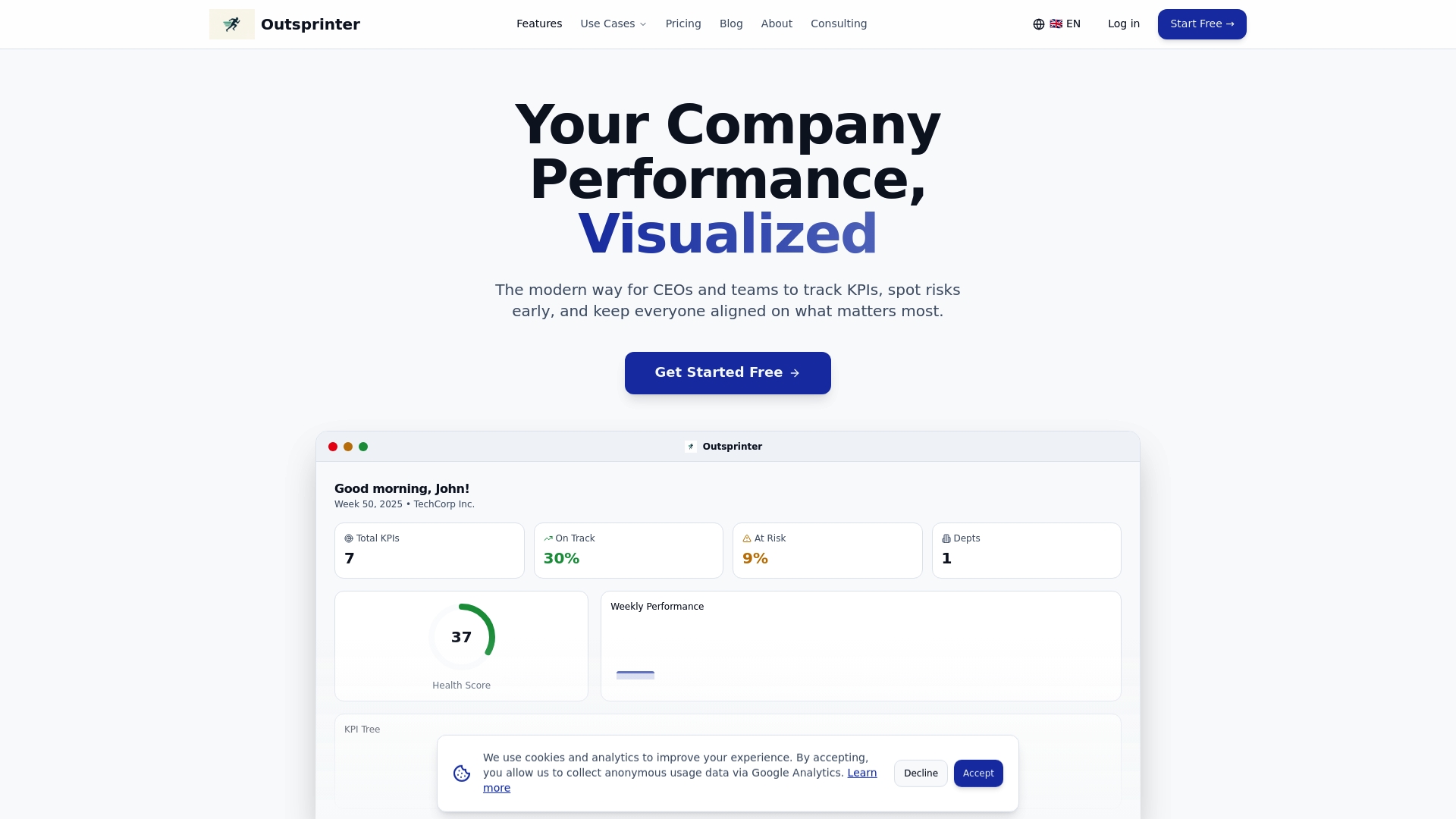
Outsprinter gives executive teams exactly that. With task management built for accountability, you can assign priorities, set deadlines, and track completion without losing visibility as workload grows. The KPI tracking tools let you define, visualize, and monitor performance indicators across every department, so your balanced scorecard is always current and actionable. And project management features connect individual work to strategic objectives with health metrics and workload analysis that keep execution on track between reviews. If you are ready to close the loop between strategy and results, Outsprinter gives you the operating infrastructure to do it.
Frequently asked questions
How is strategic execution different from strategic planning?
Strategic execution turns plans into action with systems for ownership, resource allocation, and continuous review, while planning only sets objectives. As Kaplan and Norton define it, execution is the full management system that translates strategy into measurable outcomes.
What makes strategic execution fail most often?
Failure most often comes from misalignment, lack of a consistent operating cadence, and leadership's inconsistent follow-through. HBR's 2025 research shows that organizations without a structured system for turning strategy into follow-through consistently underperform.
Why do CEOs need strategy maps and balanced scorecards?
These frameworks link vision to actionable objectives, measurable performance indicators, and regular governance cycles. The strategy map and scorecard approach ensures that every initiative and budget connects directly to strategic intent.
How can leadership teams build feedback loops into execution?
Build feedback loops by establishing weekly check-ins, monthly operational reviews, and quarterly strategic sessions, then use each cycle to ask what changed and what the strategy update should be. The closed-loop execution model formalizes learning as a built-in step, not an afterthought.
Which industries benefit most from strategic execution systems?
Technology, manufacturing, and service industries all benefit significantly, though the cadence and control emphasis vary by sector. Technology companies gain the most from fast feedback loops, while manufacturing benefits from diagnostic controls tied to operational efficiency metrics.