
TL;DR:
- Most strategy failures are due to organizational misalignment, not poor plans themselves.
- Effective execution requires system-level pillars like clear ownership, resource alignment, and ongoing monitoring.
- Leadership coordination and continuous performance measurement are critical for sustained strategic success.
Most organizations invest enormous resources in strategic planning, only to watch their carefully crafted strategies stall somewhere between the boardroom and the front line. 90% of organizations fail to execute their strategies successfully, a figure often attributed to Robert Kaplan's research. That number isn't just sobering. It's a signal that execution failure is not a random occurrence but a predictable, structural problem. This article unpacks the tested principles that consistently bridge the gap between ambitious strategy and measurable results, giving you a practical framework to apply immediately.
Table of Contents
- Why strategy execution fails: Bridging the intent-reality gap
- The pillars of effective strategy execution
- Leadership alignment: The synchronization advantage
- Structuring performance measurement for strategy execution
- Execution discipline and organizational learning
- The uncomfortable truth: Why most strategy execution advice falls short
- Turn principles into action with Outsprinter
- Frequently asked questions
Key Takeaways
| Point | Details |
|---|---|
| Portfolio management | Strategic initiatives must be managed as a portfolio with clear selection, resourcing, and accountability. |
| Leadership alignment | Unified executive action is crucial—leaders must consistently coordinate to bridge strategy and execution. |
| Performance systems | A performance management framework links operational work to strategic goals and enables real accountability. |
| Discipline and learning | Repeatable routines and experiment-driven learning help sustain and improve execution effectiveness. |
| Beyond tools | Technology supports execution, but leadership discipline and alignment are indispensable for lasting results. |
Why strategy execution fails: Bridging the intent-reality gap
The most common misconception about strategy failure is that it's an operations problem. In reality, the breakdown usually happens much earlier, in the mechanisms connecting strategic intent to day-to-day action. When strategy and execution fall out of sync, even technically sound plans produce disappointing outcomes because the organization never develops the connective tissue between what leadership planned and what teams actually deliver.
"Organizations need mechanisms to prevent the disconnect between what was planned and what gets done. When strategy and execution fall out of sync, the gap compounds quickly and becomes increasingly difficult to close."
The recurring culprits are familiar to most executives, yet they persist because they're rooted in organizational design, not individual performance:
- Vague goals: Strategic objectives stated as aspirations rather than specific, measurable targets leave teams without actionable direction.
- Poor communication: Strategy documents that sit in shared drives rather than being embedded in team conversations and performance conversations.
- Resource misalignment: Initiatives that receive strategic priority labels but no corresponding budget, headcount, or protected time.
- Weak accountability: No clear owner for strategic outcomes, creating diffused responsibility where everyone is technically responsible but no one is truly accountable.
- Siloed leadership: Executive teams that align on strategy in a planning offsite, then return to separate functional agendas without synchronized follow-through.
Bridging this gap requires more than better communication memos or cleaner org charts. It demands system-level alignment, where goals, resources, measurement, and leadership behavior all reinforce each other simultaneously. Studying proven performance management strategies reveals that organizations that consistently execute well build systems rather than relying on individual heroics.
The pillars of effective strategy execution
Execution doesn't happen through willpower. It happens through architecture. The most effective organizations treat strategy execution as a managed discipline with clearly defined pillars, each reinforcing the others. According to research from The Execution Premium, core execution mechanics include selecting and resourcing strategic initiatives and assigning accountability, typically managed as a portfolio that operates outside day-to-day operations.
Here's a comparison of how high-performing organizations approach initiatives versus how most organizations default:
| Approach | Typical organizations | High-performing organizations |
|---|---|---|
| Initiative selection | Ad hoc, politically driven | Portfolio-managed, criteria-based |
| Resource allocation | Funding follows existing budgets | Resources follow strategic priority |
| Accountability | Shared and diffuse | Named owners with clear mandates |
| Progress monitoring | Annual reviews | Frequent, structured check-ins |
| Routine vs. strategic work | Mixed together | Explicitly separated |
The numbered pillars that anchor execution success are:
- Strategic initiative selection: Choosing the right bets. Not every idea deserves strategic status. Rigorous selection criteria ensure that what gets prioritized actually connects to the strategy.
- Deliberate resource allocation: Moving money, people, and capacity toward strategic priorities rather than defaulting to last year's budget distribution.
- Clear ownership and accountability: Every strategic initiative needs a named executive sponsor and a named execution lead. Ambiguity here is fatal.
- Ongoing monitoring and adjustment: Execution is not a one-time deployment. It requires regular performance check-ins, ideally tied to leading indicators, not just lagging financial results.
- Separation of strategic and routine work: Teams that treat strategic initiatives as additional work piled on top of daily operations consistently underdeliver. Protecting dedicated capacity is non-negotiable.
Pro Tip: Treat your portfolio of strategic initiatives the same way a CFO treats a capital allocation portfolio. Each initiative should have a defined investment thesis, a clear owner, resource commitments, and explicit success metrics before it launches.
If you want to ground these pillars in a structured approach, exploring step-by-step performance management methods gives teams a practical template for building execution discipline from the ground up.
Leadership alignment: The synchronization advantage
You can have the cleanest strategy framework in your industry and still fail if your executive team operates in parallel rather than in coordination. This is what researchers describe as the need for leaders to "shadow each other," a concept that goes well beyond scheduling regular meetings. True leadership alignment means executives understand each other's priorities deeply enough to reinforce them daily, across functions and decisions, without being asked.
"Aligning the organization around strategy requires executives to coordinate closely and remain in sync rather than operating in silos. When leaders shadow each other, they create a unified execution force that compounds momentum rather than fragmenting it."
The practical best practices for sustained leadership alignment include:
- Dedicated strategy sync routines: Not general leadership meetings, but standing sessions specifically designed to assess execution progress, surface misalignments, and recalibrate priorities.
- Transparent information sharing: Leaders should have real-time visibility into each other's strategic workstreams, removing the information asymmetry that creates conflicting decisions downstream.
- Joint problem-solving sessions: When execution obstacles emerge, the default response should be cross-functional collaboration at the leadership level, not siloed troubleshooting.
- Shared execution scorecards: When all executives review the same KPI data in the same format at the same time, strategic disagreements surface earlier and get resolved more constructively.
- Explicit priority arbitration: Someone, typically the CEO, must own the final call on competing priorities. Organizations that treat this as a committee decision usually end up with indecision.
Understanding the team alignment process in depth shows that alignment is not a destination but a continuous practice. Similarly, reviewing performance alignment strategies specifically designed for organizational leaders reinforces why this ongoing work matters so much. For teams looking to sharpen their specific routines, leadership performance methods that drive high-impact results offer concrete frameworks to implement.

Pro Tip: Treat leadership team alignment as a standing agenda item with a defined owner, not as something assumed to happen naturally after planning sessions. Natural alignment decays. Deliberate alignment compounds.
Structuring performance measurement for strategy execution
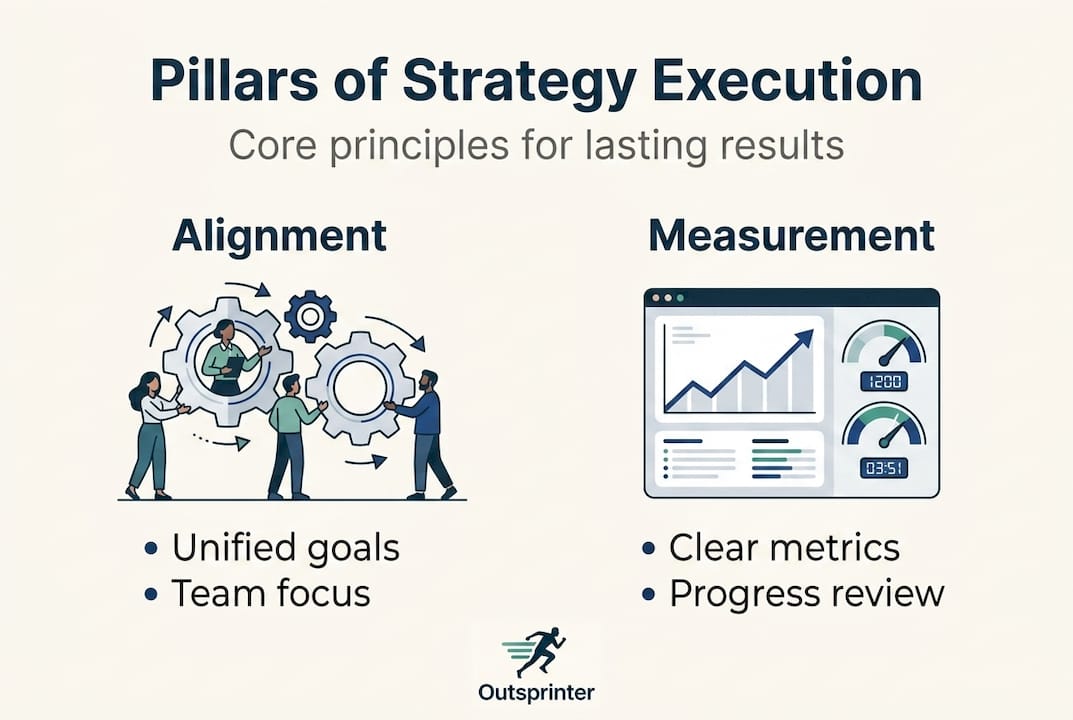
Strategy without measurement is just intention. The bridge between intention and result is a performance management system that connects every layer of the organization, from annual goals down to weekly milestones, with transparent accountability at each level. According to federal performance management research, effective execution measurement should be structured as part of a system that aligns work to goals and enables evidence-based decision-making and accountability.
The numbered sequence for embedding measurement into execution looks like this:
- Define strategic objectives in measurable terms: Transform aspirational strategy language into specific, quantifiable outcomes with a timeline attached.
- Cascade goals down organizational layers: Break annual strategic targets into quarterly milestones, then into monthly and weekly team-level actions.
- Assign KPIs to each initiative: Each strategic initiative should have at least one leading indicator and one lagging indicator, giving you early warning signals before results crystallize.
- Establish review cadences: Determine who reviews what data, at what frequency, and what decisions each review is meant to trigger.
- Build accountability into the system: Performance data should be visible to relevant stakeholders, not just the initiative owner, creating constructive social pressure and shared ownership.
Here's what an optimal performance management system for execution looks like in practice:
| Element | Purpose | Example |
|---|---|---|
| Strategic objectives | Define what success looks like | "Increase market share by 8% in 12 months" |
| Cascaded KPIs | Connect team work to strategy | Department-level revenue targets |
| Leading indicators | Provide early execution signals | Weekly pipeline conversion rates |
| Review cadences | Create accountability rhythms | Bi-weekly executive strategy reviews |
| Accountability owners | Assign clear responsibility | Named initiative lead per project |
Teams building out this measurement architecture benefit significantly from exploring scalable performance management approaches, which detail how to build systems that grow with organizational complexity. Understanding the essential performance management roles that support execution also ensures the right people are doing the right oversight work.
Execution discipline and organizational learning
The organizations that execute consistently well share a trait that often goes unnoticed: they've separated the work of reliability from the work of discovery. Bain's micro-battles approach frames this as standardizing execution discipline for repeatable processes while simultaneously deploying learning mechanisms, including experimentation and structured feedback, for developmental initiatives.
This dual-track approach prevents two common failure modes. The first is an organization so focused on innovation and experimentation that it never standardizes anything, producing chaos at scale. The second is an organization so locked into repeatable processes that it can't adapt when the environment shifts. Balancing both is what execution maturity actually looks like.
Key components of execution discipline and organizational learning include:
- Standardized routines for repeatable work: Operational processes, reporting formats, and review cadences that are consistent enough to become second nature, removing decision fatigue from well-understood tasks.
- Structured experimentation for strategic initiatives: New programs run as controlled tests, with defined hypotheses, clear timelines, and explicit learning objectives rather than open-ended pilots.
- Feedback loops that inform both tracks: Data from routine operations surfaces improvement opportunities, while lessons from experimentation inform which routines deserve updating.
- After-action reviews: Following significant execution milestones, structured retrospectives that ask what worked, what didn't, and what should change in the process next time.
- Knowledge transfer mechanisms: Lessons learned from one initiative systematically shared across teams so the organization doesn't re-learn the same hard lessons repeatedly.
Returning to proven performance management strategies reinforces that execution discipline is not about rigidity. It's about creating enough structure for teams to move fast inside a reliable framework, while preserving enough flexibility to experiment at the edges where strategic learning happens.
The uncomfortable truth: Why most strategy execution advice falls short
Here's what most strategy execution frameworks won't tell you directly: the biggest execution killer isn't a missing tool or an incomplete framework. It's the belief that once leadership agrees on a plan, execution will follow naturally. It won't. Not without relentless, often uncomfortable, executive coordination.
Most organizations get trapped in one of two failure patterns. The first is overplanning, producing beautiful strategy documents, initiative roadmaps, and KPI frameworks while never building the leadership habits that make those artifacts come alive. The second is tool overreliance, adopting performance management software expecting it to create alignment automatically without putting in the cultural work to change how leaders actually spend their time and attention.
Technology matters. Dashboards, KPI tracking, goal planners, and project management tools genuinely accelerate execution when used correctly. But they surface information. They don't generate resolve. The resolve to revisit priorities when the market shifts, to make hard calls about which initiatives to defund when resources tighten, and to hold each other accountable in leadership team meetings even when it's uncomfortable. Those behaviors are what separate organizations that execute consistently from those that have impressive strategy decks and disappointing results.
Reviewing leadership team best practices built for peak performance reveals a consistent pattern: the highest-performing leadership teams operate with almost obsessive clarity about their top three to five priorities, and they revisit those priorities frequently rather than assuming last quarter's decisions still apply. Execution excellence is not a one-time achievement. It's a standing practice, maintained through deliberate habits more than through planning artifacts.
Turn principles into action with Outsprinter
Understanding execution principles is the essential first step. Embedding them into how your organization actually operates day-to-day is where the real work begins.
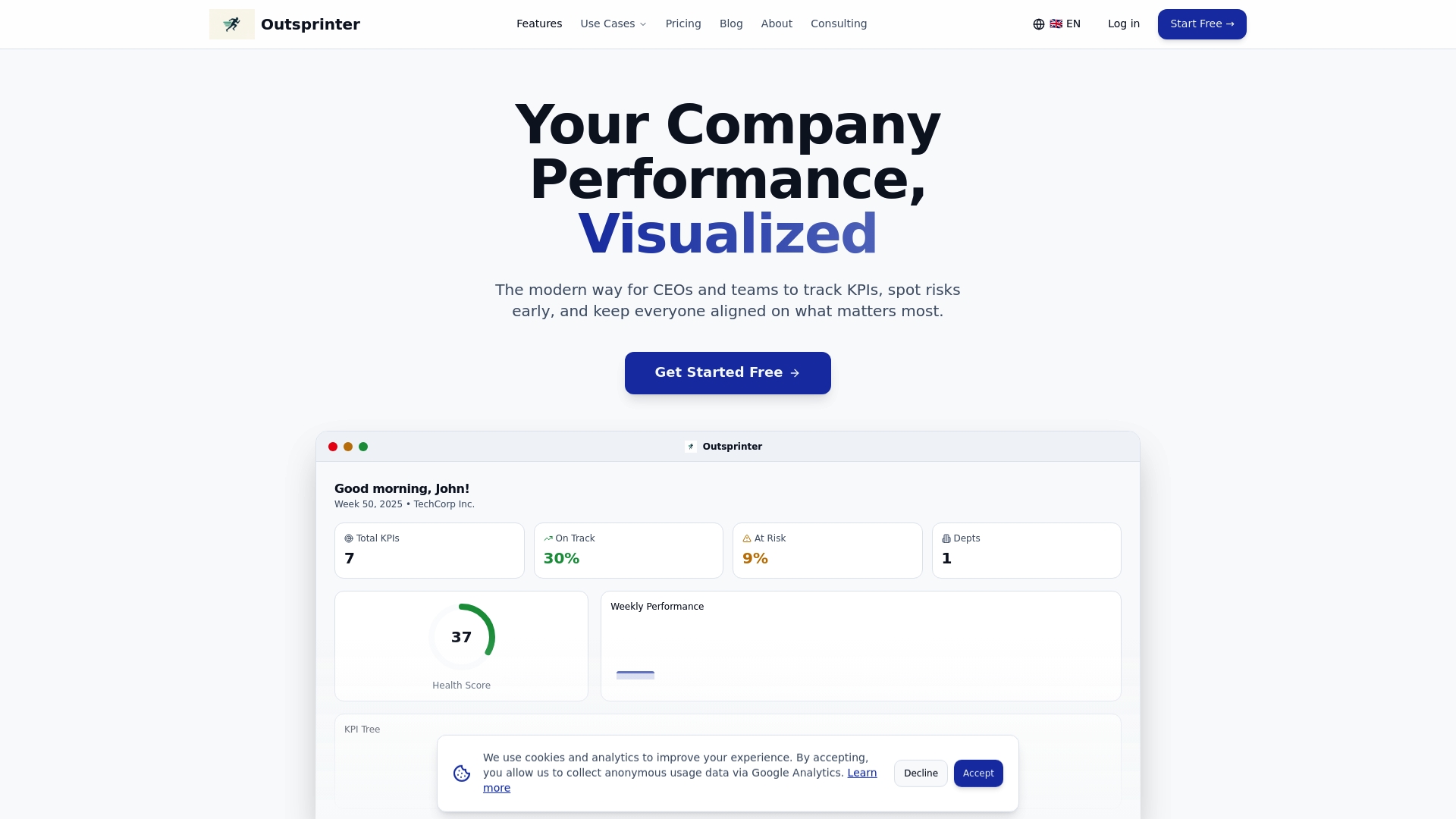
Outsprinter gives executive teams a unified platform to turn strategy into measurable action. With robust KPI management software, you can define, track, and visualize performance indicators across every department in real time, giving your leadership team the shared visibility required for true alignment. The project and task management platform lets you manage your initiative portfolio with health metrics, workload analysis, and progress tracking built in, so every strategic project has an owner, a timeline, and transparent accountability. When strategy, measurement, and leadership alignment live in one connected system, closing the execution gap becomes a manageable discipline rather than an ongoing crisis.
Frequently asked questions
What are the most common reasons strategy execution fails?
Strategy execution often fails because of poor communication, vague goals, weak leadership alignment, and misaligned resources, making it difficult for organizations to translate strategic intent into coordinated action.
How does executive team alignment impact strategy execution?
Executive team alignment ensures all leaders reinforce a unified strategy, reducing silos and driving consistent implementation. When leaders shadow each other as a deliberate practice, coordination becomes an execution advantage rather than an assumption.
What is the portfolio approach in strategy execution?
The portfolio approach manages strategic initiatives as distinct projects outside of routine operations, each with clear selection criteria, dedicated resources, and named accountability, creating a structured discipline for advancing strategic priorities.
How do performance management systems support strategy execution?
They align work to organizational goals, enable evidence-based decisions, and establish accountability frameworks. A well-structured performance management system connects every layer of the organization to strategic outcomes through visible, shared metrics.
What is the role of experimentation in execution?
Experimentation helps organizations learn and adapt by testing strategic initiatives in structured ways. Bain's micro-battles approach shows that pairing disciplined routines with deliberate learning mechanisms builds the execution capability that compounds over time.