
TL;DR:
- Leadership misalignment often manifests through missed deadlines, conflicting priorities, and repeated decision-making.
- Regular, structured alignment processes and clear decision rights are essential for sustained organizational coherence.
- Tracking KPIs, fostering disciplined debate, and maintaining visibility optimize accountability and prevent drift.
When leadership teams are misaligned, the damage rarely shows up all at once. It bleeds out slowly through missed deadlines, conflicting priorities, and decisions that get made, unmade, and made again. Research from Gallup reveals that accountability consistently ranks as the weakest leadership competency across organizations of every size, meaning the gap between what leaders believe they're executing and what their teams actually experience is wider than most executives realize. This guide will show you how to diagnose that gap, build the conditions for real alignment, execute a structured process, fix breakdowns when they happen, and measure whether your efforts are working.
Table of Contents
- Diagnosing misalignment in your leadership team
- Prerequisites: What must be true before you align
- Step-by-step: How to align your leadership team
- Troubleshooting: Fixing accountability gaps and alignment breakdowns
- Measuring results: Sustaining alignment and driving continuous improvement
- Why alignment is a moving target—and what most leaders get wrong
- Accelerate team alignment with tailored tools and support
- Frequently asked questions
Key Takeaways
| Point | Details |
|---|---|
| Spot misalignment early | Recognizing early signs like repeated debates and missed KPIs helps prevent deeper issues. |
| Prepare with clear outcomes | Alignment requires shared priorities, clear roles, and room for open debate. |
| Reset when priorities shift | Revisit and re-clarify decisions with the team whenever goals or circumstances change. |
| Build accountability layers | Use transparent KPIs, reviews, and ownership to keep teams accountable and aligned. |
| Measure and improve | Regularly review alignment using tangible data and adapt the process to sustain results. |
Diagnosing misalignment in your leadership team
Now that we recognize the critical role of alignment, the first step is to spot where and why leadership teams drift apart.
Most leaders assume that when everyone nods in the same meeting, everyone leaves with the same understanding. That assumption is one of the most expensive mistakes in organizational life. Surface agreement and genuine alignment are entirely different things. One means people stopped arguing. The other means people share the same mental model of what success looks like, who is responsible for what, and what trade-offs are acceptable.
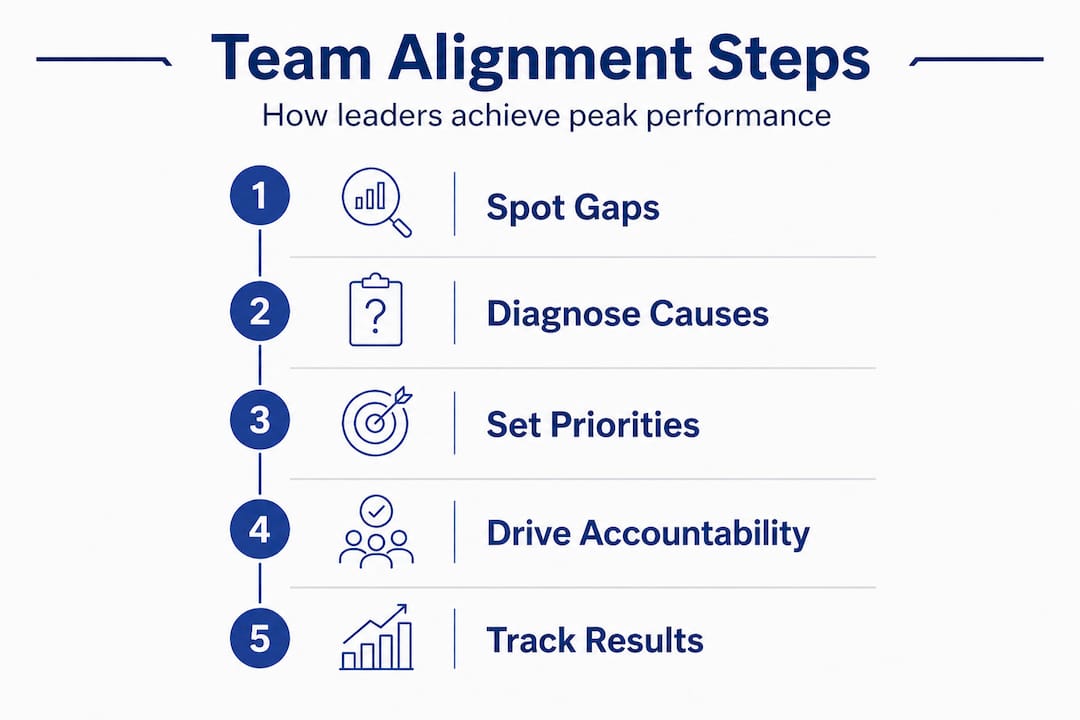
Common misalignment triggers include ambiguous goals, shifting organizational priorities, and a lack of clear decision ownership. When two leaders both believe they "own" a critical initiative, you don't get collaboration. You get turf wars, duplicated effort, and confused teams below them who receive contradictory instructions. These are the patterns that compound into real performance problems.
The warning signs appear in your data before they appear in your conversations. Watch for:
- KPIs trending off-track without a clear owner stepping in
- Repeated debates on decisions you thought were already made
- Slow approval cycles and bottlenecked projects
- Different departments reporting conflicting versions of the same status
- Teams openly confused about organizational priorities
Leadership best practices emphasize that these symptoms are lagging indicators. By the time they're visible, the misalignment has been building for weeks.
| Warning Sign | Likely Misalignment Cause | Urgency Level |
|---|---|---|
| Off-track KPIs with no response | Unclear ownership of outcomes | High |
| Repeated strategic debates | No agreed decision framework | High |
| Slow decisions and approvals | Ambiguous authority levels | Medium |
| Contradictory team updates | No shared source of truth | Medium |
| Low engagement on cross-team projects | Misaligned incentives | Medium |
Pro Tip: Run a quick "priority stack" exercise with your leadership team. Ask each executive to independently rank the top five organizational priorities. Then compare lists. Divergence in that ranking is a fast, concrete signal of where your alignment work needs to start.
Gallup's empirical benchmark data confirms that accountability is a persistent weak spot even for teams that rate themselves highly across other competencies. Combine that with the strategic alignment mistakes most leaders make, which include treating alignment as a one-time event rather than an ongoing discipline, and you have a recipe for repeated breakdown. For deeper context on B2B performance alignment, the patterns across high-growth organizations are remarkably consistent.
Prerequisites: What must be true before you align
Once misalignment is diagnosed, lay the groundwork so that new alignment efforts aren't sabotaged from the start.
You cannot align a team on tactics if they haven't agreed on outcomes. Before you run any alignment session, your leadership team must reach consensus on what the organization's critical priorities are and what is non-negotiable. These are sometimes called "must-win battles," and they serve as the anchor points around which everything else gets organized.
Essential tools for maintaining alignment aren't complicated, but they do need to be consistent:
- Shared dashboards that give every leader visibility into the same real-time data
- Playbooks that document decision-making authority and escalation paths
- Communication protocols that define how priorities are updated, who communicates them, and in what format
- Regular structured forums where leaders review alignment, not just project status
The culture component is equally critical. Many organizations confuse alignment with uniformity. They want everyone agreeing, which often means they suppress the disagreements that would have made decisions better.
"Alignment does not mean eliminating productive disagreement: leaders should clarify where the team must be aligned on shared outcomes and must-win battles while allowing disciplined debate and clear boundaries around non-negotiables." Harvard Business Review
That distinction matters enormously. A team where no one debates is not aligned. It is either disengaged or quietly resentful. Strong leadership alignment creates space for vigorous disagreement on how to get there while maintaining near-total unity on where the organization is going and why.
| Alignment Approach | Characteristic | Outcome |
|---|---|---|
| False consensus | No debate, surface agreement | Misalignment resurfaces under pressure |
| Disciplined debate | Open challenge, agreed boundaries | Durable decisions with buy-in |
| Forced uniformity | Top-down directives, no pushback | Compliance without commitment |
| Structured alignment | Clear outcomes, role clarity | Sustained team performance |
The performance method for teams that consistently outperform their peers combines clarity of outcomes with a culture that rewards honest challenge over comfortable agreement.

Step-by-step: How to align your leadership team
With the foundational pieces in place, leaders can initiate a structured alignment process using proven steps.
Alignment doesn't happen in a single offsite. It is a discipline built through repeated, structured practice. Here is a sequence that works in mid-sized organizations:
-
Define shared outcomes with measurable KPIs. Before anything else, establish what success looks like in concrete, numeric terms. Every leader should be able to state the same three to five organizational KPIs without looking at a reference document.
-
Map decision rights explicitly. Conduct a decision-rights workshop where every major category of decision is assigned a clear owner, a consulted party, and an informed party. Use a simple RACI format (Responsible, Accountable, Consulted, Informed) and make it visible to the whole leadership team.
-
Install real-time feedback loops. For any cross-functional initiative, establish a weekly check-in cadence where progress against KPIs is reviewed, blockers are surfaced, and ownership questions are resolved in real time rather than left to fester.
-
Build in priority reset protocols. When business conditions change, and they will, your team needs a formal mechanism for reassessing which priorities take precedence.
"When pressure rises and priorities change, leadership must reset how decisions are interpreted and made." Harvard Business Review
- Make accountability visible at every level. Gallup's research shows that creating accountability is the lowest-rated leadership competency for both leaders and managers. That means accountability cannot be assumed. It has to be built into your operating system through explicit KPI ownership, regular public reviews, and a culture where missed commitments are addressed directly rather than diplomatically ignored.
Pro Tip: After each major decision, document not just what was decided but why, what trade-offs were considered, and who owns follow-through. This removes ambiguity from implementation and gives you a clean reference point when priorities shift.
For practical guidance on building accountability without creating a surveillance culture, and on data transparency for teams, the evidence consistently points to shared visibility as the single most powerful lever.
Troubleshooting: Fixing accountability gaps and alignment breakdowns
Even well-constructed teams can lose alignment. Here's how to spot it quickly and bring everyone back on course.
Breakdowns are not a sign that your alignment strategy failed. They are a sign that your organization is under pressure and changing, which is normal. The question is how fast you can detect and correct drift.
The most actionable tactics for resetting accountability include:
- Weekly KPI reviews with public ownership statements. When every leader publicly confirms their number and what they're doing about any gaps, it removes the ambiguity that lets misalignment hide.
- Visible dashboards accessible to the full leadership team in real time. When everyone can see the same data simultaneously, political games around who controls information become much harder to play.
- Assigned KPI owners for every metric that matters. If a KPI doesn't have a named owner, no one will act when it starts to drift.
- Structured conflict resolution protocols for when leaders disagree on priorities mid-execution.
Gallup data shows that managers' ratings of their leaders trail leaders' self-ratings by at least 20 percentage points on six of seven core leadership competencies. That gap is a direct measure of alignment failure. Leaders think they're communicating clearly and setting accountable expectations. Their direct reports experience something very different.
When communication routines break down under shifting conditions, the instinct is often to add more meetings. That is rarely the answer. Instead, focus on the quality and structure of existing touchpoints. One well-designed weekly review with a shared dashboard is worth more than four status meetings with no single source of truth.
For teams experiencing chronic misalignment despite internal efforts, external facilitation of an executive reset session can be a legitimate and effective intervention. A skilled external facilitator can surface dynamics that internal politics make it difficult for anyone inside the room to name directly.
For a practical framework on weekly KPI tracking, the mechanics of turning data visibility into accountability are well-established and immediately deployable.
Measuring results: Sustaining alignment and driving continuous improvement
After fixing gaps and course correcting, it's essential to institutionalize what's working for ongoing impact.
Measuring alignment isn't just about tracking KPIs. It is about tracking whether your leadership team's behavior is producing the organizational outcomes you defined together. The metrics that matter most include:
- Project velocity: Is cross-functional work moving faster or slower than last quarter?
- Decision cycle time: How long does it take your leadership team to make and execute a decision?
- KPI ownership coverage: What percentage of your tracked KPIs have a named, accountable owner?
- Team engagement scores: Are the people below your leadership tier experiencing clarity and direction?
- Alignment pulse survey results: Are leaders themselves reporting clarity on priorities and decision rights?
Gallup's research shows that accountability metrics and feedback mechanisms are underutilized by most mid-sized organizations. Companies that formalize these reviews gain a significant advantage in their ability to catch drift early and correct it before it compounds.
| Alignment Metric | Review Frequency | Owner |
|---|---|---|
| KPI progress vs. targets | Weekly | Each functional leader |
| Project velocity and health | Biweekly | Project leads |
| Decision cycle time | Monthly | COO or Chief of Staff |
| Leadership pulse survey | Quarterly | CHRO or CEO |
| Strategic priority review | Quarterly or on major shifts | CEO and full leadership team |
Build systematic review checkpoints into your operating calendar so they can't be deprioritized when things get busy. The busiest periods are exactly when you most need alignment reviews, not least.
Key questions to include in leadership retrospectives and pulse surveys:
- Do you clearly understand the top three organizational priorities this quarter?
- Do you know who owns each critical decision in your area?
- When priorities change, do you receive clear and timely communication from leadership?
- Do you have the data visibility you need to make good decisions in your role?
KPI success strategies for executives consistently show that leaders who invest in these measurement disciplines outperform peers who rely on intuition and informal communication. Combined with productivity tips for leaders, the compounding effect of structured alignment measurement is significant over a 12-month horizon.
Why alignment is a moving target—and what most leaders get wrong
Here is a perspective few leadership books will give you, based on what really derails teams after goals are set.
The conventional advice on leadership alignment focuses almost entirely on how to get aligned. Set shared goals, clarify roles, improve communication. That's all valid. But the harder, less-discussed truth is that alignment decays under pressure, and most organizations have no protocol for managing that decay.
The biggest threat to alignment isn't initial disagreement. It is the moment six months into a fiscal year when priorities shift, resources get reallocated, and everyone quietly re-interprets the original agreement through the lens of their own department's interests. Nobody announces that alignment has broken. It just stops existing.
The second failure mode is what we call "false agreement." This is when the room goes quiet not because everyone genuinely agrees, but because no one wants to be seen as the obstacle. Leaders are often rewarded for appearing collaborative, which can subtly punish the kind of productive challenge that generates better decisions. Organizations that don't build explicit structures for disagreement end up making lower-quality decisions with higher buy-in, and that combination is particularly dangerous.
The practical antidote is to schedule formal team alignment process resets at predictable moments: when a major project launches, when market conditions shift materially, when a key leader joins or leaves, and at least once per quarter regardless of conditions. Harvard Business Review confirms that leadership must reset how decisions are made and interpreted whenever priorities change. Alignment is not a destination you reach. It is a discipline you practice on a regular schedule, especially when it feels least necessary.
Accelerate team alignment with tailored tools and support
If you want alignment to become a habit rather than just an initiative, the right tools make an enormous difference.
Modern performance management platforms turn alignment from a conversation into a measurable, trackable discipline. With real-time KPI dashboards, your leadership team sees the same live data simultaneously, which removes the information asymmetry that lets misalignment hide.
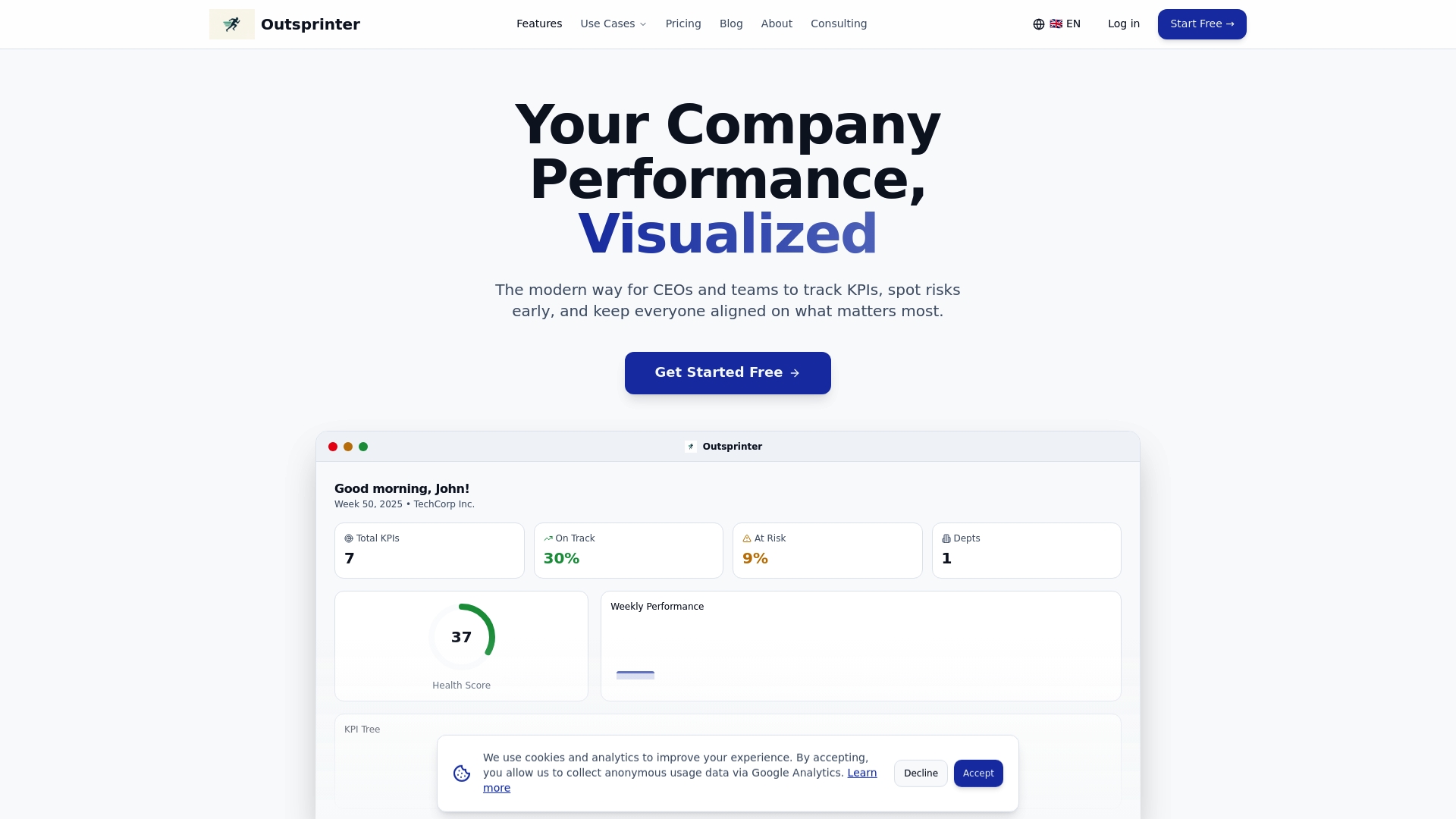
Outsprinter's task management platform keeps alignment actionable by connecting strategic priorities directly to assigned work, deadlines, and ownership. When every task ties back to a KPI and every KPI has a named owner, accountability stops being a cultural aspiration and becomes a built-in operating reality. Real-time notifications, goal planners, and AI-assisted performance analysis give leadership teams the visibility and speed they need to catch drift early, reset quickly, and sustain performance across every business cycle.
Frequently asked questions
What is the biggest barrier to leadership team alignment?
Low accountability is the most common barrier, since creating accountability ranks as the lowest-rated leadership competency according to Gallup, meaning most leaders overestimate how accountable their teams experience them to be.
How often should leadership teams realign on goals and priorities?
Teams should formally realign at least quarterly and immediately whenever major priorities shift, because leadership must reset decisions and interpretations as conditions change.
Does alignment mean eliminating disagreement?
No. Alignment does not mean eliminating productive disagreement; it means agreeing on key outcomes and decision boundaries while allowing disciplined debate on how to get there.
What are effective tools for measuring leadership alignment?
Weekly KPI tracking, leadership pulse surveys, and transparent shared dashboards are the most effective tools, since accountability metrics are underutilized by most mid-sized organizations despite their direct impact on performance.