
TL;DR:
- Genuine team alignment depends on trust, open communication, and consistent leadership behavior.
- Shared metrics and dashboards increase visibility, accountability, and proactive collaboration across teams.
- Ongoing habits, regular reviews, and leadership discipline sustain alignment beyond technology tools.
Most teams have the tools. They have the dashboards, the project trackers, the goal-setting frameworks. Yet somehow, people are still pulling in different directions, duplicating work, or chasing targets that no longer match the company's real priorities. High leadership alignment is empirically linked to much higher employee engagement, which means misalignment isn't just frustrating; it's costing your organization real performance. This article walks you through the specific, research-backed strategies that help leaders move from surface-level coordination to genuine, lasting team alignment.
Table of Contents
- Understand the core alignment challenge: More than just tools
- 1. Set clear, connected goals top-down and bottom-up
- 2. Foster a climate of trust, dialogue, and safe feedback
- 3. Use shared performance metrics and visible dashboards
- 4. Make alignment an ongoing process, not a one-time event
- Our perspective: Why alignment is a leadership habit, not a system feature
- See how Outsprinter helps you build real alignment
- Frequently asked questions
Key Takeaways
| Point | Details |
|---|---|
| Alignment is more than tools | Trust, leadership, and communication are as important as dashboards or metrics. |
| Goals must connect top to bottom | Transparent, cascading goals ensure everyone moves in the same direction. |
| Dashboards need supportive climate | Teams only use data tools when they feel safe and leaders reinforce learning. |
| Sustain alignment with routines | Frequent feedback and visible metrics help teams stay aligned over time. |
Understand the core alignment challenge: More than just tools
To solve alignment, we must first unpack why shiny new platforms alone don't fix the underlying problem.
Most leaders assume misalignment is a visibility problem. Give everyone access to the same dashboard, share the same numbers, and coordination will follow. That thinking is understandable, but it misses something deeper. The team alignment process is fundamentally a human process, not a technical one. Dashboards are only as useful as the conversations and trust built around them.
True alignment means every person understands not just what they are supposed to do, but why it matters, how it connects to the bigger picture, and what happens when priorities shift. That kind of clarity doesn't come from a software license. It comes from consistent leadership behavior, open communication, and a shared understanding of purpose.
"Dashboard tool adoption is not only a technical or UX issue; social mechanisms like safe climate, trust, and visible leadership behavior strongly influence adoption." Tool adoption depends on trust
The high-performance team science is clear on this point: teams that perform at the highest levels share norms around accountability, not just access to data. When tools are deployed without those norms, they become shelfware; technically installed, barely used, and quietly resented.
Here's what poor alignment actually looks like in practice:
- Team members interpret the same goal differently and build separate roadmaps
- Departments optimize for their own metrics at the expense of shared outcomes
- Important risks and blockers get hidden because surfacing them feels politically risky
- Check-ins turn into status theater rather than real problem-solving conversations
- New tools get adopted in name only, with real work still happening in email threads and side chats
Recognizing these patterns is the first step. Once you see them clearly, you can start addressing the root causes rather than applying another layer of technology on top.
1. Set clear, connected goals top-down and bottom-up
With the challenge clear, let's review concrete ways leaders can align goals across all levels.
Most organizations are reasonably good at cascading goals downward. The executive team sets annual objectives, managers translate those into team targets, and individuals receive their assignments. The problem is that the loop rarely closes back upward. Individual contributors rarely have a formal way to surface whether the goals they've been given actually make sense given what they see day-to-day.
Research from BCG confirms that vertical and horizontal alignment together reinforce accountability and produce genuinely shared outcomes. Vertical alignment means leaders at every level speak consistently about priorities. Horizontal alignment means teams working in parallel understand how their work connects to and depends on each other. Most organizations only build one of the two.
A practical framework for bidirectional goal alignment:
- Start with organizational objectives. Document the top three to five company priorities for the quarter and make sure every manager can explain them in plain language, not just executive jargon.
- Translate, don't just copy. Each team should have goals that clearly trace back to organizational objectives, but those goals need to be specific to the team's actual work and constraints.
- Hold translation workshops. Bring teams together to map their goals onto the company roadmap. Ask team members to explain the connection themselves. Gaps in understanding will surface quickly.
- Create feedback channels that flow upward. A monthly "priorities check" where team members can flag mismatches between their assigned goals and actual conditions is one of the most underused alignment tools available.
- Review goal relevance at every major milestone. Markets shift, strategies pivot, and a goal set in January may be irrelevant by March. Build formal review points into your calendar rather than waiting for the quarterly review cycle.
Pro Tip: Use your performance tracking guide to document goal changes formally. When everyone can see the history of how a goal evolved, there is far less confusion about why current priorities look different from what was agreed upon three months ago.
2. Foster a climate of trust, dialogue, and safe feedback
Goal setting is stronger when teams also feel safe to surface risks or issues. Here's how to build that environment.
You can have beautifully structured goals and a real-time dashboard, and still find that your team is not bringing you real information. Why? Because sharing bad news carries social risk in most organizations. If the messenger historically gets shot, people learn to filter what they communicate upward. That filtering is where alignment dies.

Social climate and leadership behavior directly influence whether teams use performance dashboards for genuine learning and course correction, or whether they use them only to present favorable information during reviews. The difference between those two behaviors is entirely determined by how leaders respond to bad news.
Strategies for building a psychologically safe alignment culture:
- Model vulnerability first. As a leader, openly discuss a goal that missed its target and walk through what you learned from it. This signals that bad news is information, not failure.
- Separate problem identification from blame. When a KPI misses, the first question should be "what's causing this?" not "whose fault is this?" That single reframing changes the entire quality of your alignment conversations.
- Reward early warnings. Publicly acknowledge team members who surface a risk before it becomes a crisis. That kind of visible recognition changes the incentive structure over time.
- Use structured safe-space formats. Retrospectives, anonymous pulse surveys, and facilitated "pre-mortem" exercises (where teams imagine a project has failed and work backward to identify risks) are all proven tools for surfacing misalignment safely.
- Act on what you hear. Nothing kills psychological safety faster than leaders soliciting feedback and then doing nothing with it. Even a brief response that says "we heard this and here's why we are or aren't acting on it" matters enormously.
Pro Tip: Review the full alignment guide for leaders to see how enterprise team ownership frameworks structure accountability without creating a blame culture. The combination of clear ownership and psychological safety is what separates high-trust teams from high-anxiety ones.
3. Use shared performance metrics and visible dashboards
Now, let's see how metrics and dashboards play an active role in day-to-day alignment.
Shared metrics do something that individual goal tracking cannot: they make interdependence visible. When your sales team's pipeline health is displayed alongside your delivery team's capacity metrics in the same dashboard, both teams can see in real time how their work affects each other. That visibility changes conversations from "that's not my problem" to "what do we need to adjust together?"
According to research, 75% of employees in organizations with high leadership alignment report being highly engaged, compared to dramatically lower rates in misaligned organizations. The visibility that shared dashboards provide is a direct driver of that alignment quality.
How shared metrics compare to siloed tracking:
| Factor | Siloed tracking | Shared dashboards |
|---|---|---|
| Goal visibility | Limited to own team | Visible across all teams |
| Dependency awareness | Reactive, discovered late | Proactive, visible in real time |
| Accountability | Individually felt | Collectively reinforced |
| Course correction | Delayed by reporting cycles | Triggered by live data changes |
| Meeting quality | Status updates | Problem-solving discussions |
The difference in meeting quality alone justifies the shift. When a team arrives at a weekly check-in already knowing the numbers because they live in a shared performance visualization environment, the conversation can skip the update phase entirely and go straight to the decisions that actually matter.
A few important cautions about metric adoption:
- Too many KPIs create noise. Limit shared dashboards to the five to seven metrics that genuinely drive decisions. More than that, and teams stop paying attention.
- Data without discussion is decoration. Dashboards need to be reviewed in meetings with dedicated time for interpreting trends, not just viewing numbers.
- Leadership must use the same tools. If executives are working off a separate data source or private spreadsheet, the message to the team is clear: the shared dashboard is for appearances, not for real decision-making.
Pairing a solid project management tool with clear team management tips creates the operational backbone that turns dashboards from passive reporting instruments into active alignment engines.
4. Make alignment an ongoing process, not a one-time event
But alignment can drift. Here's how leaders make it stick week after week.
Alignment is not something you achieve and then move on from. It is more like fitness: you build it with consistent practice, and it degrades quickly without maintenance. Many organizations do a strong alignment exercise at the start of the year, then wonder six months later why teams are acting on outdated assumptions and conflicting priorities.
BCG research reinforces that sustained alignment depends on regular feedback, structured review, and a culture where sharing challenges openly is expected and rewarded. One-time alignment workshops don't create that culture. Repeated behaviors and routines do.
A practical alignment cadence:
| Frequency | Activity | Purpose |
|---|---|---|
| Weekly | Team stand-up with KPI review | Spot early drift and blockers |
| Bi-weekly | Cross-team sync | Surface horizontal misalignment |
| Monthly | Goal relevance check | Confirm priorities still make sense |
| Quarterly | Full alignment review | Cascade updated objectives |
| Ad hoc | Milestone retrospective | Learn and recalibrate at key transitions |
Behaviors that sustain alignment over time:
- Treat every check-in as an alignment check. Ask two questions at the end of every team meeting: "Are we still working toward the right goal?" and "Is anything blocking us that leadership needs to know about?" These are small habits with a large cumulative effect.
- Document decisions and their rationale. When goals shift, record why. When priorities are deprioritized, document that too. Teams that can trace the history of their decisions experience far less confusion and far less cynicism about whether leadership knows what it wants.
- Use dashboards as living conversation starters. A track team performance approach that treats data as a prompt for dialogue rather than a report card changes how teams relate to their metrics entirely.
- Build alignment reviews into project workflows. Every major project phase transition is a natural moment to ask whether the team's understanding of the goal is still accurate, and whether the goal itself still serves the broader strategy.
Following a team building checklist for each new project phase can help standardize these alignment touchpoints without making them feel bureaucratic. Consistency in small practices is what keeps larger alignment intact over time.
Our perspective: Why alignment is a leadership habit, not a system feature
Here's the uncomfortable truth that most performance tool vendors won't tell you: buying better software doesn't create alignment. It reveals the alignment you already have, or don't have.
We've seen organizations with basic spreadsheet setups where every team member could articulate the company's top priority without hesitation, and those same companies outperform technically sophisticated competitors who can't get their departments to agree on what success looks like this quarter. The technology is a multiplier. If the underlying alignment is weak, better tools just make the confusion more visible.
The leaders who build genuinely aligned teams treat alignment as a personal discipline. They repeat key messages relentlessly, which feels redundant to them but is often the third or fourth time a team member has actually processed the information. They ask questions more than they give answers, because good questions surface misalignment before it compounds. They openly discuss their own uncertainty, which gives teams permission to do the same.
The biggest mistake we see is leaders who confuse goal-setting with alignment. They set the goals clearly in January, cascade them properly, and then shift their attention to execution. Alignment work is just beginning at that point. The real work is the weekly habit of asking "are we still all pointing in the same direction?" and having the discipline to course correct when the answer is no.
Alignment isn't something your platform solves. It's something your leadership practice builds, and your platform supports.
See how Outsprinter helps you build real alignment
Building team alignment takes the right habits and the right infrastructure to support those habits.
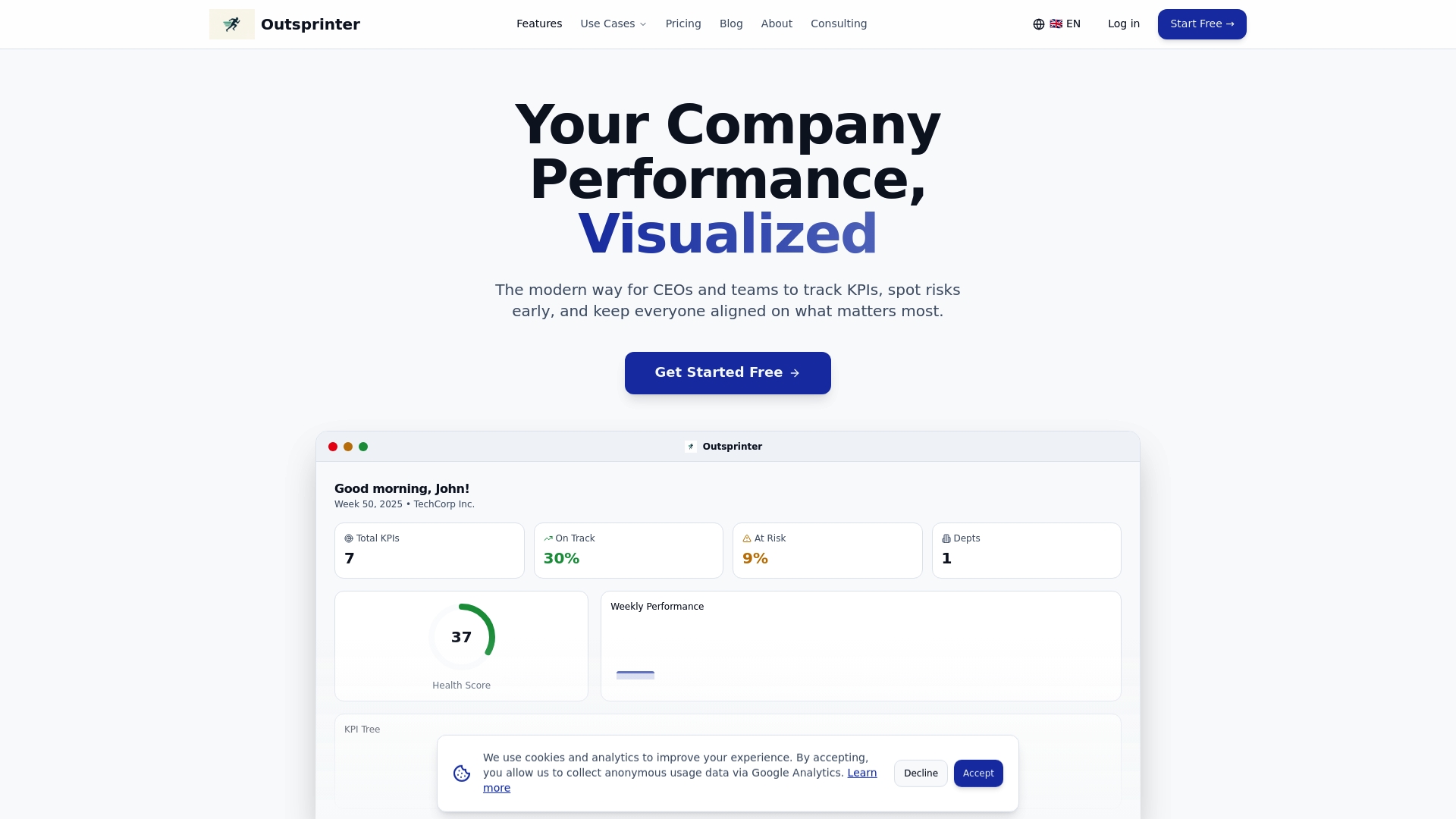
Outsprinter gives team leaders a single environment where goals, KPIs, tasks, and progress are all visible in real time. The Goal Planner lets you set yearly targets and break them into weekly milestones so the connection between daily work and strategic objectives is never ambiguous. The real-time Dashboard updates instantly as teams enter data, so your alignment check-ins start with shared facts, not competing versions of the truth. The built-in AI Assistant helps you analyze performance trends and surface insights before small misalignments become costly mistakes. When alignment is visible, it becomes manageable.
Frequently asked questions
How can leaders measure if their team is truly aligned?
Leaders can measure alignment through consistent communication patterns, shared goal progress, and pulse survey scores on clarity and buy-in. High leadership alignment correlates directly with higher reported engagement and role clarity among team members.
What is the main reason teams struggle with dashboard adoption?
Beyond technology issues, lack of trust and visible leadership support are the primary reasons teams resist using shared dashboards meaningfully. Research confirms that tool adoption depends on a supportive climate and consistent leadership behavior, not just ease of use.
Can setting shared goals really improve engagement and retention?
Yes, transparent goals connected to broader organizational objectives significantly improve both engagement and retention. In organizations with high alignment, 75% of employees report being highly engaged, which directly reduces turnover risk.
What practical steps foster a trusting team climate?
Encourage open discussion of challenges, model vulnerability by sharing your own setbacks, and use regular feedback loops to address issues before they grow. Social climate and leadership behavior are the primary predictors of whether teams use performance data for genuine learning.
How often should team alignment be revisited?
Teams should revisit alignment at least monthly, with quick checks at each major milestone or whenever strategy shifts. More frequent small check-ins are far more effective than infrequent large alignment events.