
TL;DR:
- Modern project success focuses on stakeholder value and long-term outcomes, not just time and budget.
- Selecting and tailoring the right methodology depends on project stability and feedback needs.
- Continuous review and adaptation are essential for delivering lasting value beyond initial plans.
Finishing a project on time and under budget used to be the gold standard. But PMI research reframes success away from traditional metrics and toward stakeholder value and lasting outcomes. For project managers and team leaders in mid-sized companies, that shift changes everything. The practices that once felt like enough are now just the starting point. This article walks you through the best practices that actually move the needle, from defining what success really means, to choosing the right methodology, to tracking execution in ways that prevent failure before it happens.
Table of Contents
- Define clear project success criteria
- Select and tailor your project management methodology
- Focus on stakeholder value and outcomes
- Strengthen execution with effective task and performance management
- The overlooked secret: Success means revisiting and adapting what works
- Maximize your project management impact with Outsprinter
- Frequently asked questions
Key Takeaways
| Point | Details |
|---|---|
| Quality drives success | Projects only succeed long-term when quality standards are met in addition to basic milestones. |
| No one-size methodology | Choose Agile, Waterfall, or hybrid project management based on your team and project context. |
| Value over output | Defining and pursuing stakeholder value produces greater project impact than budget or time focus alone. |
| Performance habits matter | Ongoing task management and review routines are crucial for keeping execution on track. |
Define clear project success criteria
Most projects that "fail" were actually completed. Deadlines were met, budgets were respected, and reports were filed. The real problem is that they failed to deliver anything meaningful once the dust settled. That gap exists because teams defined success too narrowly at the start.
Relying only on schedule and budget as success metrics is a trap. Both are lagging indicators. By the time you know you missed them, it is too late to course correct on what matters most: output quality, stakeholder satisfaction, and measurable business value. Research confirms this. Empirical findings on long-term outcomes show that meeting short-term milestone thresholds is necessary but not sufficient. Quality output is what drives lasting results.
Effective success criteria go beyond the project charter's schedule and cost columns. Build your criteria around:
- Output quality: Does the deliverable meet the standard required for real-world use?
- Stakeholder satisfaction: Are the people affected by this project genuinely better off?
- Measurable value: Can you point to a metric, revenue, efficiency, or risk reduction, that improved?
- Process adherence: Did the team follow the agreed workflows that prevent rework?
- Knowledge transfer: Is the team or client equipped to sustain the outcome after handoff?
"Meeting short-term thresholds is necessary but not sufficient for long-term success. Quality output is the factor that separates projects that stick from those that quietly unravel after launch."
Good task management results depend on everyone knowing what "done" actually means. And the same applies at the project level. Strong performance metrics are not invented by the project manager alone. They are negotiated with the team and stakeholders before the first task is assigned.
Pro Tip: Run a 30-minute "definition of done" session at kickoff where every key stakeholder, including delivery team members, agrees on what success looks like across all five dimensions above. Write it down. Review it at every milestone.
Select and tailor your project management methodology
Once you know what success looks like, the next decision is how you will work toward it. This is where methodology comes in, and where a lot of teams make a costly mistake: they pick one approach and apply it rigidly, regardless of what the project actually needs.
Methodology selection is context-dependent and depends primarily on two factors: how stable your requirements are and how much you need iterative stakeholder feedback. Neither Agile nor Waterfall is universally better. They are tools for different situations.
When to use Agile: Choose Agile when requirements are likely to change, when customer or user feedback must influence the product as it develops, and when speed to value matters more than exhaustive upfront planning. Software products, marketing campaigns, and UX design projects often fit here. Review Agile sprint best practices to get the structure right.
When to use Waterfall: Choose Waterfall when requirements are well-defined and unlikely to change, when compliance documentation is mandatory, or when dependencies between phases are strict. Infrastructure rollouts, construction projects, and regulated product launches often need this structure.
When to go hybrid: Complex environments, like launching a new product line in a regulated industry, often need both. The sprint execution rhythm that Agile offers can coexist with the phase-gate governance that Waterfall provides.
| Methodology | Best for | Pros | Cons |
|---|---|---|---|
| Agile | Evolving requirements, high feedback need | Flexibility, faster iterations, early value | Less predictability, harder to scope |
| Waterfall | Fixed scope, compliance-heavy, clear phases | Clear milestones, easy to document | Rigid, late feedback, slow to change |
| Hybrid | Complex, regulated, or cross-functional work | Balances structure and adaptability | Requires discipline to manage both modes |
Common matching scenarios:
- Stable scope + regulatory requirements = Waterfall
- Rapidly changing user needs + small team = Agile
- Enterprise transformation + multiple departments = Hybrid
- Short campaign with defined output = Agile sprint
Pro Tip: If your project sits in a regulated but dynamic environment, use Waterfall-style phase gates for approvals and compliance checkpoints, then run Agile sprints within each phase to stay responsive to feedback without losing governance.
Focus on stakeholder value and outcomes
You have defined success and chosen a methodology. Now comes the part that most project plans skip: explicitly mapping what value you are delivering and for whom.

PMI's M.O.R.E. framework offers a research-backed structure for this. Applying all four M.O.R.E. elements pushes the Net Project Success Score from 27 to 94. Only 7% of professionals currently use all four, which means your team can gain a significant advantage just by being intentional here.
The four M.O.R.E. elements are:
- M (Mindset): Teams adopt a value-creation mindset, not just a task-completion one
- O (Outcomes): Projects are scoped around outcomes for stakeholders, not just deliverables
- R (Relationships): Active stakeholder engagement is built into the project rhythm, not bolted on at review time
- E (Environment): The organizational context, culture, tools, and support structures, is set up to enable success
| M.O.R.E. elements applied | Net Project Success Score |
|---|---|
| 0 elements | 27 |
| 1 element | 44 |
| 2 elements | 61 |
| 3 elements | 78 |
| 4 elements | 94 |
The jump from zero to four is not incremental. It is transformational. Start at project launch by mapping each stakeholder group, what outcome they expect, and how you will measure whether that outcome was delivered. Then revisit that map at every major milestone.
Using a structured team management checklist can help you build stakeholder outcome reviews into your rhythm without adding overhead. The goal is to make value visible throughout execution, not just at the final retrospective.
Strengthen execution with effective task and performance management
Planning for value is only useful if your execution engine can deliver it. This is where many mid-sized teams lose ground. The strategy is sound, but tasks slip, ownership blurs, and performance drifts without anyone noticing until it is too late.
42% of tasks fail due to poor tracking, which means nearly half of the work your team does is at risk if you do not have a solid execution system.
Follow these steps to build one:
- Assign every task to a single owner. Shared ownership means no ownership.
- Set explicit priorities and deadlines. "High priority" without a date is not a priority.
- Break work into subtasks. Large tasks are where progress disappears. Smaller units create accountability.
- Build recurring review checkpoints. Weekly or sprint-end reviews keep the team honest.
- Track completion rates and blockers. What gets measured gets managed.
The most common pitfalls that derail execution:
- Unclear task ownership leading to duplicated or dropped work
- Missing priority levels causing teams to work on the wrong things first
- No follow-up process, so tasks age silently without resolution
- Retrospectives that identify problems but do not update the plan
Digital tools make this manageable at scale. Task management software that supports priorities, subtasks, deadlines, and recurring rules removes the cognitive load of tracking manually. If you want to understand why the right tool matters, the case for task tool benefits is well established. A structured project tracking process connects task-level data to project-level health metrics, so you always know where things stand.
Pro Tip: Schedule a 15-minute team check-in every Monday to surface blockers before they become delays. Pair this with a Friday task review to close the week with clarity on what carried over and why.
The overlooked secret: Success means revisiting and adapting what works
Here is the uncomfortable truth that most project management guides skip: best practices are not a checklist you complete at kickoff and forget. They are a cycle you run throughout the entire project lifecycle.
We have seen it repeatedly. A team defines strong success criteria, picks the right methodology, maps stakeholder outcomes, and then runs the project on autopilot. Milestones get checked off. The dashboard looks green. And then the final delivery lands flat because the environment shifted and no one updated the plan to match.
Poor output quality undermines long-term success even when every milestone metric is technically met. That is the trap. Metrics tell you whether you executed your original plan. They do not tell you whether your original plan still reflects what stakeholders actually need.
The fix is simple but rare: build formal checkpoints into your project, not just for status but for relevance. Ask whether the success criteria you set at kickoff still apply. Ask whether the methodology you chose is still the right one. If the answers have changed, adapt. A task management guide for team leaders can help you build this adaptive review into your team's regular habits without turning it into a bureaucratic process.
The teams that consistently deliver lasting value are not the ones with the most rigorous initial plans. They are the ones who treat their best practices as living tools, reviewed, refined, and recommitted to at every phase gate.
Maximize your project management impact with Outsprinter
Putting these best practices into action requires more than intention. It requires tools that keep your team aligned, your tasks visible, and your outcomes measurable in real time.
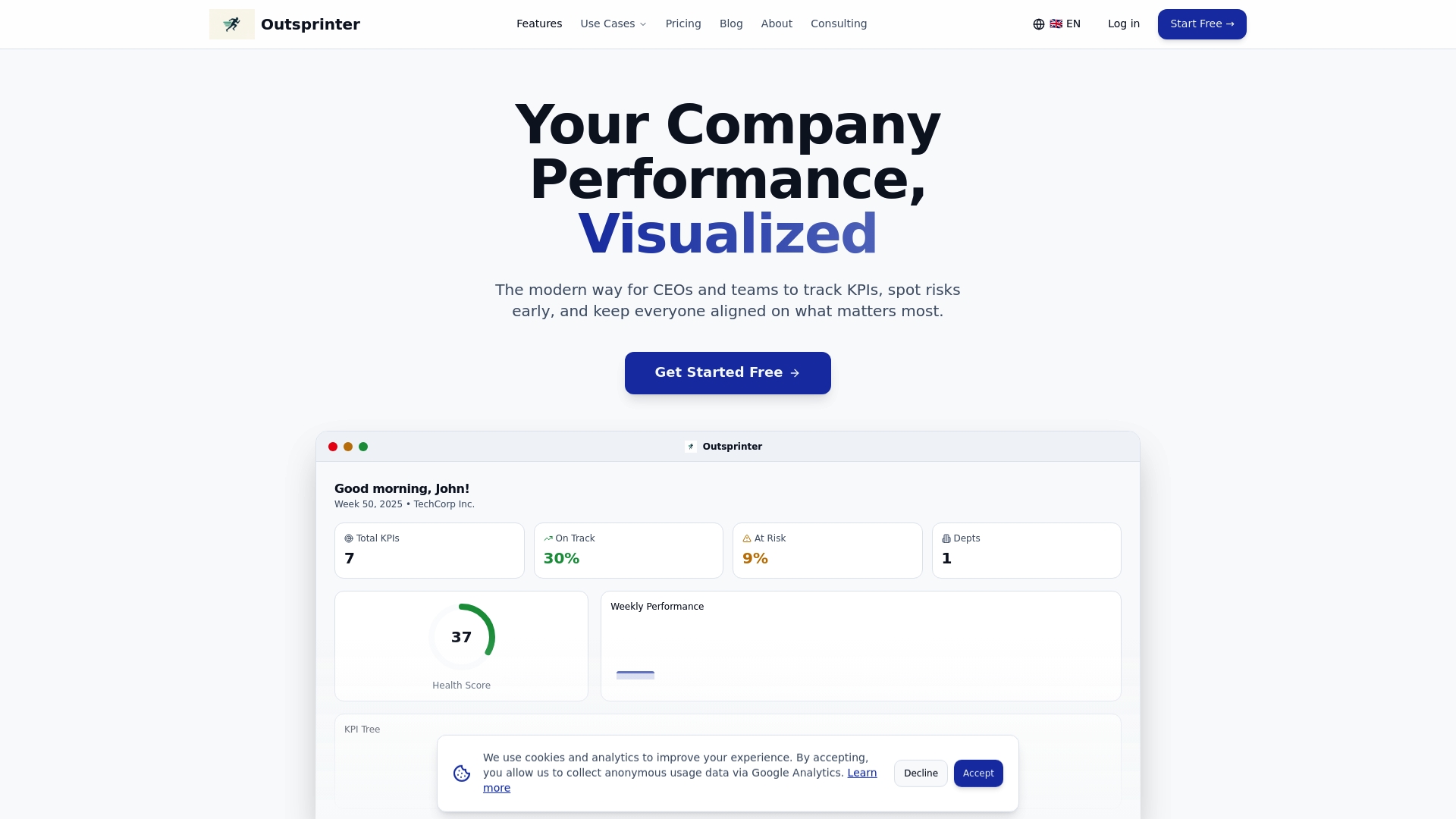
Outsprinter gives mid-sized teams a single platform to manage the full project lifecycle. From KPI and task management tools that track health metrics and workload across your projects, to advanced task management with priorities, subtasks, and recurring rules built in, every feature maps directly to the practices covered in this article. You can also explore project management use cases tailored to teams like yours. When your tools match your method, execution gets sharper and stakeholder outcomes stop being a guessing game.
Frequently asked questions
What are the key elements of project management best practices?
The key elements include setting clear success criteria, choosing the right methodology for the project context, focusing on stakeholder value, and consistently tracking execution quality throughout delivery.
How do I choose between Agile, Waterfall, or a hybrid for my project?
Match Agile to projects with changing requirements and Waterfall to fixed-scope work. Hybrid approaches fit best when you need both governance structure and the flexibility to respond to feedback during execution.
Why is stakeholder value emphasized in modern project management?
Because value-oriented project success produces dramatically better outcomes. Organizations that align projects to stakeholder outcomes consistently outperform those that measure only time and budget.
How can performance tracking support successful project execution?
Regular tracking surfaces blockers early and keeps teams accountable. Since 42% of tasks fail due to poor tracking, structured reviews and digital tools significantly improve the odds of on-target delivery.