
TL;DR:
- Only 50% of projects deliver value exceeding efforts invested.
- Effective project execution involves coordinating teams, managing risks, and ensuring quality in real time.
- Common pitfalls include scope creep, communication gaps, and unclear accountability, which can be mitigated with proper tools and frameworks.
Only 50% of projects succeed in delivering value that exceeds the effort and expense invested. That number should stop every project manager in their tracks. Not because planning is easy, but because execution is where most teams quietly fall apart. You can have a flawless project charter, a detailed Gantt chart, and a fully aligned stakeholder group, and still watch the whole thing unravel the moment work actually starts. This guide breaks down what project execution really means, how it works, which methodologies fit which situations, what derails teams most often, and what genuinely separates the projects that deliver from the ones that disappear into the archive.
Table of Contents
- What is project execution? Definitions, scope, and why it matters
- Core mechanics of project execution: Activities, deliverables, and management
- Project execution methodologies: Waterfall, Agile, Hybrid, and more
- Common pitfalls, edge cases, and best practices for flawless execution
- Why most teams struggle with execution — and what actually works
- Ready to level up your project execution?
- Frequently asked questions
Key Takeaways
| Point | Details |
|---|---|
| Execution brings plans to life | Project execution is where teams turn strategies into concrete results through coordinated action. |
| Six mechanics drive success | Managing tasks, resources, communication, quality, risk, and procurement is essential for robust execution. |
| Choose the right methodology | Matching execution methods (like Agile, Waterfall, or Hybrid) to your context increases the chances of success. |
| Pitfalls can be avoided | With frameworks like M.O.R.E. and best practices, most execution-phase risks are manageable. |
| People beat process | Team cohesion and psychological safety matter more than tools or methodology for delivering projects successfully. |
What is project execution? Definitions, scope, and why it matters
Project execution is the phase in the project life cycle where the project plan is put into action. It is the longest and most labor-intensive phase, and the one where actual deliverables get produced. If planning is the blueprint, execution is the construction site.
But execution is far more than just "doing the work." It involves coordinating people, managing project task management systems, keeping stakeholders informed, monitoring quality, and responding to risks as they surface. It requires constant judgment calls. The plan gives you direction; execution demands you navigate the gap between that direction and reality.
Here is what project execution actually covers:
- Team management: Directing people, resolving conflicts, and keeping morale aligned with deadlines
- Resource allocation: Making sure the right people, tools, and budget are available when needed
- Stakeholder engagement: Regular updates, expectation management, and feedback loops
- Quality control: Verifying that outputs meet the defined standards before they move forward
- Risk response: Acting on identified risks and managing surprises that were not anticipated
What makes execution distinct from the other phases is the stakes. Planning is reversible. Controlling and monitoring runs alongside execution and helps course-correct. But execution is where time, money, and team energy are being spent in real time. Mistakes here cost more than mistakes on paper.
"Execution is not the phase after planning. It is the phase where planning gets tested against reality every single day."
When you look at software project execution specifically, the challenges compound. Requirements shift. Technical debt builds. Teams are often distributed. The definition of "done" gets blurry. Understanding execution as a discipline, not just a phase, is what gives project managers a fighting chance.
Core mechanics of project execution: Activities, deliverables, and management
Once you understand what execution is, the next question is: what does it actually look like on a day-to-day basis? The key mechanics include task management, resource allocation, stakeholder communication, quality assurance, risk response, and procurement, all guided by a Project Execution Plan, or PEP.

Think of the PEP as the operational version of your project plan. It translates strategy into specific processes, responsibilities, and sequences. Without it, teams often improvise, which leads to inconsistency and rework.
Here is what a project manager's execution focus might look like on a given day:
- Review task status: Check what is on track, what is blocked, and what is overdue
- Unblock dependencies: Find out why a task is stuck and remove the obstacle
- Run the standup: Get alignment on priorities and surface risks early
- Update stakeholders: Share progress, flag concerns, and manage expectations proactively
- Log risks and issues: Document new problems and review mitigation actions
- Review deliverable quality: Check outputs against acceptance criteria before they move downstream
Using solid task management software makes each of those steps faster and more reliable. When tasks live in a shared system with clear owners, deadlines, and priorities, less falls through the cracks.
One of the most underused tools in execution is the RACI matrix. RACI stands for Responsible, Accountable, Consulted, and Informed. It maps every key activity to a person and a role. Without it, you get the classic execution disease: everyone assumes someone else is handling it.
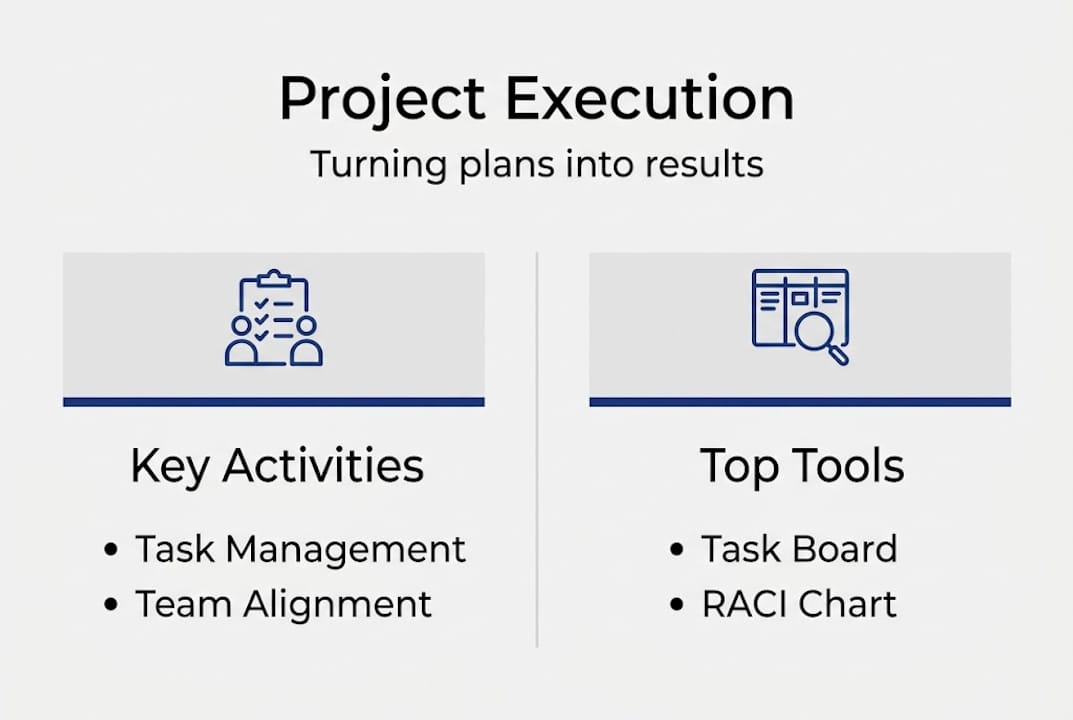
Pro Tip: Build your RACI before execution starts, not during it. Trying to define accountability after confusion erupts wastes time and damages trust. Use task tools for collaboration to make those role assignments visible to the whole team.
Good execution also depends on your team management checklist being complete before work kicks off. That means onboarding is done, access is granted, and every team member knows not just what they are doing but why it matters. For deeper insight on engineering team management strategies, the structural approaches that work in technical teams translate well across other disciplines too.
Project execution methodologies: Waterfall, Agile, Hybrid, and more
Not all projects should be run the same way. The methodology you choose shapes how your team organizes work, responds to change, and delivers results. Common methodologies for project execution include Waterfall, Agile, Hybrid, Scrum, Kanban, PRINCE2, and PMBOK, each designed for different environments and constraints.
Here is a side-by-side look at the three most widely used approaches:
| Methodology | Best for | Flexibility | Risk level | Governance |
|---|---|---|---|---|
| Waterfall | Stable, well-defined requirements | Low | High if changes arise | High |
| Agile | Evolving requirements, fast feedback | High | Lower through iteration | Low to medium |
| Hybrid | Large or regulated projects | Medium | Balanced | High |
Waterfall works well when the path is clear and change is unlikely, such as construction or compliance-driven projects. Agile thrives in environments where learning and iteration matter more than a fixed plan. Think product development, software, or marketing campaigns that need frequent adjustment.
For broader context on choosing between project management methodologies, the key variable is always how much uncertainty exists at the start.
Hybrid methodologies are best for regulated or large-scale projects that need governance and adaptability at the same time. Think pharmaceutical projects that need audit trails but also need to adapt to trial results. The trap here is what practitioners call "Scrumfall," where teams claim to use Agile but layer in Waterfall approval gates that kill sprint velocity.
Pro Tip: When using a hybrid model, define the boundaries explicitly. Which phases use Waterfall gates? Which sprints are fully Agile? Ambiguity between the two is where projects get stuck. Use popular task tools and best project management software that can flex between structured and iterative workflows to support your chosen approach.
Key questions to ask before locking in a methodology:
- How well-defined are the requirements today?
- How often will stakeholders want to change direction?
- Does the project require regulatory documentation or formal sign-offs?
- How experienced is the team with iterative versus sequential delivery?
Common pitfalls, edge cases, and best practices for flawless execution
Even well-planned projects hit turbulence during execution. Knowing where the landmines are gives you a real advantage. Edge cases like scope creep, communication breakdowns, ambiguous accountability, and distributed team issues are the most common execution killers. Each one has a proven mitigation strategy.
| Pitfall | Impact | Solution |
|---|---|---|
| Scope creep | Blown budget and timeline | Formal change control process |
| Communication gaps | Misaligned work, rework | Structured cadence (standups, status reports) |
| Unclear accountability | Dropped tasks, blame culture | RACI matrix, defined ownership |
| Distributed teams | Coordination delays, siloed info | Async tools plus regular syncs |
| Overloaded resources | Burnout, quality drops | Workload balancing and task failure rates monitoring |
Only 50% of projects succeed, but the M.O.R.E. framework has been shown to boost project success rates to 94%. M.O.R.E. stands for:
- M: Mobilize stakeholders around shared value, not just deliverables
- O: Optimize execution rhythms with regular, structured check-ins
- R: Realign the team whenever conditions change, not just at milestones
- E: Evaluate outcomes honestly against intended business impact
Building an execution rhythm into your project is one of the highest-leverage changes you can make. Teams that run consistent weekly check-ins catch problems earlier and respond faster.
"The best project managers do not just track progress. They create the conditions for honest reporting."
For project KPI tracking, define your success metrics before execution begins. Not just time and budget, but quality indicators, stakeholder satisfaction signals, and team health metrics. Tracking the right numbers changes what people pay attention to.
Pro Tip: Prioritize psychological safety over tool adoption. Teams that feel safe raising problems early outperform teams with perfect software and fearful cultures. A team that hides bad news kills execution faster than any missing feature.
Why most teams struggle with execution — and what actually works
Here is the uncomfortable truth: most teams do not fail at execution because they lack the right methodology or software. They fail because priorities are unclear, accountability is diluted, and leaders avoid the hard conversations.
Research consistently points to stakeholder value alignment and team cohesion as the real drivers of success, not the iron triangle of time, budget, and scope. Projects that obsess over those three constraints while ignoring whether the work actually matters to the people it serves tend to deliver on paper and disappoint in practice.
The hardest skill in execution leadership is not managing a Gantt chart. It is sitting in a room with your team and honestly answering, "Is what we are building still the right thing?" That question requires psychological safety, and psychological safety requires leaders who model vulnerability over authority.
What actually moves the needle: rhythm-based check-ins that surface problems before they compound, execution plans that are treated as living documents rather than contracts, and teams that trust each other enough to say "this is not working." Exploring how AI in project execution can surface patterns and flag risks earlier is one area where modern teams are gaining a genuine edge.
Ready to level up your project execution?
Understanding execution theory is valuable. But putting it into practice is where most teams need support. Outsprinter gives project managers and team leads the tools to move from planning to doing without losing visibility or control.
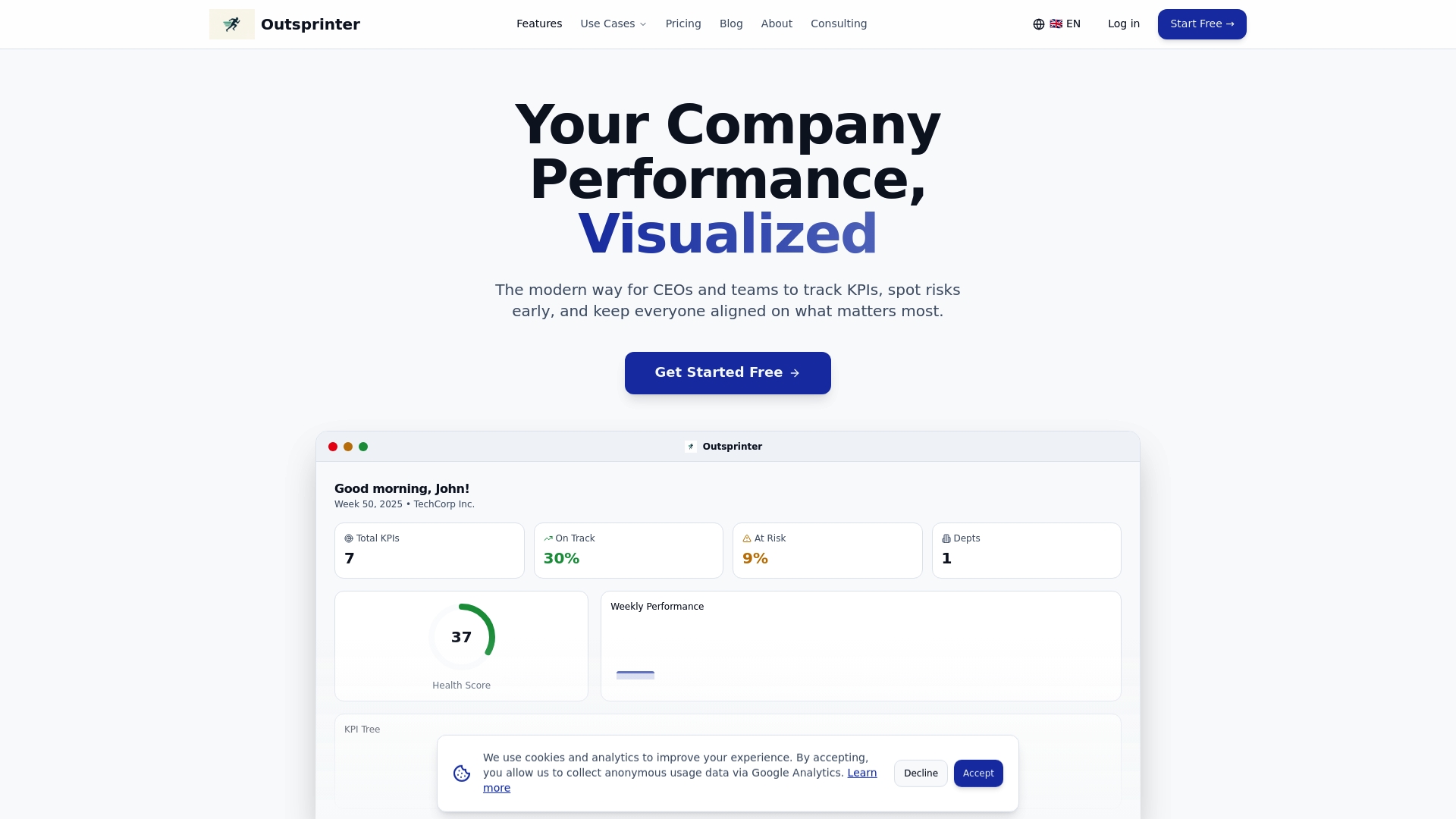
With Outsprinter's project management features, you get real-time health metrics, workload analysis, and progress tracking built into a single dashboard. Use KPI management tools to define and monitor the metrics that matter most across your team. And with advanced task management, every task has an owner, a deadline, and a priority so nothing slips through the cracks. Execution does not have to be the hardest part of the project lifecycle.
Frequently asked questions
What are the main activities during project execution?
Core activities include managing tasks, allocating resources, stakeholder communication, quality assurance, risk response, and procurement per the project plan. These are coordinated through the Project Execution Plan to keep work aligned and accountable.
How does project execution differ from project planning?
Planning designs the strategy and scope; execution puts that plan into motion to produce real deliverables. Execution is where resources are consumed and where decisions carry real cost and consequence.
What is the biggest risk during the execution phase?
Scope creep is the top risk during execution, where unmanaged changes erode the project boundary. The best defense is a formal change control process that requires approval before any scope addition is accepted.
Which project execution methodology is best for large or regulated projects?
Hybrid methodologies offer the best mix of governance and adaptability for large or regulated environments. They combine structured oversight with the flexibility to iterate when conditions evolve.