
Performance management is often treated as a productivity exercise, a way to track KPIs, assign tasks, and measure progress. But here's the uncomfortable reality: without security at its core, even the most sophisticated performance system becomes a liability. Sensitive employee data, strategic goals, and confidential metrics flow through these systems daily. One misconfigured permission or unmonitored access point can expose that data to the wrong people, internally or externally. This article walks you through what secure performance management actually means, why it matters more than most leaders realize, and how to build it into your organization's workflows before a problem forces your hand.
Table of Contents
- The foundations of secure performance management
- Why security is vital for modern performance management
- Key features of a secure performance management system
- Integrating security into performance workflows
- Unlocking strategic value through secure performance management
- Our perspective: Why security-first is non-negotiable in modern team management
- Put secure performance management into action with Outsprinter
- Frequently asked questions
Key Takeaways
| Point | Details |
|---|---|
| Security is foundational | Protecting performance data prevents costly breaches and builds team trust. |
| Evaluate system features | Look for encryption, auditing, and access controls in every tool you deploy. |
| Enables strategic growth | Secure performance management fuels accurate decisions and collaboration. |
| Integrate security everywhere | Embedding security in daily workflows ensures consistent compliance and protection. |
The foundations of secure performance management
Secure performance management means more than locking down a spreadsheet. It's the practice of ensuring that every piece of performance data, from individual KPI scores to team-level progress reports, is collected, stored, and accessed in a controlled, auditable way. Three pillars hold this up: data privacy, access controls, and audit trails.
Data privacy means employees and stakeholders can trust that their performance information won't be misused or exposed. Access controls ensure that only the right people see the right data, a sales manager shouldn't have visibility into HR compensation metrics, for example. Audit trails create a record of who accessed or changed what, and when. Together, these three elements make performance insights trustworthy and defensible.
Why does this matter strategically? Because performance management trends show that organizations are handling increasingly large and sensitive datasets, and secure performance management is becoming a top trend as those datasets grow. Without a secure foundation, the insights you generate are built on shaky ground.
The risks of skipping these essentials are concrete:
- Unauthorized access to employee performance records
- Accidental exposure of strategic goals to competitors
- Inability to meet data privacy regulations
- Loss of credibility when data integrity is questioned
Understanding roles in performance management also matters here. Different stakeholders need different levels of access, and defining those roles clearly is the first step toward a genuinely secure system.
Pro Tip: Before evaluating any performance management tool, map out which roles in your organization need access to which data categories. This role map becomes your access control blueprint.
Why security is vital for modern performance management
Let's be direct. Insecure performance management doesn't just create IT headaches. It creates organizational crises. When access to sensitive data is unmanaged, you get internal leaks, accidental exposure, and the kind of trust erosion that takes years to rebuild.
Consider a scenario where a mid-level manager gains access to a peer's performance review data. Even if nothing malicious happens, the perception of unfairness can fracture team dynamics. Now scale that to a department or an entire organization. The damage compounds quickly.
Secure systems help prevent team trust issues and reputational damage that stem from data leaks, and the impact reaches all the way to the executive level when it comes to boosting CEO decisions.

There are also legal dimensions. Regulations like GDPR and CCPA impose strict requirements on how employee data is handled. Non-compliance can result in significant fines and legal exposure. Secure performance management isn't optional if your organization operates across borders or handles data from regulated industries.
| Risk scenario | Insecure outcome | Secure outcome |
|---|---|---|
| Unauthorized access | Data breach, legal exposure | Access blocked, audit logged |
| Accidental data sharing | Confidential info exposed | Permission controls prevent sharing |
| Regulatory audit | Non-compliance penalties | Full audit trail available |
| Employee data misuse | Trust breakdown, turnover | Transparent, controlled access |
"Organizations that treat performance data as a strategic asset, not just an operational output, are the ones that build lasting team trust and competitive resilience."
Strong organizational KPI strategies depend on data people can rely on. Security is what makes that reliability possible.
Key features of a secure performance management system
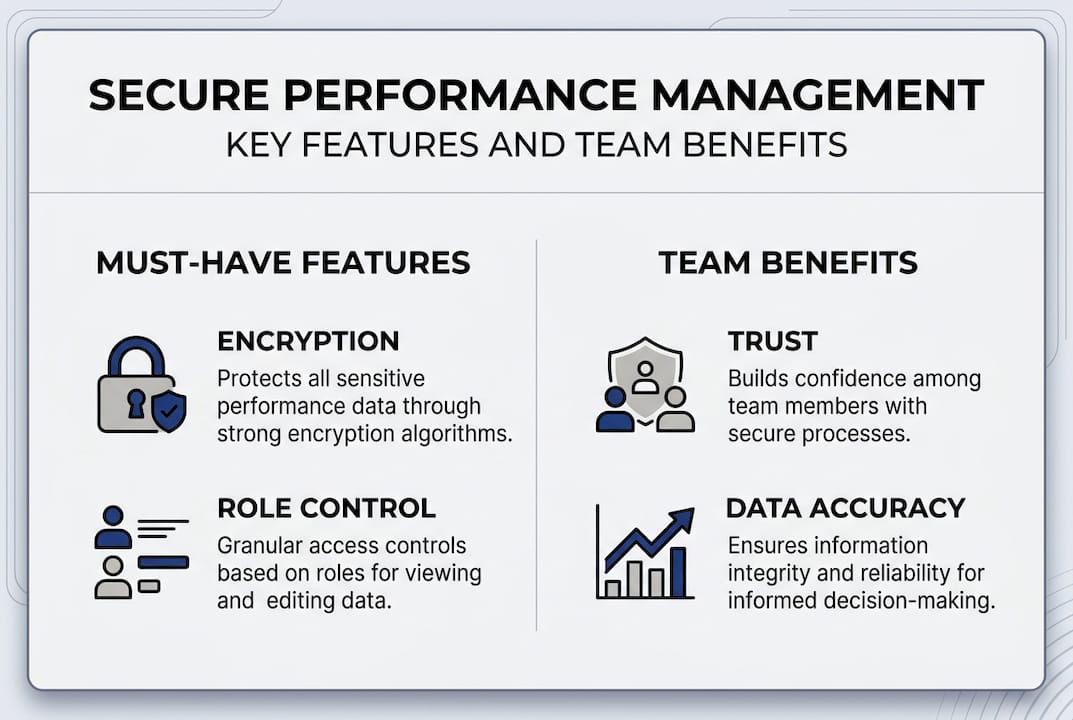
Not all performance management tools are built with security in mind. When you're evaluating options, certain features are non-negotiable. Missing even one of them creates a gap that can be exploited.
The must-have capabilities include:
- End-to-end encryption for data in transit and at rest
- Role-based access controls that limit visibility by job function
- Detailed audit logs that track every data access and change
- Compliance monitoring to flag potential regulatory violations
- Single sign-on (SSO) and multi-factor authentication to verify user identity
IT teams are adopting systems with advanced permissions and audit features specifically because these capabilities reduce both internal and external risk. Reviewing IT security solutions purpose-built for performance environments gives you a clearer picture of what enterprise-grade protection looks like in practice.
| Feature | Secure system | Insecure system |
|---|---|---|
| Data encryption | Always on, end-to-end | Optional or absent |
| Access controls | Role-based, granular | Broad or undefined |
| Audit trails | Automatic, detailed | Manual or nonexistent |
| Compliance tools | Built-in monitoring | Requires manual checks |
| Authentication | MFA and SSO supported | Password only |
When auditing your current tools, ask these questions: Can you restrict data access by department? Does the system log who viewed or edited a record? Are there alerts for unusual access patterns? If the answer to any of these is no, you have a gap to close. Robust KPI management features should include these security layers as standard, not as add-ons.
Integrating security into performance workflows
Choosing a secure tool is step one. Embedding security into how your team actually works is where the real protection happens. Security can't be a one-time setup. It needs to live inside every workflow stage.
Here's how to integrate security at each key stage:
- Data entry: Require authentication before any performance data is submitted or updated. Use validated input fields to prevent data corruption.
- Review and evaluation: Restrict access to performance reviews so only direct managers and HR can view individual records. Avoid shared logins.
- Reporting and analysis: Export reports only through secure, logged channels. Limit who can generate organization-wide reports.
- Goal setting and planning: Ensure strategic goals are visible only to relevant stakeholders. Segment access by team or department.
- Archiving: Define retention policies and automate secure deletion of outdated records.
Technology is accelerating this integration. AI-driven analytics can support security and accuracy in performance data analysis by flagging anomalies, detecting unusual access patterns, and surfacing data quality issues before they become problems. Exploring AI in performance management reveals how these tools are reshaping what secure, intelligent oversight looks like.
Strong performance visualization techniques also play a role here. When data is displayed through controlled dashboards rather than raw exports, you reduce the risk of sensitive information being mishandled.
Pro Tip: Run a quarterly access audit. Review who has permission to what, remove access for employees who've changed roles, and document the review. This simple habit closes most internal security gaps.
Unlocking strategic value through secure performance management
Here's the part most security conversations miss. Security isn't just defensive. It's a strategic enabler. When your performance data is protected and trustworthy, the decisions you make from it are stronger, faster, and more confident.
Think about it this way: if leaders suspect that performance data has been tampered with or selectively accessed, they second-guess every insight. Secure systems remove that doubt. They create a single source of truth that everyone can act on without hesitation.
Security-focused management creates a strategic advantage for organizations tracking KPIs, especially when performance alignment strategies depend on cross-functional data sharing.
The strategic benefits compound over time:
- Confident decision-making: Leaders act on verified, untampered data
- Cross-team collaboration: Departments can share performance insights without fear of exposure
- Regulatory readiness: Audits become straightforward rather than stressful
- Talent retention: Employees trust that their performance data is handled fairly
- Resilient culture: Teams focus on growth instead of worrying about data misuse
Statistic callout: Organizations with strong data governance practices are significantly more likely to report high confidence in their strategic decisions, according to multiple enterprise performance studies.
Building a resilient performance culture starts with the belief that data is safe. When that belief is earned through real security practices, not just policy documents, it becomes a foundation for sustained organizational growth.
Our perspective: Why security-first is non-negotiable in modern team management
Most organizations treat security as a compliance checkbox. They implement the minimum required controls, document the policies, and move on. That approach made sense a decade ago. It doesn't anymore.
The conventional wisdom is that performance management is about metrics and accountability. We'd argue it's equally about trust. And trust, once broken by a data incident, is extraordinarily expensive to rebuild. We've seen organizations spend years recovering from a single internal data leak, not because of the legal costs, but because of the cultural damage.
The organizations that lead in 2026 aren't the ones with the most sophisticated KPI frameworks. They're the ones where teams feel safe contributing honest data, where managers trust the numbers they're acting on, and where executives can make bold moves without second-guessing their information sources.
Tracking performance metrics for efficiency only delivers value when the underlying data is protected. Security-first isn't a technical posture. It's a leadership posture. And the organizations that adopt it early will find that it accelerates everything else they're trying to achieve.
Put secure performance management into action with Outsprinter
Understanding the principles is one thing. Having the right tools to execute them is another.
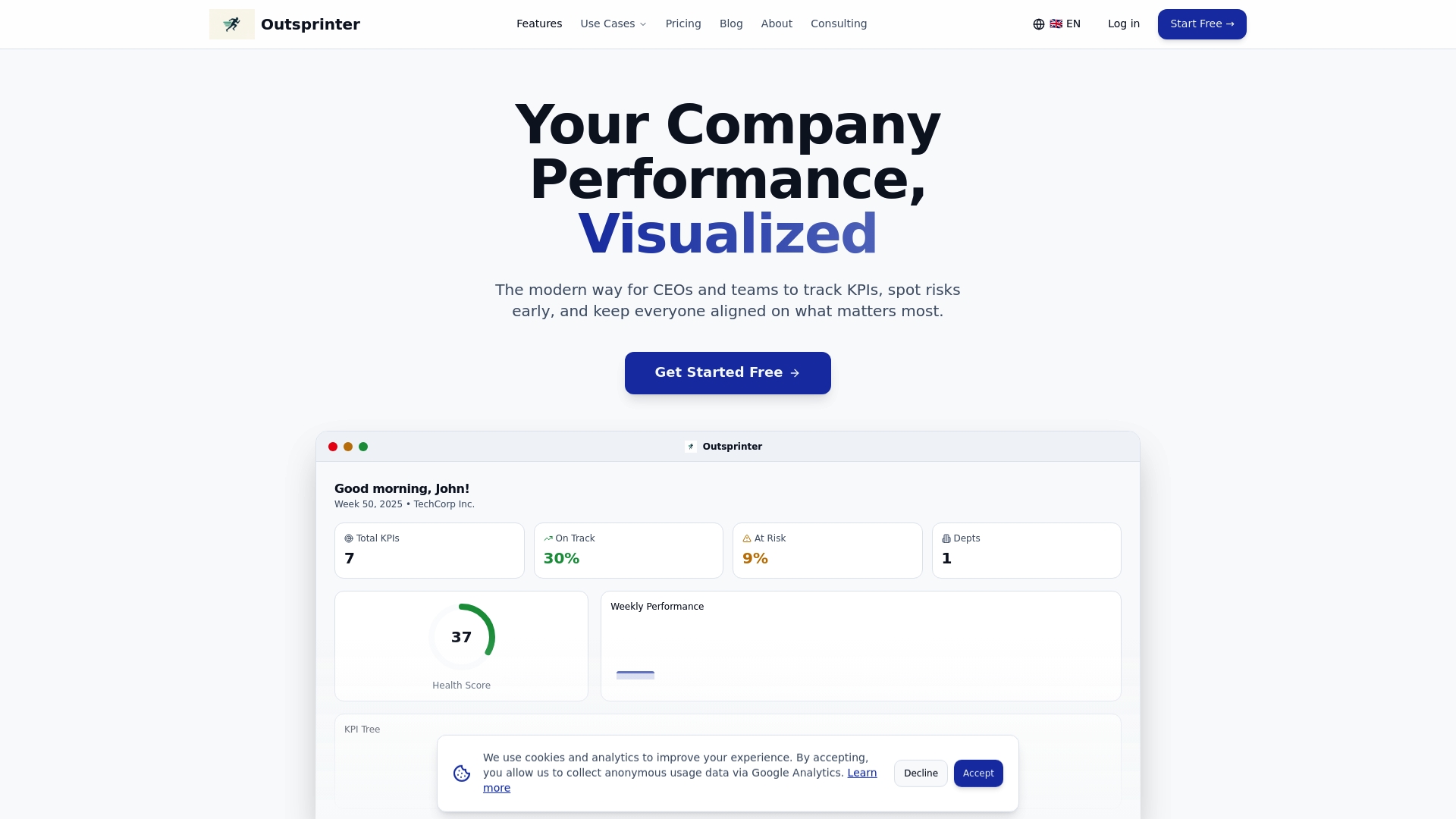
The Outsprinter platform is built with security and strategic alignment at its core. Role-based access controls, real-time dashboards, and structured KPI management solution features give your team the visibility they need without exposing data to the wrong people. The project management tools layer in workload analysis and progress tracking so you can manage performance holistically. Whether you're starting from scratch or upgrading an existing system, Outsprinter gives you the infrastructure to make secure performance management a daily reality, not just a goal.
Frequently asked questions
What are the risks of not securing performance management systems?
The main risks are data breaches, loss of confidential employee information, decreased team trust, and potential legal or regulatory penalties. Unsecure systems raise the chance of data leaks and the trust issues that follow them.
Which features make a performance management tool secure?
Key features include encryption, role-based access controls, detailed audit trails, and compliance monitoring. IT teams prioritize advanced permissions and audit features as the baseline for any secure system.
How does secure performance management benefit team productivity?
Security enables safe data sharing, honest feedback, and seamless collaboration, which support high team productivity and alignment. Security-focused tools lead to better collaboration and more reliable performance tracking across departments.
Can AI help secure performance management processes?
Yes, AI-driven analytics can support more secure and accurate handling of performance data by detecting anomalies and flagging irregularities in real time. AI analytics can increase accuracy and security in performance data analysis at scale.