
TL;DR:
- Organizational performance comprises financial, operational, customer, and learning/growth dimensions.
- Using tailored frameworks like the Balanced Scorecard helps align metrics with strategic goals.
- Benchmarking against industry standards fosters continuous improvement and early risk detection.
Organizational performance is not just a financial scoreboard. Many executives reduce it to revenue, margin, and cost control, but that framing leaves critical blind spots. Organizational performance spans financial, operational, customer, and learning/growth dimensions, each one influencing the others in ways that a single quarterly report will never reveal. For mid-sized organizations especially, understanding this full picture is what separates reactive management from genuine strategic leadership. This guide breaks down the core dimensions, the most reliable measurement frameworks, and how to tailor your approach so that performance data actually drives better decisions.
Table of Contents
- Defining organizational performance: The four dimensions
- How organizational performance is measured: Frameworks and approaches
- Tailoring performance measurement for mid-sized organizations
- Benchmarking and continuous improvement: Making performance actionable
- Why multidimensional performance beats financial focus every time
- Enhance your organizational performance with the right tools
- Frequently asked questions
Key Takeaways
| Point | Details |
|---|---|
| Multidimensional performance matters | Focusing on multiple performance dimensions gives a clearer, stronger view of organizational health. |
| Fit frameworks to your context | Select measurement tools that match your organization’s size and sector for best results. |
| Benchmarking powers improvement | Comparing to industry peers helps identify gaps and stimulates growth. |
| Continuous review is essential | Regularly revisiting metrics ensures your strategy stays effective over time. |
Defining organizational performance: The four dimensions
At its core, organizational performance is the capacity to achieve strategic goals efficiently and consistently over time. It is not a moment in time. It is a pattern. And patterns require more than one data point to understand.
Organizational performance is measured across four interconnected dimensions: financial, operational, customer, and learning/growth. Each one captures a different layer of how well your organization is actually functioning.
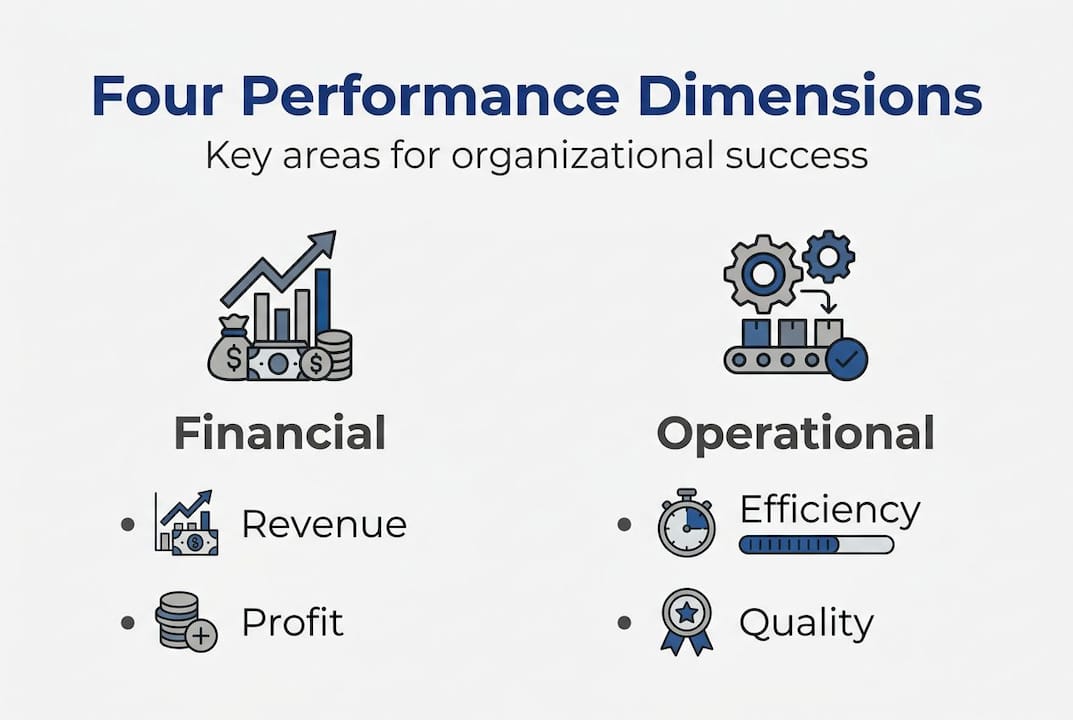
Financial metrics are the most familiar. Revenue growth, profit margin, return on investment, and cash flow all belong here. They tell you what happened. But they are lagging indicators, meaning they reflect decisions made weeks or months ago.
Operational metrics measure how efficiently your internal processes run. Think cycle time, error rates, resource utilization, and on-time delivery. These are closer to real-time and give managers a view into where friction lives inside the organization.
Customer metrics capture how your market perceives you. Net Promoter Score, customer retention rate, satisfaction scores, and acquisition cost all belong here. Strong customer metrics today often predict strong financial results tomorrow.
Learning and growth metrics are the most underused. Employee engagement, training completion rates, internal promotion rates, and innovation output measure your organization's capacity to adapt and improve. These are leading indicators, the early signals of future performance.
Here is a quick breakdown of KPIs by dimension:
- Financial: Revenue growth rate, gross margin, operating cash flow
- Operational: Process cycle time, defect rate, on-time delivery percentage
- Customer: Net Promoter Score, churn rate, customer lifetime value
- Learning/Growth: Employee engagement score, training hours per employee, internal promotion rate
Tracking team efficiency metrics across all four dimensions gives you a far more accurate picture than any single category alone. Organizations that measure across multiple dimensions consistently outperform those focused only on boosting KPI results through financial metrics alone.
Pro Tip: Before adding a new KPI to your dashboard, ask one question: does this metric connect directly to a strategic goal? If you cannot draw a straight line from the metric to the vision, it is noise.
With a broader view of what organizational performance really means, let us examine how it is measured in practice.
How organizational performance is measured: Frameworks and approaches
Once the dimensions of performance are clear, it is vital to choose measurement tools that actually reflect your organization's unique context. Two frameworks stand out for mid-sized organizations: the Balanced Scorecard and contingency-based measurement.
The Balanced Scorecard turns strategy into actionable objectives across four perspectives: financial, customer, internal processes, and learning/growth. It is used by Fortune 500 firms precisely because it forces leadership to connect day-to-day operations to long-term strategy. Rather than tracking dozens of disconnected metrics, the BSC organizes them into a coherent story.
Here is how BSC compares to financial-only measurement:
| Factor | Balanced Scorecard | Financial-only measurement |
|---|---|---|
| Scope | Four dimensions | Revenue and cost only |
| Indicator type | Leading and lagging | Mostly lagging |
| Strategic alignment | Built in | Often absent |
| Decision speed | Faster, more context | Slower, reactive |
| Risk visibility | High | Low |
To implement the BSC in your organization, follow these steps:
- Define your strategic objectives across all four perspectives.
- Identify two to three KPIs per perspective that directly measure progress.
- Set targets and thresholds for each KPI.
- Assign ownership so every metric has a responsible team or leader.
- Review results on a regular cadence, monthly at minimum.
Contingency theory adds an important nuance. No universal performance measure works for all organizations. The right metrics depend on your industry, size, competitive environment, and organizational structure. A manufacturing firm and a professional services firm should not be using the same KPI set, even if both adopt the BSC format.
"The best measurement system is the one that fits your organization's reality, not the one that looks most impressive in a board presentation."
Using an organizational performance metrics checklist helps you audit which metrics are truly relevant versus which ones are there out of habit. For B2B leaders specifically, performance alignment between sales, operations, and customer success is where the BSC delivers the most value. You can also explore how experts approach analyzing organizational performance to deepen your framework knowledge.
Tailoring performance measurement for mid-sized organizations
Not all organizations require the same approach to performance measurement, especially in the mid-market, where flexibility can be an advantage.
Mid-sized organizations sit in an interesting position. They are large enough to need structured measurement but small enough to move quickly when something is not working. That agility is a genuine competitive edge, but only if measurement systems are designed to support fast decisions rather than slow them down.
Adaptable frameworks consistently outperform rigid systems in mid-sized organizations. A framework borrowed wholesale from a 10,000-person enterprise will often create more bureaucracy than clarity for a 200-person team. The goal is rigor without complexity.
Common performance pitfalls for mid-sized firms include:
- Tracking too many metrics at once, which dilutes focus and overwhelms teams
- Copying enterprise frameworks without adjusting for organizational scale or culture
- Measuring outputs instead of outcomes, which rewards activity over results
- Skipping the review cycle, so data is collected but never acted upon
- Siloing metrics by department, which prevents cross-functional visibility
Research on performance review practices confirms that organizations with streamlined, context-appropriate measurement systems see stronger adoption and more consistent follow-through from managers.
Pro Tip: Before rolling out a new measurement framework organization-wide, pilot it with one team for 60 days. Collect feedback, adjust the KPIs, and then scale. This prevents costly misalignment and builds buy-in from the start.
Leadership plays a defining role here. When executives treat performance data as a tool for learning rather than a tool for judgment, teams engage with metrics more honestly and more consistently. Tracking organizational performance is most powerful when it shapes how leaders ask questions, not just how they report results.
Benchmarking and continuous improvement: Making performance actionable
Having chosen measurement frameworks, organizations need a way to put results in context and drive actionable change. That is where benchmarking comes in.
Benchmarking is the practice of comparing your performance metrics against peer organizations, industry standards, or best-in-class performers. It answers the question your internal data cannot: are we actually good, or do we just look good compared to last quarter?

Benchmarking drives growth and quality improvement in organizations that apply it consistently. The European Network for Advanced Performance Studies (ENAPS) offers a structured benchmarking approach particularly suited to small and mid-sized enterprises.
Here is how ENAPS KPIs compare to typical industry averages:
| ENAPS KPI category | ENAPS benchmark | Typical industry average |
|---|---|---|
| On-time delivery | 95%+ | 82% |
| Customer satisfaction index | 85%+ | 74% |
| Employee productivity ratio | Top quartile | Median |
| Process cycle efficiency | 70%+ | 55% |
To launch a benchmarking initiative in your organization:
- Select three to five KPIs that are most critical to your strategic goals.
- Identify credible benchmark sources: industry associations, published research, or peer networks.
- Collect your current baseline data for each selected KPI.
- Compare your results and identify the largest performance gaps.
- Set improvement targets and assign accountability for closing each gap.
You can explore the ENAPS benchmarking methodology in detail to understand how it applies to your sector. Continuous review is what makes benchmarking more than a one-time exercise. Building a scalable performance management system means embedding regular benchmark reviews into your leadership calendar, not treating them as annual events. Pairing benchmarking with proven performance strategies creates the feedback loop that sustains improvement over time.
Why multidimensional performance beats financial focus every time
With frameworks, benchmarking, and context in hand, let us step back and question some conventional wisdom still common in boardrooms.
Financial tunnel vision is not just a measurement problem. It is a risk management problem. When leadership teams fixate on margin and revenue, they often miss the signals that predict future decline: rising employee turnover, slipping customer satisfaction, stagnant skill development. These are not soft metrics. They are early warnings.
Over-reliance on financial metrics can blind organizations to risks that are already building beneath the surface. A mid-sized logistics company we have seen illustrates this well. They hit revenue targets for three consecutive years while their employee engagement scores quietly dropped. By year four, turnover spiked, institutional knowledge walked out the door, and operational quality suffered. The financial metrics looked fine right up until they did not.
Leading indicators, like measuring team productivity and customer loyalty scores, give you time to respond. Lagging indicators only confirm what already happened.
"Activity tracking is as vital as outcome measurement."
The organizations that build genuine resilience are the ones that treat learning, customer experience, and operational health as equally important to profit. Financial results are the outcome. Everything else is the engine.
Enhance your organizational performance with the right tools
Understanding performance dimensions and frameworks is the first step. Turning that understanding into daily practice requires the right infrastructure.
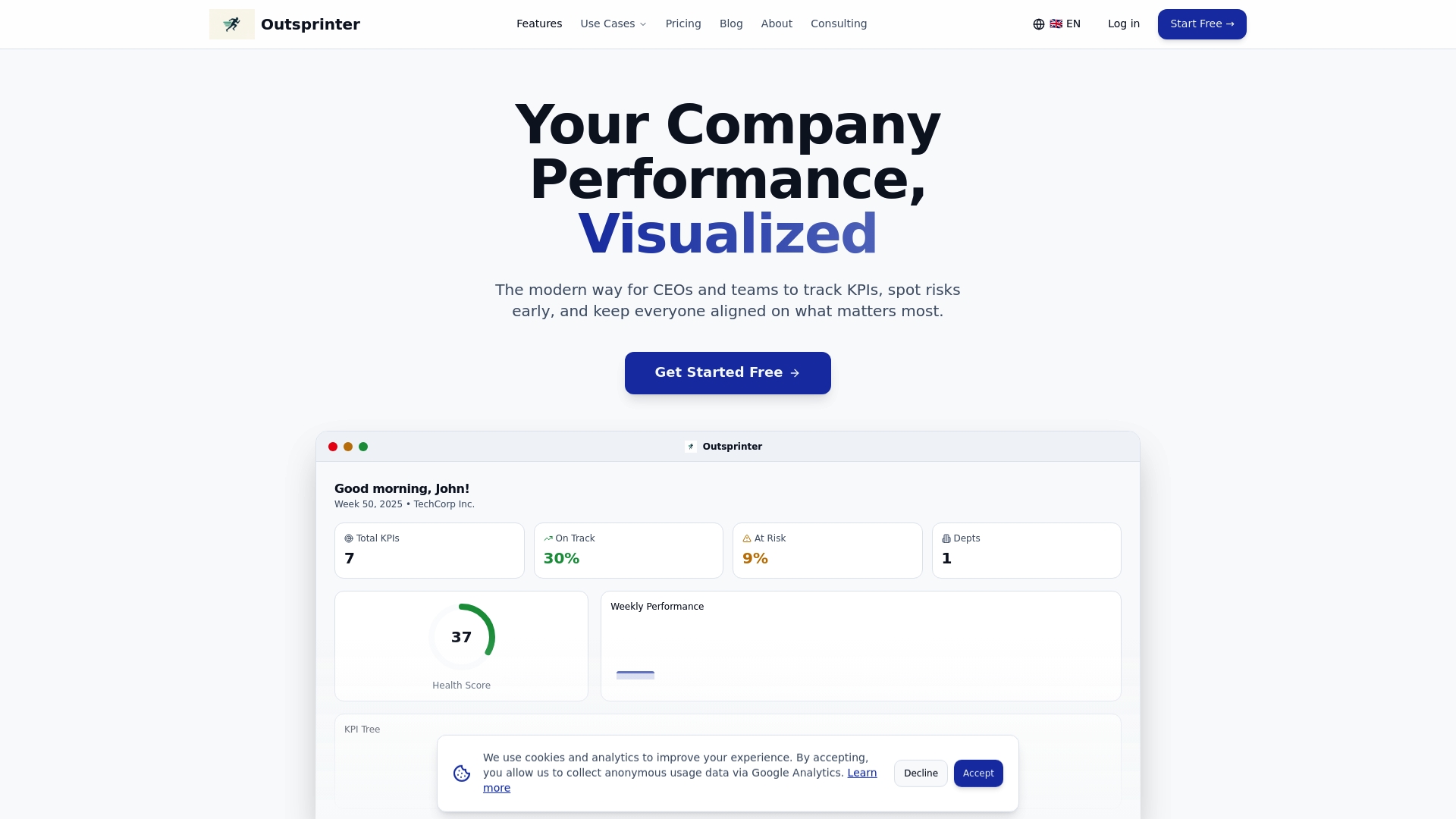
Outsprinter is built specifically for mid-sized teams that need real-time visibility without enterprise-level complexity. The Outsprinter platform connects your strategic goals to day-to-day execution through live dashboards, structured goal planning, and automated alerts. With KPI management software that lets you define, track, and visualize every metric across your organization, and task management tools that tie individual work to broader outcomes, you get the full picture in one place. Explore a demo and see how teams are making performance measurement a habit, not a headache.
Frequently asked questions
What are the four core dimensions of organizational performance?
Organizational performance is evaluated across financial, operational, customer, and learning/growth dimensions, each reflecting a distinct area of value creation that affects long-term results.
How is the Balanced Scorecard different from traditional performance metrics?
Unlike financial-only approaches, the Balanced Scorecard balances leading and lagging indicators across customer, process, and learning/growth perspectives for a complete strategic view.
Why should mid-sized organizations tailor their performance measurement?
Tailoring ensures your measurement system fits your actual context. Contingency theory confirms that measurement must match organizational size, structure, and sector to be effective.
What is benchmarking and how does it benefit organizations?
Benchmarking compares your metrics to peer organizations and industry standards. Benchmarking consistently links to measurable gains in sales growth and quality improvement when applied with clear targets.