
TL;DR:
- Structured workflows with clear steps improve organizational performance and success rates.
- Continuous feedback and benchmarking are key to sustainable, data-driven improvements.
- Using the right tools and leadership commitment ensures effective performance management.
Picture this: your quarterly review is three weeks out, your team is behind on two major initiatives, and no one can clearly explain why. The goals exist. The talent exists. But without a structured workflow connecting daily actions to strategic targets, performance slips through the cracks in ways that feel invisible until it's too late. That scenario plays out in organizations every quarter, and the fix isn't more ambition or harder work. It's clarity. A repeatable, evidence-based performance improvement workflow transforms how your organization identifies gaps, acts on them, and sustains progress over time. This guide gives you exactly that, step by step.
Table of Contents
- Why structured workflows drive lasting improvement
- The 7-step organizational performance improvement workflow
- Real-world frameworks: PDCA, Kaizen, and benchmarking in action
- Troubleshooting and optimizing your workflow: Common pitfalls and smart solutions
- Why most performance improvement workflows fail and how to rewrite the rules
- Build high-performance workflows with the right tools
- Frequently asked questions
Key Takeaways
| Point | Details |
|---|---|
| Structured workflows matter | Following a clear step-by-step workflow increases efficiency and success rates across organizations. |
| Continuous over annual feedback | Real-time feedback dramatically improves initiative, reduces turnover, and is favored by the majority of employees. |
| Benchmarking drives growth | Regular benchmarking against industry leaders identifies gaps and unlocks actionable performance improvements. |
| Optimize, then automate | Use data-driven tools to track, monitor, and refine your workflow for ongoing performance gains. |
Why structured workflows drive lasting improvement
To understand why workflow matters, let's examine the results organizations see when they rely on clear, repeatable processes instead of improvisation.
Most organizations sit somewhere on a performance maturity spectrum, and where you fall determines almost everything about your results. The Process Optimization Maturity Model defines five levels, from Reactive (Level 1) to Optimized (Level 5), and the differences are stark. At Level 1, teams respond to problems as they arise, with no documentation, no standard process, and no consistency. At Level 3, processes are defined and managed deliberately. At Level 5, organizations achieve continuous improvement through data, feedback loops, and cross-functional collaboration, and they show 47% higher efficiency along with 3.4x better cost structures compared to their reactive peers.
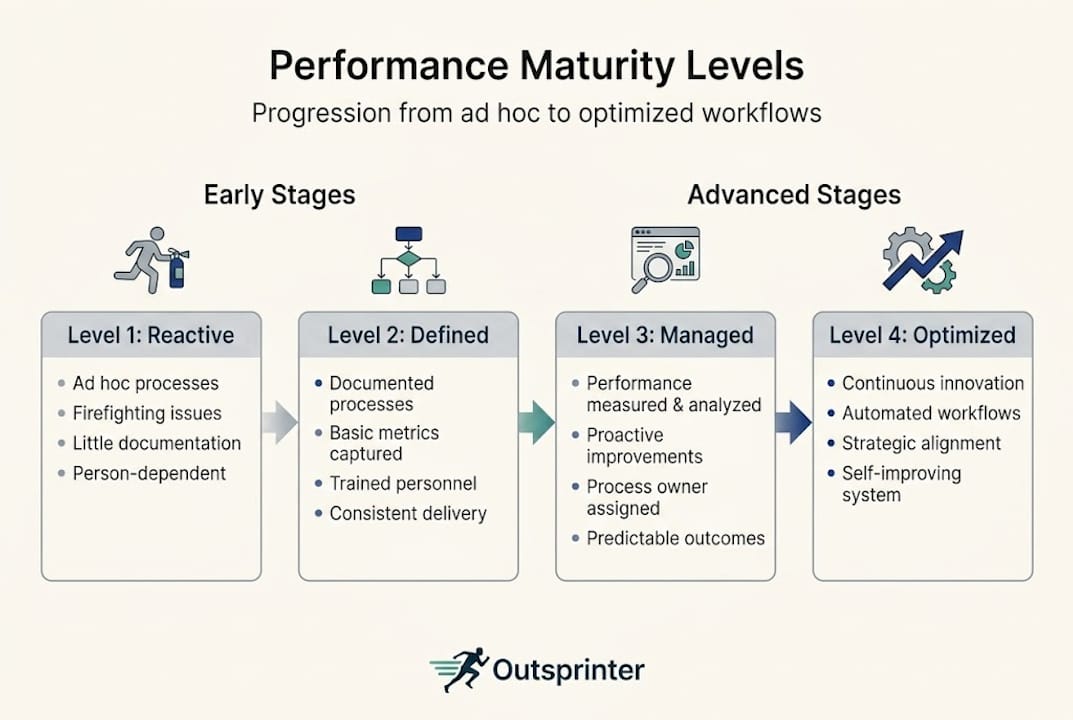
The failure rate data is just as compelling. Level 1 organizations fail 60 to 70 percent of the time when launching improvement initiatives. Level 5 organizations succeed 75 to 85 percent of the time. That isn't coincidence. It's the direct result of having a repeatable workflow that removes guesswork from the equation. Investing in team performance tracking is often the first visible signal that an organization is moving up the maturity ladder.
Here's a quick comparison to make the difference tangible:
| Characteristic | Reactive (Level 1) | Optimized (Level 5) |
|---|---|---|
| Process documentation | None or minimal | Fully documented and reviewed |
| Response to problems | After-the-fact | Proactive, data-driven |
| Success rate | 60–70% failure | 75–85% success |
| Efficiency advantage | Baseline | 47% higher than Level 1 |
| Cost structure | Variable, unpredictable | 3.4x more favorable |
Beyond the numbers, structured workflows deliver benefits that compound over time. Consider what a repeatable process actually buys your organization:
- Repeatability: Teams replicate what works without reinventing it each cycle.
- Clarity: Every person knows what they're responsible for and how success is measured.
- Accountability: When steps are documented, gaps and delays become visible immediately.
- Faster iteration: You spend less time diagnosing problems and more time solving them.
For organizations building scalable performance management practices, structured workflow is the foundation, not an optional extra.
The 7-step organizational performance improvement workflow
With the need for structure clear, here's a step-by-step breakdown of a proven workflow any organization can adapt.
The 7-step performance improvement framework aligns closely with well-established cycles like PDCA (Plan-Do-Check-Act) and Kaizen. Each step builds on the last, creating a rhythm your teams can follow quarter after quarter.
-
Define objectives. Start by anchoring every improvement effort to a clear business outcome. What specific result are you trying to change, and why does it matter now? Vague objectives like "improve performance" are impossible to act on. Specific ones like "reduce ticket resolution time by 20% in Q3" give your team a real target.
-
Performance assessment. Before you can set meaningful goals, you need an honest baseline. Gather quantitative data (output rates, error frequency, cycle time) alongside qualitative input from team leads and frontline staff. This dual view prevents bias toward metrics that look good on paper but miss operational reality.
-
Set goals. Use your assessment to define SMART goals. Specific, Measurable, Achievable, Relevant, and Time-bound targets transform aspirations into plans. Tie each goal back to a measurable KPI so progress is unambiguous.
-
Action plan. Map the specific actions, owners, timelines, and resources needed to hit each goal. This is where many organizations lose momentum, as they confuse planning with doing. A strong action plan names exactly who does what by when, with no ambiguity.
-
Implement. Execute the plan in a controlled, phased way when possible. This mirrors the "Do" phase in PDCA and the rapid-improvement events in Kaizen. Document implementation decisions as you go, because that record becomes invaluable in the review stage.
-
Monitor results. Track progress in real time against your defined KPIs. Weekly check-ins, dashboard reviews, and automated alerts all serve this function. The goal is to catch drift early, before a small deviation becomes a missed target.
-
Feedback and adjust. Close the loop by reviewing what worked, what didn't, and why. Apply those lessons to the next cycle. This step is what separates organizations that improve from those that just repeat the same mistakes with better intentions.
| Step | PDCA equivalent | Key output |
|---|---|---|
| Define objectives | Plan | Clear business outcome statement |
| Performance assessment | Plan | Baseline data and gap analysis |
| Set goals | Plan | SMART KPIs tied to outcomes |
| Action plan | Plan | Assigned tasks with deadlines |
| Implement | Do | Executed actions with documentation |
| Monitor | Check | Real-time performance data |
| Feedback and adjust | Act | Updated process for next cycle |
Following this as a guide for step-by-step performance management keeps teams aligned and moving in the same direction every single sprint.

Pro Tip: Don't treat this workflow as a one-time project. Embed it into your regular operating cadence by tying each step to a scheduled meeting or review checkpoint. Teams that integrate the workflow into existing rituals, rather than treating it as a separate initiative, are far more likely to sustain it beyond the first quarter.
A thorough performance improvement guide can help your managers apply each of these steps with confidence, especially when facing unfamiliar performance challenges.
Real-world frameworks: PDCA, Kaizen, and benchmarking in action
Aside from general process steps, global leaders also lean on best-practice frameworks to reinforce and accelerate results.
Kaizen and PDCA cycles form the backbone of continuous improvement workflows used by organizations across every industry, from manufacturing to financial services to healthcare. Understanding how each one works helps you choose the right tool for the right situation.
PDCA (Plan-Do-Check-Act) is a four-stage loop designed for iterative problem solving. You plan a change, execute it on a small scale, measure the outcomes, and either standardize what worked or revise your approach. It's ideal for process-level improvements where you need controlled testing before full rollout. Think of it as hypothesis-driven management applied to operations.
Kaizen focuses on continuous, small improvements made by everyone in the organization, not just leadership. Kaizen events are short, focused workshops where cross-functional teams tackle a specific problem in two to five days. The speed of the approach is its strength. Instead of months-long improvement projects, you make targeted changes and see results within the same week.
Here's how both frameworks map to real business scenarios:
- A logistics team runs a Kaizen event to cut order processing errors. In three days, they redesign a handoff procedure, and errors drop 40% within the month.
- A software company applies PDCA to reduce deployment failures. They test a new review protocol on one team for four weeks, check the defect rates, and roll it out organization-wide after confirming a 30% improvement.
- A retail chain benchmarks its customer satisfaction scores against top competitors, identifies specific checkout experience gaps, and redesigns the payment workflow.
That third example introduces benchmarking, and it deserves its own focus. Benchmarking research consistently shows improved sales growth, quality, and competitiveness for organizations that benchmark systematically against industry leaders.
Organizations that combine internal improvement cycles with external benchmarking create a two-directional feedback loop: they learn what's possible from the best performers in their field, then use Kaizen or PDCA to close the gap as efficiently as possible.
Benchmarking works best when it's structured. Identify the specific performance metrics you want to compare, find credible external data sources or peer networks, and translate the findings into actionable targets. Without that last step, benchmarking data just becomes an interesting report rather than a catalyst for change. Connecting benchmarking outputs directly to your KPI framework is one of the most effective KPI improvement tips we can offer.
Troubleshooting and optimizing your workflow: Common pitfalls and smart solutions
No workflow is perfect out of the box. Here's how you can spot trouble early and continuously optimize for better results.
Even well-designed improvement workflows stall. Knowing where the most common failure points are allows you to build in safeguards before problems surface. The top five reasons performance improvement workflows fail:
- Lack of management commitment. When leaders visibly disengage from the process, teams follow. Sponsorship must be active, not ceremonial.
- Vague accountability. If no one specific owns an action, no one owns the outcome. Assign names, not departments.
- Skipping the monitoring phase. Implementation without tracking is wishful thinking. Build in checkpoints before you start, not after you notice drift.
- No follow-up after improvement events. Kaizen events risk failure when there's no follow-up system. Use 30, 60, and 90-day audits to confirm changes are holding.
- Annual review dependency. Organizations that rely solely on yearly performance reviews lose the feedback frequency needed to course-correct in real time.
On that last point, a direct comparison between annual and continuous feedback models is worth examining closely:
| Feedback model | Turnover impact | Employee initiative | Bias risk |
|---|---|---|---|
| Annual reviews | Higher baseline turnover | Lower between reviews | Higher due to recency effect |
| Continuous feedback | 14.9% turnover reduction | Consistently higher | Significantly lower |
That turnover figure isn't minor. For a 200-person organization, a 14.9% reduction in turnover represents real savings in recruitment, onboarding, and lost productivity.
For individual-level situations, Performance Improvement Plans (PIPs) require their own structured approach. An effective PIP follows eight defined steps, covers a 30 to 90-day timeframe, and includes weekly or biweekly check-ins to assess progress. Edge cases, like an employee going on leave mid-PIP, require a decision about whether to extend the timeline rather than pause indefinitely.
Pro Tip: Embed real-time tracking into your workflow from day one. Use performance visualization tips to create dashboards your managers actually check daily. When progress is visible and immediate, the natural incentive to course-correct kicks in far earlier than in organizations waiting for monthly reports.
The smartest optimization move? Combine frequent check-ins with a clear escalation path. When a KPI drifts beyond a defined threshold, who gets notified, and what action do they take within 24 hours? Defining that in advance turns a passive monitoring process into an active performance management system.
Why most performance improvement workflows fail and how to rewrite the rules
Here's what most performance improvement articles won't tell you: the framework matters far less than the culture you build around it. We've worked with organizations that followed the 7-step cycle precisely, invested in best-in-class software, and still saw no meaningful change after two quarters. Why? Because they treated the workflow as a compliance exercise rather than a genuine management commitment.
Continuous feedback outperforms annual reviews on every major dimension. It reduces turnover by 14.9%, increases initiative, and is preferred by 94% of employees. Yet the majority of organizations still structure their performance processes around annual cycles because it's administratively easier for HR. That's a leadership choice with measurable consequences.
The organizations that actually break through are the ones where leaders treat workflow as a living discipline. They review measuring team productivity data weekly, not quarterly. They use real-time performance tools not just to report results but to trigger conversations. The platform is a catalyst, not a substitute for engagement. If your managers aren't willing to act on what the data shows, even the best workflow becomes decoration.
Build high-performance workflows with the right tools
With strategic insight in mind, here's how technology can help you implement a robust workflow for ongoing results.
Knowing what to do is only half the equation. Having tools that make it operationally easy is what separates organizations that sustain improvement from those that revert to old habits after the first quarter. Outsprinter is designed specifically to support every phase of the performance improvement workflow you've just mapped.
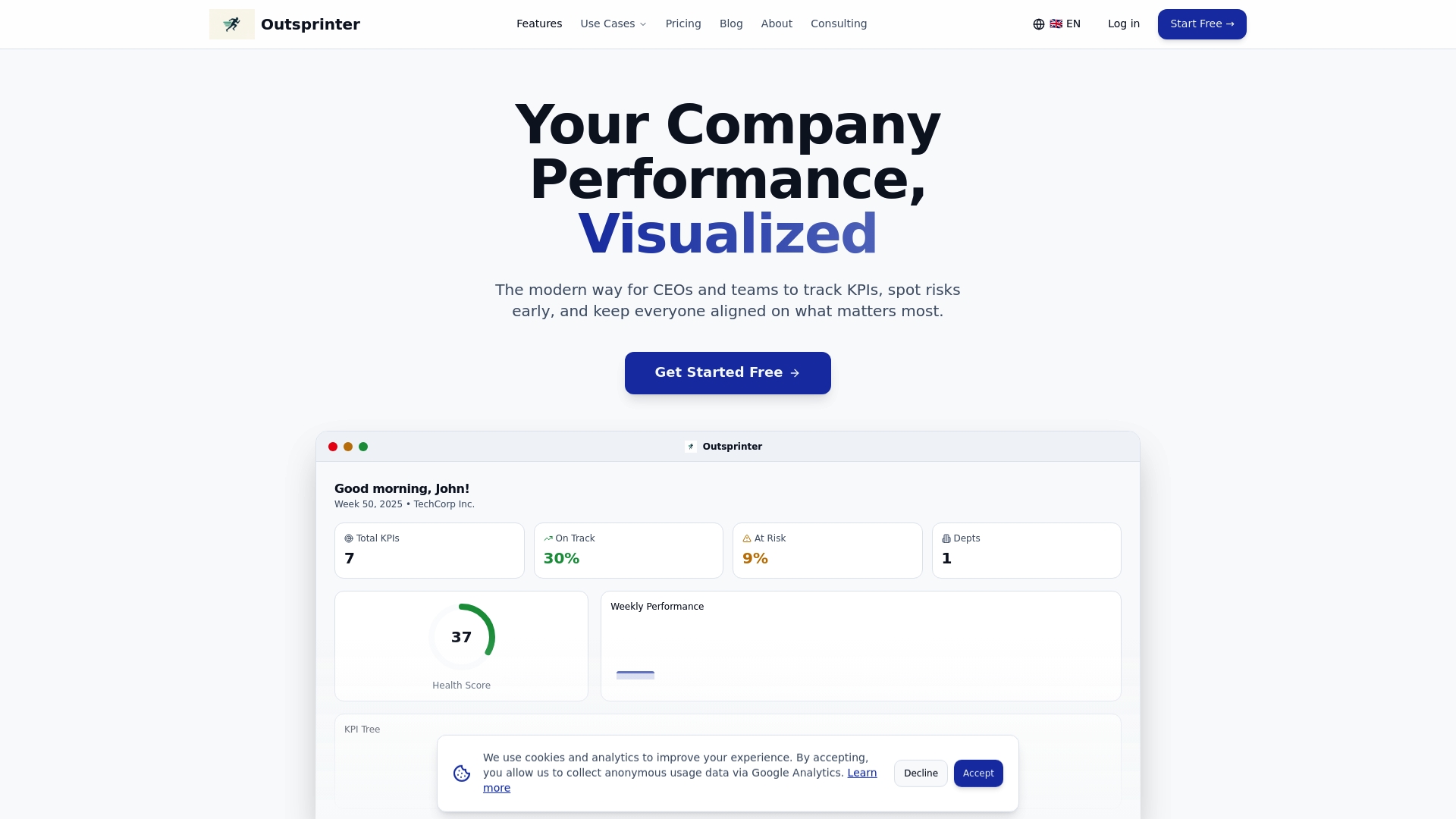
With Outsprinter's KPI tracking platform, you can define and monitor indicators across every department in real time, with automatic alerts when performance drifts. The project management tools give you health metrics and workload analysis so you always know where your initiatives stand. And task workflow solutions let you assign, prioritize, and track actions with recurring rules that keep your improvement cycle running automatically. It's the operational backbone your workflow needs.
Frequently asked questions
What are the most important steps in a performance improvement workflow?
The essential steps are defining objectives, assessing current performance, setting goals, planning actions, implementing solutions, monitoring results, and adjusting based on feedback, following a structured improvement cycle that applies across industries and team sizes.
How can benchmarking improve my team's performance?
Benchmarking helps organizations discover performance gaps, adopt proven best practices, and stay competitive by learning from industry leaders, with research consistently showing improved sales growth, quality, and competitiveness as direct outcomes.
What is the difference between annual and continuous performance reviews?
Continuous feedback is preferred by 94% of employees and reduces turnover by 14.9% while increasing initiative, compared to annual reviews that are more vulnerable to recency bias and lower mid-year engagement.
What tools support workflow monitoring and improvement?
Performance management and KPI tracking platforms streamline monitoring, reporting, and iterative improvement cycles by centralizing data and automating alerts so managers can act on issues in real time rather than after the fact.
How do you ensure performance improvement plans (PIPs) succeed?
Successful PIPs require clear objectives, specific documented incidents, and regular check-ins every one to two weeks across a defined 30 to 90-day timeline, supported by consistent management engagement throughout the process.