
TL;DR:
- Even experienced executive teams often miss strategic targets due to broken decision-making workflows. Effective leadership requires clear roles, decision frameworks, and behavioral alignment to ensure rapid, accountable execution. Continuous measurement and system design, like context engineering, enable decentralized decision-making and sustained performance improvements.
Even the most experienced executive teams can miss their strategic targets when their internal workflows break down. A well-crafted strategy on paper means nothing if the people responsible for executing it are working in silos, debating authority, or sitting through meetings that produce no decisions. C-suite teams often fail due to poor structure, with oversized groups creating blurred priorities and slow decisions. This guide walks you through exactly how to design, execute, and continuously optimize a leadership strategy workflow built for real results.
Table of Contents
- Why leadership strategy workflows fail—and what to fix first
- What you need: Tools, structure, and leadership behaviors
- Step-by-step: Implementing decision-making frameworks
- Upgrade execution: Context engineering for distributed performance
- Verify progress: Track, adapt, and improve your leadership workflow
- Most leaders get workflow wrong: Here's what actually works
- Simplify your leadership workflow with the right platform
- Frequently asked questions
Key Takeaways
| Point | Details |
|---|---|
| Structure your C-suite | Smaller, clearly defined C-suite teams make faster, more aligned decisions. |
| Use proven frameworks | Integrate tools like RAPID, SPADE, and Cynefin for efficient decision-making. |
| Enable context engineering | Build systems that support decentralized action and cut bottlenecks. |
| Track and adapt performance | Monitor KPIs and feedback loops to continuously improve leadership results. |
| Prioritize behavioral synergy | Balance task focus, relationships, and adaptability for C-suite effectiveness. |
Why leadership strategy workflows fail—and what to fix first
Most C-suite teams don't fail because of bad strategy. They fail because of how they work. A leadership strategy workflow is the repeatable system your executive team uses to make decisions, assign ownership, run meetings, and track performance. When that system is broken, even brilliant strategy stalls.
The most common failure modes are surprisingly consistent. Lack of structural clarity tops the list. When roles and decision rights are undefined, every cross-functional decision becomes a negotiation. Role ambiguity means two or three executives believe they own the same outcome, while other critical responsibilities fall through the cracks entirely. The result? Meetings spiral into debate rather than resolution, and priorities shift based on whoever speaks loudest rather than what the strategy demands.
Oversized leadership teams are another silent killer. C-suite groups with poor structure create gridlock, blurred accountability, and reactive rather than proactive decision-making.
Consider the case of a global technology firm that grew its C-suite to 18 executives over five years. Every major investment decision required sign-off from a minimum of nine leaders. What should have been a 48-hour approval process routinely took six weeks, costing the company multiple first-mover opportunities and significant market share.
This is not an edge case. It's a pattern that repeats in organizations across industries as headcount and complexity grow. You can spot a broken leadership workflow through these warning signs:
- Decisions get revisited in every meeting instead of finalized
- Strategic initiatives lag months behind their original timeline
- Individual executives pursue departmental goals that conflict with organization-wide priorities
- Team members below the C-suite receive contradictory direction from different leaders
- Performance reviews happen, but no corrective action follows
If several of these sound familiar, it's time to redesign your workflow from the ground up. Start by studying leadership team best practices that high-performing organizations have proven at scale. Also review leadership team productivity tips specifically designed for C-suite dynamics.
What you need: Tools, structure, and leadership behaviors
Before you can implement a better workflow, you need the right foundation. That means the right team size, the right digital infrastructure, and the right leadership behaviors in place.
Here's a quick reference for the core prerequisites:
| Factor | Recommendation | Why it matters |
|---|---|---|
| Team size | 5 to 8 core members | Keeps decisions fast and accountability clear |
| Decision tool | RAPID or SPADE framework | Removes ambiguity about who decides |
| Performance platform | Real-time KPI dashboard | Enables instant visibility into progress |
| Meeting cadence | Weekly operational, monthly strategic | Separates tactical from strategic thinking |
| Role clarity | Written decision rights by domain | Prevents territorial conflicts |
The behavioral side is just as important as the structural side. Balanced leadership behaviors across task orientation, relationship management, change leadership, and external focus work together to drive performance in organizations undergoing digital transformation, with emotional intelligence as the glue that holds these behavioral patterns together. Without that balance, even the best-designed framework falls apart in execution.
The behavioral prerequisites for a high-functioning leadership workflow include:
- Task orientation: Clear goals, metrics, and accountability ownership
- Relationship management: Psychological safety that enables honest dialogue
- Adaptability: Willingness to pivot when data changes the picture
- Emotional intelligence: Reading the room, managing conflict constructively, and building trust across the team
Pro Tip: Before overhauling your workflow, run a 30-minute team audit. Ask each executive to independently list the top three decisions they own outright and the top three they feel are unclear. Where answers diverge, that's exactly where your workflow is broken. Use this as your starting point for redesign.
Digital tools accelerate this work significantly. When your team is tracking KPIs in spreadsheets and managing projects through email threads, accountability is invisible. Platforms that centralize improving team performance through real-time dashboards and task management give every executive a shared view of progress. Pair that with core strategy execution principles and your team gains both the cultural alignment and technical infrastructure needed to operate at a higher level.

Step-by-step: Implementing decision-making frameworks
Knowing a framework exists is very different from using it consistently. The following steps help you integrate proven decision frameworks directly into your weekly leadership rhythm.
-
Map your decision inventory. List every recurring decision type your C-suite handles. Categorize them by complexity (simple, complicated, or complex) and by urgency.
-
Assign frameworks to decision types. Use SPADE for high-stakes decisions (Setting, People, Alternatives, Decide, Explain) where thorough analysis and clear ownership are critical. Use RAPID (Recommend, Agree, Perform, Input, Decide) for cross-functional decisions involving multiple stakeholders. Apply the Cynefin framework to diagnose whether a decision sits in a simple, complicated, complex, or chaotic domain. Use Vroom-Yetton-Jago when you need to calibrate how directive or collaborative your decision style should be based on urgency and buy-in needs. The Eisenhower Matrix handles prioritization of competing initiatives.
-
Build frameworks into meeting agendas. Each decision item on the agenda should be pre-labeled with its assigned framework. This removes the guesswork and keeps the meeting focused.
-
Designate a decision owner before the meeting ends. Every decision must leave the room with one named owner and a deadline. No exceptions.
-
Run a 10-minute debrief. At the end of each strategic meeting, confirm what was decided, who owns it, and what the next action is. Document this in your performance platform immediately.
Here's a quick-reference comparison:
| Framework | When to use | Key benefit |
|---|---|---|
| SPADE | High-stakes, time-permitted decisions | Forces thorough analysis and buy-in |
| RAPID | Cross-functional decisions | Clarifies who recommends vs. who decides |
| Cynefin | Complex or ambiguous situations | Matches response to the type of problem |
| Vroom-Yetton-Jago | Decisions with varying urgency or buy-in | Calibrates directive vs. collaborative style |
| Eisenhower Matrix | Prioritization of initiatives | Separates urgent from important |
Pro Tip: When a decision feels stuck, ask: "Are we using the right framework for this type of problem?" Most decision gridlock happens because the team is applying a consensus model (RAPID) to a crisis requiring directive action, or vice versa. Matching the framework to the situation cuts through the stall in minutes. Explore a proven performance method for high-impact results and keep executive leadership checklists on hand to reinforce consistent application.
Upgrade execution: Context engineering for distributed performance
Here's a concept that's gaining significant traction in forward-thinking executive teams: context engineering. It's not a buzzword. It's a fundamental shift in how leadership operates.
Context engineering is an emerging leadership methodology where leaders design the systems, inputs, constraints, and signals that enable better decentralized decision-making, thereby reducing bottlenecks as organizations become increasingly networked and distributed. Rather than controlling every decision from the top, context engineers create the conditions for good decisions to happen at every level of the organization.
Why does this matter for your workflow? Because in distributed or hybrid organizations, the old model of "every important decision goes up the chain" is a performance ceiling. You cannot scale execution through a single funnel of C-suite approval.
Here's how to implement context engineering in your organization:
- Design your decision signals. What information should reach each level of the organization to enable confident decisions? Define this explicitly. Create dashboards that surface real-time KPIs relevant to each team's scope.
- Set clear boundaries and constraints. Define which decisions require C-suite approval and which are fully delegated. Write it down. Share it widely.
- Engineer feedback systems. Build mechanisms that automatically surface deviations from strategy. When a business unit's performance drifts, the right leader should see it immediately, not six weeks later in a quarterly review.
- Test and refine regularly. Context engineering is iterative. Run controlled experiments with delegation. Measure the speed and quality of decisions made without C-suite involvement.
Most organizations that adopt context design report significantly faster strategic pivots, because the time-to-pivot drops when teams are empowered with clear context rather than waiting for direction. Explore how tracking organizational performance in real time directly supports this model.
Pro Tip: To spot decision bottlenecks in your current system, track where decisions queue up most frequently. If the same three people are consistently the last stop before any initiative moves forward, those individuals are bottlenecks, and context engineering is the fix. Redesign the information and authority flow around them, not through them.
Verify progress: Track, adapt, and improve your leadership workflow
Designing a workflow is step one. Verifying that it actually works, and fixing it when it doesn't, is where most leadership teams fall short. Effective leadership workflows rely on structured C-suite teams using frameworks like RAPID, SPADE, and Cynefin alongside context engineering, not traditional top-down oversight alone, to enable fast execution.
The essential KPIs for measuring leadership workflow effectiveness include:
- Decision cycle time: How many days does it take from identifying a decision to finalizing it?
- Strategic initiative velocity: What percentage of strategic projects are on or ahead of schedule?
- Meeting output rate: What percentage of meetings produce a documented decision or clear next action?
- Cross-functional alignment score: Survey-based measure of how aligned departments feel with overall strategy.
- KPI achievement rate: What percentage of quarterly KPIs are met or exceeded?
Run rapid-cycle feedback reviews every four to six weeks. These are short, structured sessions where the team reviews its own workflow performance, not just business performance. Ask: What slowed us down this period? What decision took longer than it should have? What can we eliminate or delegate?
Pro Tip: Automate your KPI tracking so leaders see live data without waiting for reports. When your performance platform updates in real time, you spend meeting time making decisions rather than reviewing status updates. This single shift can reclaim hours of executive time every week. See performance improvement tips for specific tactics on building this discipline into your leadership rhythm.
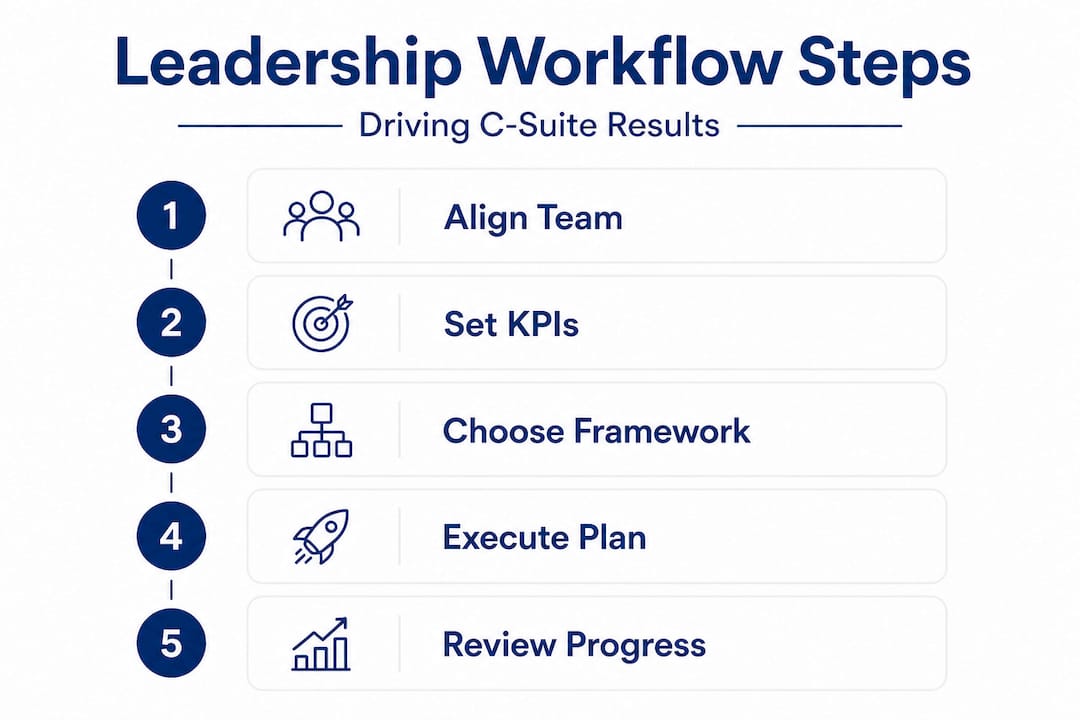
Continuous verification separates high-performing leadership teams from the rest. It's not about accountability theater. It's about creating a genuine feedback loop where the workflow itself evolves in response to what the data shows.
Most leaders get workflow wrong: Here's what actually works
Here's an uncomfortable truth: most C-suite teams adopt frameworks and then expect performance to improve automatically. They implement RAPID, run a few workshops, and check the box. Six months later, the same decision bottlenecks exist under a new name.
The real differentiator isn't which framework you use. It's whether your leadership team has the behavioral foundation to use any framework consistently. Emotionally intelligent, adaptive leaders will outperform rigid planners every time, even if the rigid planners have a better-designed system on paper. That's because real-world strategy execution is messy, and the ability to read what's happening and adjust in real time beats any static playbook.
Traditional hierarchical leadership is insufficient for distributed work environments. The shift from top-down control to system design and fast time-to-pivot is not optional in 2026. It's the baseline for competitive execution.
The invisible pitfalls that derail workflow even after adopting frameworks are almost always behavioral. A team adopts SPADE but the CEO overrides decisions in the last mile. A team implements context engineering but middle leaders hoard information rather than sharing it. The framework looks good; the behavior undermines it entirely.
Real workflow excellence requires engineering both the system and the culture simultaneously. The strategy execution principles that distinguish top-performing organizations consistently point to this: structure without behavioral change is theater, and behavioral change without structure is chaos. You need both, reinforced by data, feedback, and leadership accountability.
Break out of autopilot by scheduling a quarterly "workflow autopsy." Not a strategy review. A workflow review. Ask: Did our process enable our strategy this quarter, or fight against it?
Simplify your leadership workflow with the right platform
The frameworks and principles covered in this guide are powerful on paper. But execution requires infrastructure that keeps your team accountable in real time, not just during reviews.
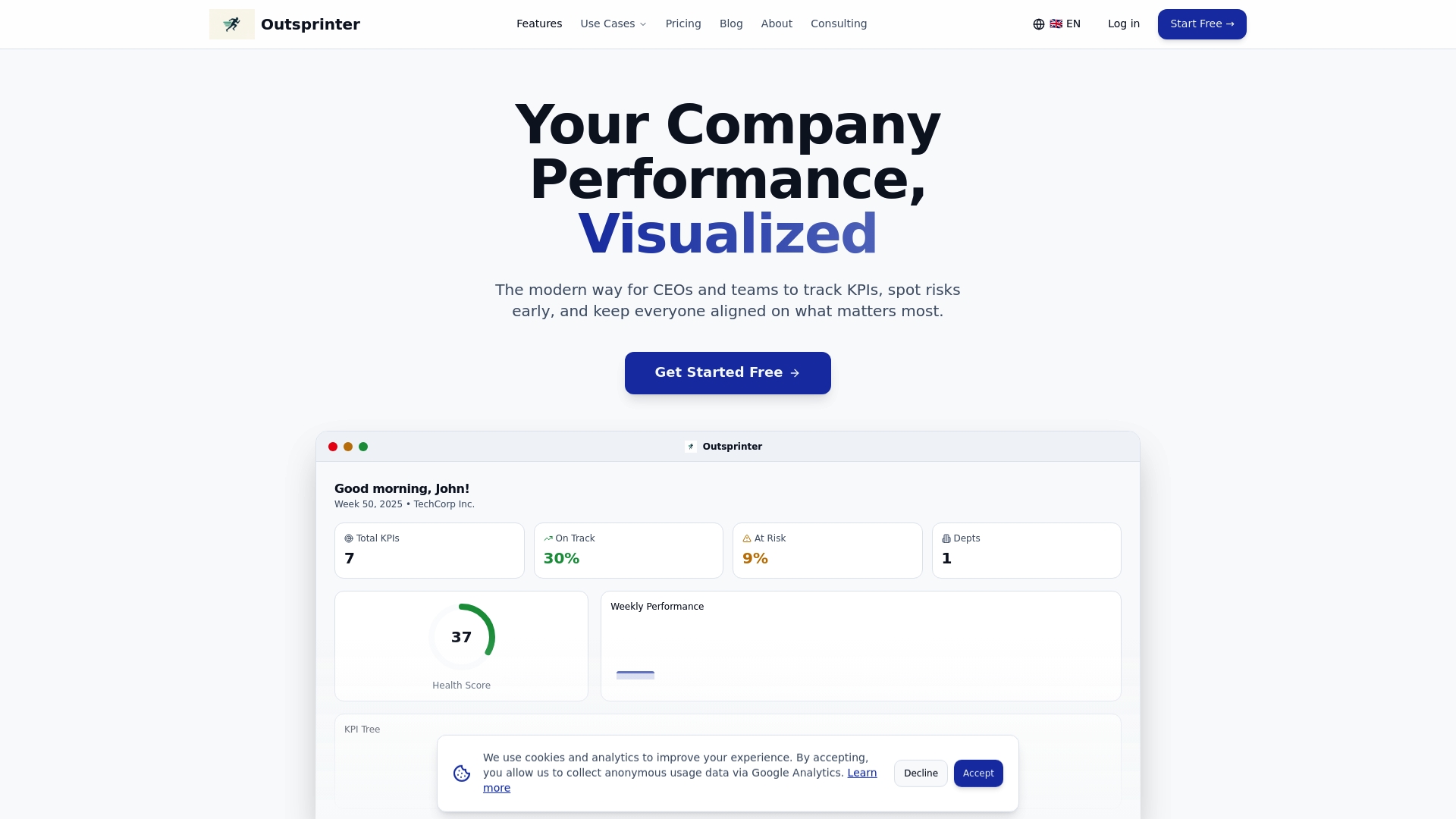
Outsprinter is built specifically for C-suite teams that need integrated workflow, performance, and KPI management in one place. The KPI management platform lets you define, track, and visualize every key performance indicator across your organization, with instant updates as teams enter data. The project and task management tools give your leadership team a live view of initiative health, workload, and progress. And with built-in AI assistance, goal planning, and role-based access, the team performance platform makes it possible to move from strategy design to measurable execution without switching between disconnected tools.
Frequently asked questions
What is a leadership strategy workflow?
A leadership strategy workflow is a structured, repeatable process for C-suites to make decisions, assign roles, and track performance toward strategic goals. Effective workflows use frameworks like RAPID and SPADE alongside context engineering to replace top-down control with fast, accountable execution.
Which decision frameworks work best for C-suites?
SPADE, RAPID, Cynefin, and Vroom-Yetton-Jago each serve different situations, covering decision complexity, urgency, and how much stakeholder buy-in the situation requires. The key is matching the framework to the decision type rather than applying one model universally.
How can leadership teams avoid slow decision-making?
Right-sizing the leadership team to five to eight core members, clarifying decision rights in writing, and consistently using RAPID to assign accountability are the most direct fixes. Oversized C-suites with unclear structures are the primary driver of decision delay.
What is context engineering in leadership?
Context engineering is the practice of designing systems, signals, and boundaries that empower teams to make good decisions independently. This methodology reduces bottlenecks by distributing decision authority rather than concentrating it at the top.
How often should leaders review and adapt their workflows?
Leadership teams should review their own workflow effectiveness every four to six weeks operationally, with a full strategic workflow review each quarter or immediately following any major shift in strategy or organizational structure.